The current Hiring processes are broken, with AI-native startups and team org structures rewriting hiring needs and workflows.
A few structural shifts have collided at the same time, creating an environment where traditional processes, and even innovative AI-powered improvements, thought to be helpful, are turning into massive problems for both job seekers and employers alike.
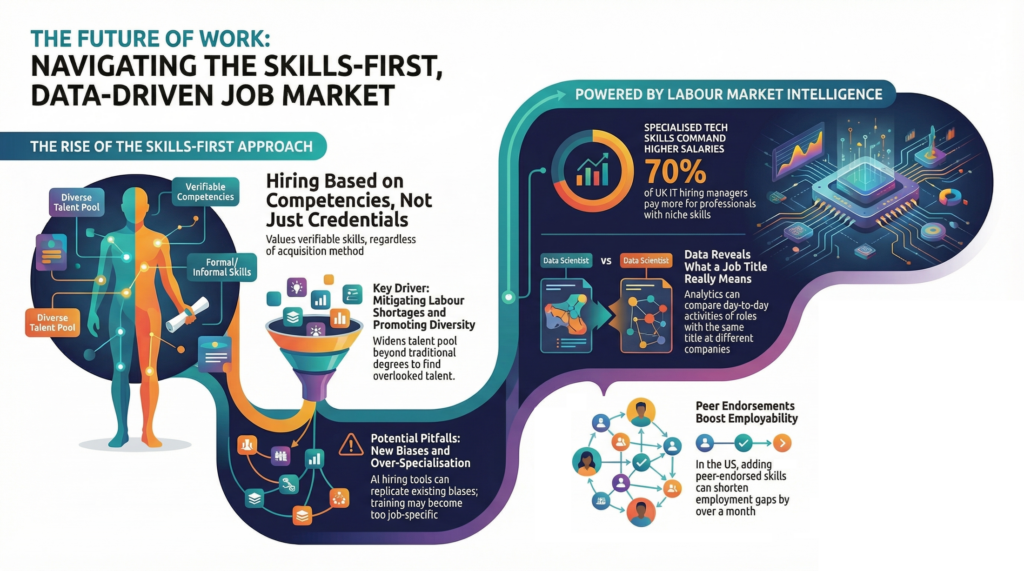
Multi-faceted Structural Shifts
AI Native Org structures
- Shift from titles/CVs to capability + evidence: Hiring becomes a skills-verification exercise (tests, work samples, portfolio outputs, simulations) for humans, and a benchmarking exercise (task success rate, tool proficiency, reliability, cost-per-task, guardrails) for AI agents. Why it changes hiring: the “best candidate” is whoever can prove they can deliver the outcomes—credential signalling matters less than measurable performance.
- Shift from “roles” to outcomes + modular execution: Work gets decomposed into outcome-based modules that a human can fulfil, an AI agent, or a hybrid team—then orchestrated like a system. Why it changes hiring: you don’t just hire people; you “compose” a workforce (humans + agents) based on speed, quality, risk, and unit economics—turning hiring into continuous matching and performance management, not a one-time decision.
Volume + automation spiral
- AI tools and “one-click apply” features mean candidates can mass-apply. One study found ~38% of job seekers now mass-apply using AI tools, flooding recruiters with applications.
- Many companies respond by tightening ATS filters or adding more automated steps, which makes it even harder for genuine candidates to stand out.
- Increase reliance on AI in sourcing, screening, interview scheduling, and even assessments and video interviews, with ~75% of CVs being rejected by ATS before a human ever sees them.
AI on both sides = signalling breakdown
- Businesses are re-wiring around data, automation and new AI-powered operating models faster than traditional resume or CV writing and submission can keep up. Old job descriptions define roles, but the actual work is fluid, outcome-focused, and cross-functional, so traditional CV-and-job-title matching fails to capture fit.
- Employers use AI for screening and interviews; candidates use AI to generate CVs, cover letters and even assessment answers. There’s an “AI arms race in hiring” that has become a “huge mess for everyone,” with generic, polished applications and little differentiation among candidates.
This creates problems for the main participants:
Job Seekers
- Most candidates don’t know why they’re rejected. ATS and AI models rarely give reasons, and HR often can’t see or explain the precise logic themselves.
- Ghosting is rampant; many would prefer a quick “no” to silence, but don’t even get that.
- AI-written CVs make everyone sound the same, and Employers see dozens of near-identical profiles.
- Real human motivation, skills, strengths, character traits and value potential don’t come through; keywords do.
Unfair or opaque AI
- Candidates don’t know which tools are used, what data they’re judged on, or how to improve. Relevant feedback is rarely provided.
- Being ignored repeatedly erodes confidence and trust. Candidates would rather get a prompt rejection than nothing at all, and many report ghosting as one of the worst parts of the process.
Employers
- Mass applications (often AI-assisted) mean recruiters sift through hundreds of CVs that all look similar.
- ATS/AI models filter aggressively on keywords, degrees or rigid criteria that may not correlate well with actual performance.
- Poorly tuned systems can screen out strong non-traditional candidates and skew towards “safe” profiles, increasing homogeneity.
- People may clear the automated process but not thrive in the actual role.
AI native Org structures
- AI strategy, AI-powered competitive advantage, and knowing how to pick and leverage AI agents to deliver outcomes remain challenging.
- AI tools can import bias from training data and create opaque decisions. Regulators are increasingly interested in AI fairness, transparency, and compliance.
Activo is reshaping the hiring process: Leveraging AI but ensuring human engagement is fair and transparent.
Hiring processes are placing greater emphasis on matching People with Meaning, Outcomes, Skills, Execution Speed, and the ability to configure and orchestrate the growing use of autonomous AI Agents. In addition, every startup, business unit, or team must consider how to leverage AI to maximise decision velocity, productivity, and value generation.
An autonomous AI workforce will increasingly handle end-to-end workflows by interpreting multimodal inputs, continuously evaluating results and adapting to execute their tools’ specialisations. These AI agents integrate with downstream components and utilise “human-in-the-loop” for validation, guidance, creativity, and orchestration.
“Human” role profiles:
- Chief Technology Officer
- Chief Information Officer
- Chief Data Officer
- Enterprise Architect
- AI Engineer
- AI Product Manager
- Data Product Manager
- Growth Product Manager
- Technical Product Manager
- Digital Product Manager (SaaS)
- Software Engineer (mobile app)
- Software Engineer (web app)
- Software Engineer (backend)
- DevOps Engineer
- NoCode Developer
- Data Scientist
- Data Engineer
- Data Architect
- Transformation Lead
- Change Manager
- Program Manager
- Technical Project Manager
- UX Designer
- Content Manager
- Content Producer
- Digital Marketing Manager
- Social Media Manager
- Brand Manager
“Autonomous” AI Workforce:
- Customer Support Agent
- Customer Success Agent
- Customer CRM Agent
- Outbound SDR Agent
- Lead Qualification Agent
- OmniChannel Content Agent
- Finance Cashflow Control Agent
- Finance Accounts Payable Agent
- Security Risk Agent
- Security Compliance Agent
- HR Recruiting Agent
- HR Onboarding Agent
- Data Analytics Agent
- Software Coding Agent
- Founder/CEO Profit Agent
- Founder/CEO OKR Agent
- Founder/CEO Org Agent
- Founder/CEO Risk Agent
- Receptionist Agent