The current Job recruitment market and talent finding processes are broken.
A few structural shifts have collided at the same time, creating an environment where traditional processes, and even innovative efficiencies thought to be helpful, are turning into massive problems for both job seekers and employers alike.
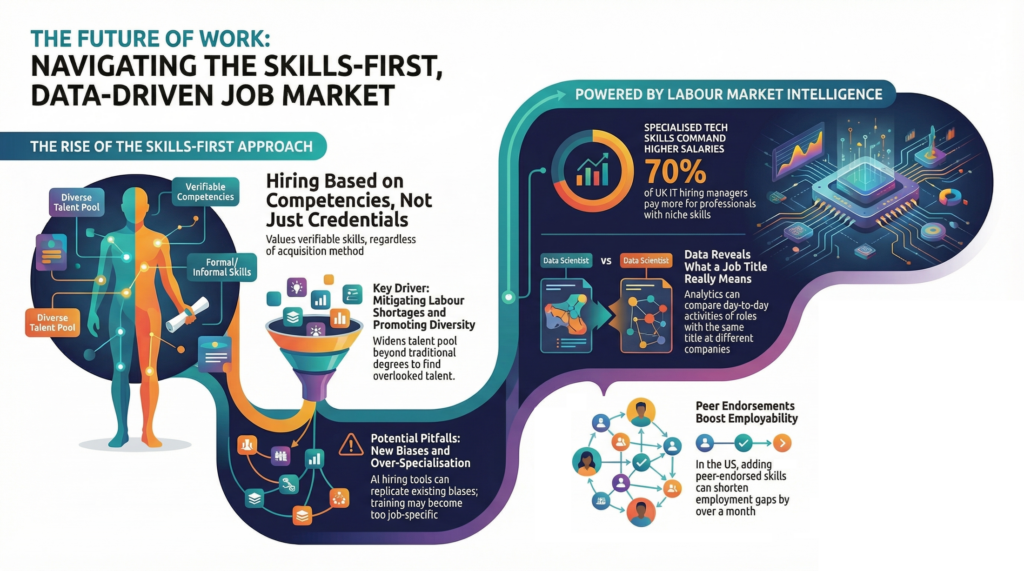
Multi-faceted Structural Shifts
Volume + automation spiral
- AI tools and “one-click apply” features mean candidates can mass-apply. One study found ~38% of job seekers now mass-apply using AI tools, flooding recruiters with applications.
- Many companies respond by tightening ATS filters or adding more automated steps, which makes it even harder for genuine candidates to stand out.
ATS (+AI) gatekeeper is becoming a bottleneck
- Around 71% of hiring managers rely on ATS to screen applications using traditional rules.
- Some UK estimates suggest ~75% of CVs are rejected by ATS before a human ever sees them.
- Employers also use AI in sourcing, screening, interview scheduling, and even assessments and video interviews.
Ghosting and “ghost jobs”
- 55% of British job seekers say they never hear back after applications.
- Reports suggest more than half of UK employers ghost applicants, and about 17% of UK LinkedIn postings are “ghost jobs” (roles that don’t really exist or won’t be filled).
AI on both sides = signalling breakdown
- Employers use AI for screening and interviews; candidates use AI to generate CVs, cover letters and even assessment answers. The FT described this as an “AI arms race in hiring” that has become a “huge mess for everyone,” with generic, polished applications and little differentiation among candidates.
Rapidly changing skill needs
- Businesses are re-wiring around data, automation and new operating models faster than job architectures can keep up. Old job descriptions define roles, but the actual work is fluid and cross-functional, so traditional CV-and-job-title matching fails to capture fit.
This creates problems for the main participants:
Candidates
Black-box filters and zero feedback
- Most candidates don’t know why they’re rejected. ATS and AI models rarely give reasons, and HR often can’t see or explain the precise logic themselves.
- Ghosting is rampant; many would prefer a quick “no” to silence, but don’t even get that.
High noise, low signal
- AI-written CVs make everyone sound the same: “results-driven,” “strategic,” “data-driven.” Employers see dozens of near-identical profiles.
- Real strengths, character and potential don’t come through; keywords do.
Unfair or opaque AI
- Studies show AI-driven hiring tools can misinterpret accents, speech patterns, or non-standard backgrounds, creating a risk of discrimination.
- Candidates don’t know which tools are used, what data they’re judged on, or how to improve.
Misleading job adverts
- Some roles are posted with internal candidates already lined up, others are “evergreen” roles, and some get shelved after people apply. That’s time, energy and sometimes money wasted for candidates.
Emotional toll
- Being ignored repeatedly erodes confidence and trust. Surveys show the majority of candidates would rather get a rejection than nothing at all, and many report ghosting as one of the worst parts of the process.
Employers
Application overload, little differentiation
- Mass applications (often AI-assisted) mean recruiters sift through hundreds of CVs that look incredibly similar. Signal-to-noise is terrible.
Over-reliance on imperfect tools
- ATS/AI models filter aggressively on keywords, degrees or rigid criteria that may not correlate well with actual performance.
- Poorly tuned systems can screen out strong non-traditional candidates and skew towards “safe” profiles, increasing homogeneity.
Brand damage from bad candidate experience
- Ghosting, lengthy processes and lack of transparency damage employer brands and future talent pipelines. Greenhouse’s research shows drawn-out and misleading processes significantly reduce candidate willingness to accept offers or reapply.
Mis-hires and poor retention
- When CV keywords and generic interviews drive hiring, people may clear the process but not thrive in the actual team or culture.
- That’s expensive: ramp-up time, lost productivity, and re-hiring costs.
Legal and ethical risk
- AI tools can import bias from training data and create opaque decisions. Regulators are increasingly interested in AI fairness and transparency, which will become a compliance burden for companies.
- Brand reputations are at risk because every bad experience a candidate has could go viral and attract negative press.
Activo is creating a better way
We are designing and creating a human-centred, skills-based, transparent hiring flow where AI is used to augment judgment, not replace it. Stay tuned for our alpha launch, initially centred on these roles:
- Chief Technology Officer
- Chief Information Officer
- Chief Data Officer
- Enterprise Architect
- AI Engineer
- AI Product Manager
- Data Product Manager
- Growth Product Manager
- Technical Product Manager
- Digital Product Manager (SaaS)
- Software Engineer (mobile app)
- Software Engineer (web app)
- Software Engineer (backend)
- DevOps Engineer
- NoCode Developer
- Data Scientist
- Data Engineer
- Data Architect
- Transformation Lead
- Change Manager
- Program Manager
- Technical Project Manager
- UX Designer
- Content Manager
- Content Producer
- Digital Marketing Manager
- Social Media Manager
- Brand Manager