Imagine having a steady queue of ideal customers waiting to work with you—before you’ve even finished building the product. Most founders obsess over features and funnels, but the real leverage comes from creating visible demand: scorecards that diagnose problems, waitlists that prove people care, discussion groups that build trust, and intro events that convert at scale. In this post, you’ll learn a simple “signals before sales” system you can plug into any business to generate more (and better) leads without shouting louder on social media.
Daniel Priestley’s accelerator program and content inspire this blog. A founder and in-demand speaker himself, he blends economic principles with the challenges that many startups and established businesses face as they grow. Building a good product matters a lot, but despite the easy access to channels with millions of users, targeting and attracting the right high-value customers remains a challenge for many businesses and startups.
The main tactics
Price = demand–supply tension
- If supply is effectively infinite (like digital products) and demand isn’t constrained or made visible, price tends to zero.
- Your job is to create and show demand–supply tension (queues, waitlists, limited spots), not just build a great product.
Transparency of demand is a growth superpower.
- When people see you’re in demand (queues, sold-out events, waitlists), their willingness to pay goes up, and discount requests go down.
- Think: restaurant with a line outside vs. an empty restaurant.
Signals first, then sales
- Don’t start by asking people to buy.
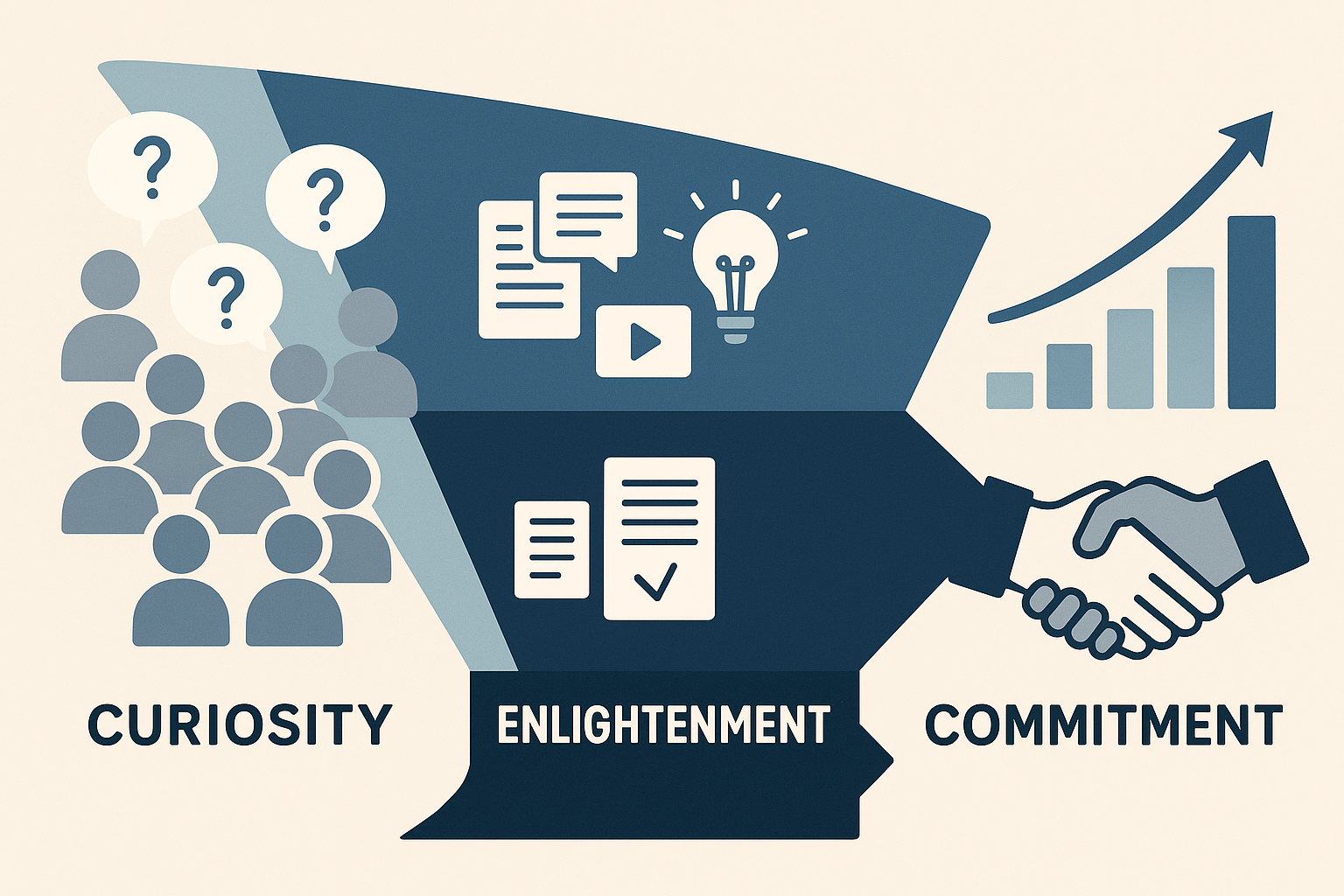
- First, ask for signals of interest (waitlist, assessment, discussion group, intro event).
- Then sell only to those who signalled interest (like Glastonbury tickets or Tesla Cybertruck deposits).
Data beats emotion
- Customers are not rational; they’ll say “too expensive” and then pay much more for a similar thing in a different context.
- Use data from polls, scorecards, and waitlists (including willingness-to-pay questions) to:
- Find high-value segments.
- Set pricing.
- Stop joining the race to the bottom on price.
Lead generation is upstream of everything.
- A business with too many leads can fix almost everything else.
- A brilliant product with poor lead generation is effectively worth zero.
Leads are assets
- A data-rich list (emails + helpful answers) is one of your most valuable business assets.
- Acquirers ask, “How many are on your database?”
- People may join your list and buy 2–3 years later; you need a big, nurtured list.
Core Campaign Types
1. Scorecards / Assessments
Purpose: Generate qualified, data-rich leads and position yourself as an expert.
What it is:
- An interactive quiz or assessment that answers:
- “Are you ready to X?”
- “Which type of X are you?”
- Examples:
- “Are you ready to invest in real estate? Answer 10 questions to find out.”
- “Which type of founder are you? Answer 12 questions to find out.”
How it works:
- User fills out 10–15 questions about their situation.
- They get personalised results (score + advice).
- You get structured data: readiness, pain points, budget, and segment.
Use cases:
- B2C (fitness, property, parenting, life coaching).
- B2B / corporate: assessment-based selling
- Sell an assessment first (survey employees/customers, present findings).
- Then upsell the complete solution based on the data.
Key tips:
- Name formula:
- “Are you ready to ___? Answer 10 questions to find out.”
- Ask at least one pricing/willingness-to-pay question.
- Use the data to:
- Tailor follow-up emails.
- Target higher-price segments.
- Decide what product to build next.
2. Waitlists (Signal Collection Campaigns)
Purpose: Create demand–supply tension, test ideas, and capture early adopters.
What it is:
- A pre-launch signup for something that doesn’t fully exist yet (or is limited).
- You offer just enough info to spark curiosity:
- “New AI tool for authors launching later this year—join the waitlist.”
- “Luxury property development coming in Q4—join the waitlist for details.”
How it works:
- Landing page explains “a new approach to X” and why it’s exciting.
- People join the waitlist instead of buying outright.
- Optionally: Ask a few extra questions:
- “What would you most want from this?”
- “What would you be willing to pay?”
Benefits:
- Validates demand before you invest heavily.
- Surfaces unexpected high-paying segments.
- Creates scarcity and urgency:
- “700,000 registered, 130,000 tickets” (Glastonbury style).
- “We have limited spots / units / licenses.”
Key tips:
- Treat the waitlist like a product:
- Professional landing page, strong promise, clear benefit for joining.
- Use it for:
- Software, training programs, retreats, property launches, and new services.
- Promote the waitlist hard, as if it is the main offer.
3. Discussion Groups (Problem-Aware Communities)
Purpose: Build community and authority by talking about problems, not just your solution.
Problem-aware vs Solution-aware:
- Solution-aware: “I want a CrossFit gym.”
- Problem-aware: “I’m not happy with my fitness.”
- The problem-aware audience is much bigger.
What it is:
- A group (Facebook, WhatsApp, Slack, etc.) where people talk about a problem they care about, not your product.
- Named around improvement, not identity or shame.
Naming formula:
- “How to improve ___ in 30 days – join the discussion.”
- “How to improve your fitness in 30 days.”
- “How to improve your property portfolio in 30 days.”
- “How to improve your finances in 30 days.”
How to position it:
- Don’t say: “Here’s my WhatsApp group, join.”
- That’s like giving expensive jewellery in a plastic supermarket bag.
- Do say:
- “We run a curated discussion group for [type of person] to improve [problem]. Apply to join here.”
- Use a landing page as the “gift box” around the group.
Key tips:
- Treat the group as a premium free product:
- Application or simple questionnaire.
- Clear promise of value (insights, guidance, peer learning).
- Use the group to:
- Listen to the language your audience uses.
- Test ideas, content, offers.
- Build trust before direct selling.
4. Introductory Workshops / Webinars (“Intro Events”)
Purpose: Educate at scale, demonstrate expertise, and systematically drive sales.
What it is:
- A repeatable intro session:
- “An introduction to [topic]: how to get [result] better, faster, cheaper.”
- Can be delivered online (Zoom) or in person.
- Run on a regular cadence (weekly, twice a month, etc.).
Why it works:
- People prefer a safe intro to a topic before a 1:1 sales call or big commitment.
- Repeating the same event:
- Makes you very good at delivering it.
- Produces predictable lead flow and sales.
- Real examples:
- Real estate companies are running weekly webinars.
- Financial planner doing weekly boardroom sessions—sold for $30m after years of this.
Key tips:
- Keep the format consistent:
- Same outline, slides, flow, and call to action.
- Focus on:
- Explaining the landscape (market, pitfalls, opportunities).
- Showing how your method or offer fits in.
- Run it on autopilot:
- Set dates for the next 3–6 months.
- Promote via email, social, partners, and your scorecards/waitlists.
5. Books as Relationship Engines (Not Revenue Products)
Purpose: Build authority, trust, and long-term relationships at scale.
Core idea:
- The book that changes your life is the one you write, not the one you read.
- A book gives:
- Credibility (you’re now “the author of…”).
- Scalable relationship-building (book can “have coffee” with thousands of people).
How to use a book:
- Think of it as a relationship asset, not a direct revenue source.
- Strategy:
- Write a focused book on your niche.
- Give away ~1,000 copies a year (digital or physical).
- On page 1, send people to a scorecard/assessment:
- “To get the most out of this book, take the [X] scorecard.”
Funnel flow:
- A person gets a book (free or cheap).
- Reads a bit, takes the scorecard.
- You get rich data + permission to follow up.
- You offer a call, program, product, or service.
Key tips:
- Don’t obsess about making money from book sales.
- Obsess about:
- Distribution (getting it into the right hands).
- Integration with your scorecard & email funnel.
Capabilities Behind These Campaigns
For most of the campaigns above, the basic structure is:
Landing page
- “A new approach to ___.”
- Clear promise, explanation of what’s coming, and why it matters.
- Call to action: join the waitlist / take the scorecard / apply to the group/register for the workshop.
Questionnaire / Assessment
- Capture data beyond just email:
- Situation (stage, goals, challenges).
- Preferences/interests.
- Budget/willingness to pay.
- This turns a lead into a data-rich asset.
Dynamic results / immediate value
- For scorecards: results page with insights and next steps.
- For waitlists: confirmation + what to expect next.
- For groups/events: thank you + event details/group rules / first piece of value.
Follow-up
- Segment based on answers.
- Nurture via:
- Emails.
- Group content.
- Invites to intro events.
- Then move to sales conversations with the most engaged segments.
Tools & AI
- You can use AI to:
- Draft landing page copy.
- Generate quiz questions.
- Outline scorecard or book.
- But you must “ice the cake”:
- Add your voice, story, branding, examples, and specific promises.
Conclusion
If you take nothing else from this, remember that your real leverage isn’t the product you build, it’s the demand you can visibly prove exists for it. Founders who win don’t shout louder; they collect better signals: scorecards that diagnose real problems, waitlists that show scarcity, discussion groups that keep you close to the market, intro workshops that convert at scale, and eventually a book that cements your authority.
Start small: pick one core problem you help people solve, create a simple “Are you ready to…?” scorecard around it, and share it with your existing network for a week. Once people are engaging, add a waitlist for your main offer and invite them into a discussion group where you host a monthly intro session. Keep iterating based on the data and conversations, and you’ll steadily move from chasing customers to managing a queue.