The Finance System every Startup needs
Create and follow simple, effective finance processes without complex software or a CFO.
Most startups do not die because of bad products, weak teams or tiny markets. They die because the founder wakes up one day and realises: “We’re out of money, and I saw it too late.” Finance gets pushed to “later, when we’re bigger”, and by then the bad habits are baked in. You do not need fancy software or a finance team to avoid this. You need a handful of simple processes and the discipline to look at your numbers every week.
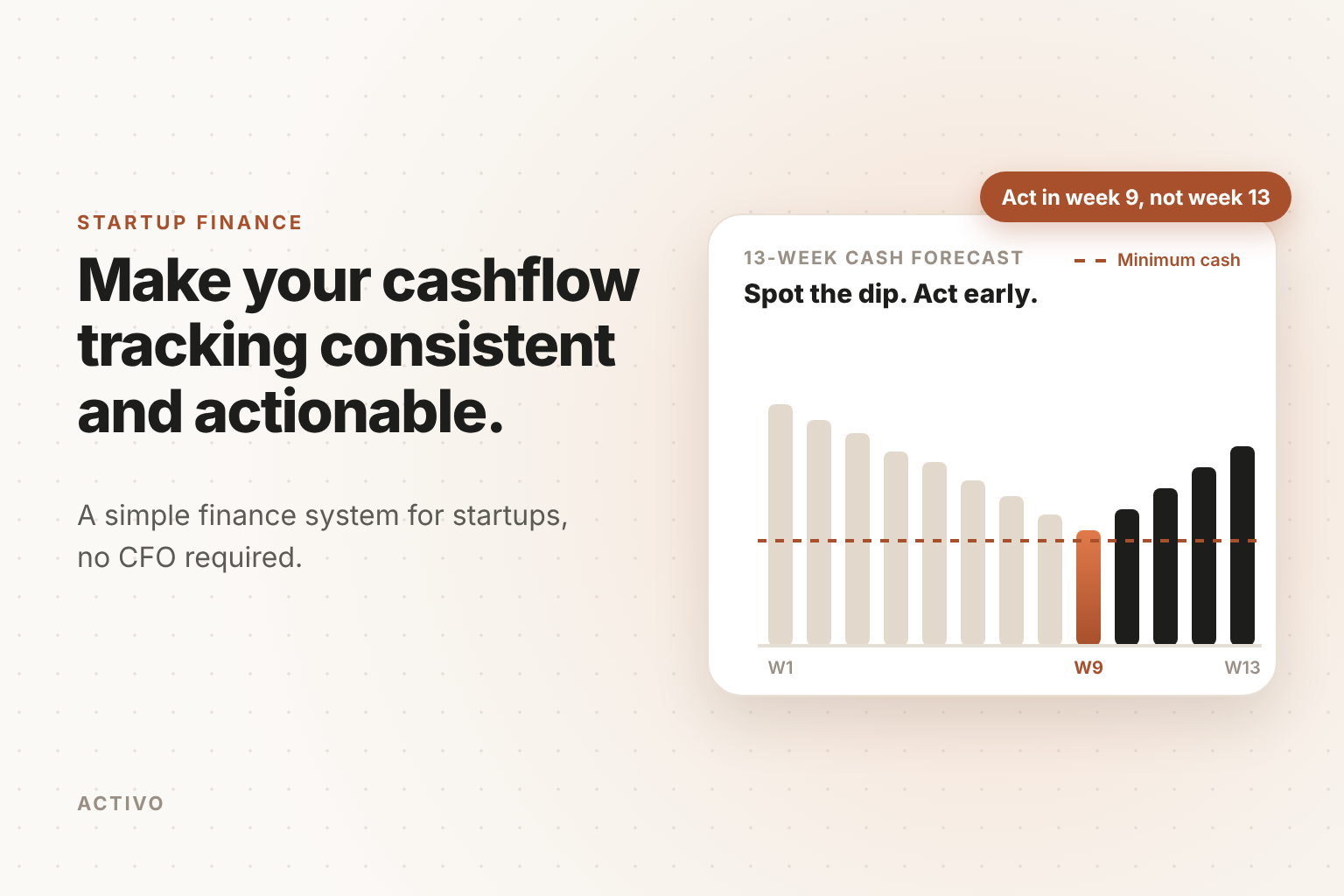
Process 1: Build a 13-week cash flow
Most founders live inside their P&L, and that is how they get blindsided. A P&L tells you whether you look good on paper. Cash flow tells you whether you will make the next payroll. A 13-week cash flow is a simple spreadsheet showing what will actually hit your bank account over the next quarter. Create 13 rows, one per week, with these columns:
| Week | Starting cash | Cash in | Cash out | Ending cash | Runway |
|---|---|---|---|---|---|
| 1 | €1,100k | €30k | €70k | €1,060k | 32.7 weeks |
| 2 | €1,060k | €55k | €68k | €1,047k | 32.3 weeks |
| 3 | €1,047k | €40k | €72k | €1,015k | 31.3 weeks |
| 4 (payroll) | €1,015k | €48k | €110k | €953k | 29.4 weeks |
Cash in means payments received, not invoices sent. Cash out covers payroll, tools, rent, contractors and tax. Ending cash is starting cash plus cash in minus cash out. Runway in weeks is ending cash divided by your average weekly net burn. Update it every Monday and share it with at least one other founder or mentor, so you cannot fool yourself.
Process 2: Speak both cash and accrual
Cash basis answers “Can I make payroll?” Accrual basis answers “How healthy and scalable is this business over time?” Founders often look at the pretty accrual graph while cash is telling a different story. Once a month, get both views and a one-page bridge explaining the gap: prepaid expenses (paid now, expensed later), deferred revenue (collected now, earned later) and accounts receivable (invoiced, not paid). If cash and accrual differ by more than 20%, find out why: late invoices, big prepayments, or revenue you have not collected. Investors care about accruals. Survival depends on cash.
Process 3: Use scenarios for big spending decisions
Hiring a senior engineer, committing €50k to a channel, ramping ad spend: these rarely kill you on their own. The unexamined pattern does. For every major decision, write it down clearly and run three cases.
| Scenario | Question to ask | Example: hire an engineer for €120k |
|---|---|---|
| Bear (revenue –10%) | Does this push runway below our red line, for example six months? | Runway falls from 7 to 5 months: fails |
| Base (flat revenue) | Is this the best use of the cash compared with the alternatives? | Unblocks the top customer request: passes |
| Bull (revenue +10%) | Would we regret not doing it if growth accelerates? | Yes, delivery would bottleneck: passes |
The rule: if two of the three cases clearly support the decision, go ahead. If two look risky or weak, delay or kill it. In the example, two pass, so you hire, but agree in advance what you will cut if the bear case arrives. Revisit big decisions quarterly.
Process 4: Stay funding-ready and exit-ready
Being ready for a round means you never negotiate in a rush. Acquisition interest arrives as a random email or warm intro, and the founders who respond fast win. Keep one folder with about ten files and refresh it every quarter, even if no one is asking:
- Company deck, a basic three-year model, and historical P&L, cash flow and balance sheet
- Fully diluted cap table, team list with short bios, and product roadmap
- Top 10–20 customers and why they buy, plus key customer and vendor contracts
- Legal basics (incorporation, IP ownership) and your last three monthly one-pagers (Process 7)
Process 5: Control cards and small spend
“Everyone gets a card, we trust people” often ends with “Why did burn jump 15% last quarter?” Set card limits by role, with small monthly limits for most staff and higher ones for leads. Agree approval thresholds: under €X needs no approval, €X to €Y needs finance sign-off against a budget line, and anything over €Y needs a founder. Scan card statements weekly for anything you do not recognise or that feels nice-to-have. Once a month, list every subscription and cancel anything not tied to a current initiative.
Process 6: Track five weekly numbers, not twenty
Every Monday, post one short message in the same channel: runway in weeks, weekly burn (four-week average), collections or days sales outstanding, one growth metric (MRR, GMV or active customers) and one unit-economics proxy (CAC payback, LTV:CAC or gross margin). End with one action.
| Metric | This week | Status |
|---|---|---|
| Runway | 34 weeks (–2) | Red |
| Burn (4-week average) | €52k vs €45k target | Red |
| Days sales outstanding | 41 days, up from 35 | Amber |
| MRR | €62k, +€3k week on week | Green |
| CAC payback | 7.5 months vs 6 target | Amber |
| Top action | Chase four overdue invoices worth about €38k | |
Process 7: Send a monthly financial one-pager
If your board pack needs its own executive summary, it is too complicated. Put cash, monthly burn against budget and runway in weeks at the top. Explain budget variances in the middle, with no storytelling, plus small boxes for money owed to you, money you owe and your top vendors. Finish with three to five risks, such as customer concentration or renewals, and three to five decisions needed. Send it on a fixed day every month, whether anyone asks or not.
Process 8: Keep the system simple and repeatable
- Spend approvals: who approves what, at which thresholds (Process 5).
- Purchase orders: any contract over a set amount, for example €20–25k a year, needs a PO so big renewals get reviewed rather than auto-charged.
- Monthly close checklist: same steps, order and owners every month: bank reconciliation, receivables and payables reports, payroll check, vendor payments, cash flow update, one-pager.
- Simple chart of accounts: 15–20 categories at most. If choosing a category takes more than five seconds, it is too complex.
- Tags: tag every significant expense with a team and an initiative, so you can answer “what did that launch cost?” in 30 seconds.
Document it well enough that someone new could run it within a week.
Process 9: Think about the cost of dilution
Every amount you raise costs a slice of the company forever. Before each raise, calculate the ownership you give up and the months of runway it really buys. Then compare it with internal options: cutting monthly burn, revenue-focused experiments, or sensible non-predatory debt. Early rounds are the most expensive in equity, and the more disciplined your finances, the more leverage you have when you do raise. Would you rather own 50% of a €20m outcome or 80% of a €10m one?
The cadence that keeps you honest
| When | Time | What to do |
|---|---|---|
| Daily | 5 minutes | Check cash in the main account. Approve or reject big spend requests. |
| Weekly | 15–30 minutes | Update the 13-week cash flow, post the five metrics and agree one action. |
| Monthly | 3–4 hours | Run the close checklist, send the one-pager, review burn against plan and decide on cuts or reallocations. |
| Quarterly | Half a day | Refresh the data room, rerun scenarios on big decisions, and revisit hiring, major contracts, funding options and spend policies. |
Start this week: three steps
- Calculate your true runway. Cash in the bank divided by average monthly net burn. Under 12 months is a red zone; treat it seriously.
- Build your 13-week cash flow. Thirteen rows and the columns in the table above. Update it every Monday for the next four weeks, no excuses.
- Book a weekly 15-minute money stand-up. Same time every week. Share runway, burn, collections, one growth metric and one unit-economics metric, and end with one explicit action.
Do just these three and you will already be ahead of most founders, who only check their finances when fundraising, or when it is too late.
Once your finance system has clear rules, ActivoRules can run them: versioned policies that automate approvals and keep your ledger clean and auditable. Explore ActivoRules →
We can set up your 13-week cash flow, weekly metrics and monthly one-pager, then hand it over to your team.
Get in touchSources: CB Insights, The top reasons startups fail (March 2026). Cash flow and scenario figures are illustrative.