Network effects can create outrageous growth. But they also create a brutal strategic tension: the very thing that makes a network valuable (lots of users) is the thing you don’t have at the start—so you’re often forced to price at zero to get momentum.
That tension is the network pricing paradox:
- Price too early → you kill growth and never reach critical mass.
- Never price → you create massive value… and leak it to users, partners, or competitors.
This article breaks down the paradox, the “cold start” trap behind it, proven ignition strategies, and the pricing models that help you capture value once the network tips.
What Is the Network Pricing Paradox?
The network pricing paradox is the conflict between:
- Growth pricing: free or heavily subsidised pricing to expand the network
- Value-capture pricing: charging enough to monetise the value your network creates
The problem is structural: a network is weak when it’s small and strong when it’s big. Early on, your product may have near-zero utility without other users—so asking people to pay is a non-starter. But once the network becomes valuable, failing to charge leads to value leakage (the network’s value exists, but your business doesn’t capture it).
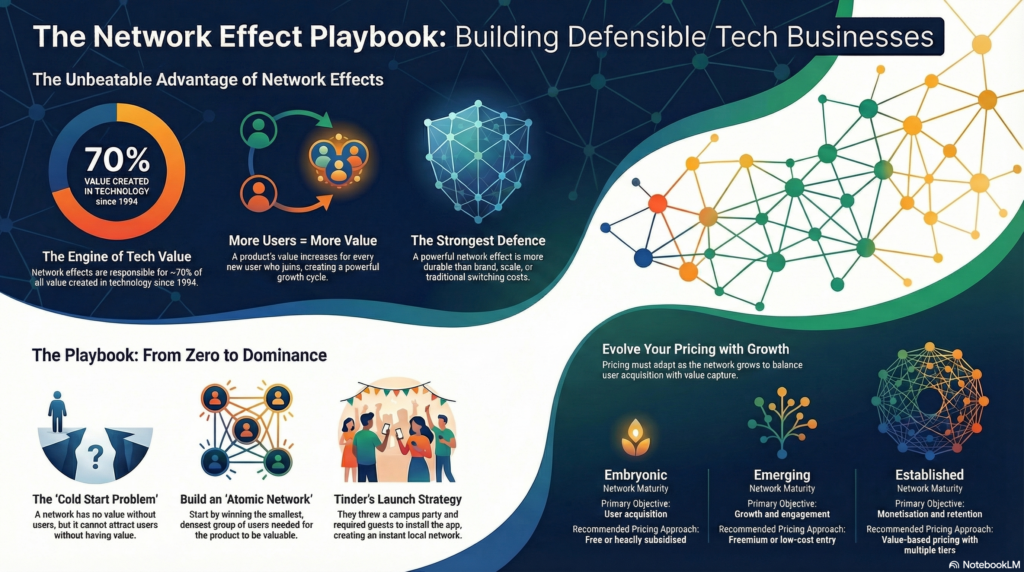
The Real Enemy: The Cold Start Problem
Before network effects work for you, they work against you.
A new network with zero users has zero network value. That’s why early-stage marketplaces and platforms feel impossible: users ask, “Who else is here?” and the honest answer is “No one.”
Your goal isn’t “go viral.” It’s to reachthe tipping point—the moment when the perceived value of joining finally exceeds the friction/cost of joining.
How to Ignite a Network: 5 Proven Strategies That Beat Cold Start
1) Start with an Atomic Network (Kindling Before Logs)
Instead of launching “to the world,” focus on the smallest group where the network can actually work.
What it looks like:
- Launching in one campus, one city, one industry niche, or even one event
- Creating a tight loop of repeated interactions within a small community
Why it works:
A small network can feel “alive” faster than a large empty one.
Analogy: The Bonfire
You can’t light a giant log with one match. You start with kindling—small twigs that catch fast—then the big log ignites later.
2) “Flintstone” It (Do Things That Don’t Scale)
Many networks fake early momentum with manual operations to avoid looking like a ghost town.
What it looks like:
- Founders personally recruiting users
- Seeding listings/content
- Manually matching supply and demand
- Acting like a concierge behind the scenes
Why it works:
Early users don’t join empty rooms. They join the activity.
Analogy: The Flintstone Car
It looks like a car, but the founders are powering it with their feet until the “engine” (the network effect) kicks in.
3) Subsidise the Hard Side (Hard vs Easy Side in Marketplaces)
Two-sided networks aren’t symmetrical. One side usually:
- costs more to acquire,
- cares more about economics,
- and determines whether the marketplace has “liquidity.”
That side is the hard side (often the supply side).
What it looks like:
- Paying or heavily incentivising the hard side to join
- Reducing their friction to near-zero
- Giving them control, protection, or guaranteed demand
Analogy: The Anchor Tenant
Shopping malls sometimes give the anchor store incredibly favourable terms because their presence attracts everyone else. If you charge the anchor tenant “full price” too early, the mall stays empty.
4) Build Single-Player Mode (Come for the Tool, Stay for the Network)
One of the cleanest solutions is to build a product that provides value to a user, even if no one else joins.
What it looks like:
- A tool that helps a user do a job better today
- Then layering the network on top once enough people are using it
Example pattern:
Sell software to businesses first → then connect them to consumers once adoption is dense.
Analogy: The Telephone (with a built-in tool)
A single telephone is useless alone. But if it had a calculator or a game, you’d buy it anyway—and later the network becomes the principal value.
5) Use Financial Incentives (Break the Chicken-and-Egg Loop)
Sometimes you must pay users to create liquidity and habit.
What it looks like:
- sign-up bonuses
- referral incentives
- guaranteed payouts for early supply
Why it works:
It “buys” the first critical transactions that build trust, provide proof, and create momentum.
When to Switch From Growth to Monetisation
Your monetisation timing isn’t about “revenue goals.” It’s about network maturity.
Once you hit the tipping point, you can start shifting from subsidy to value capture—carefully, and often asymmetrically.
Pricing Models That Capture Value Without Killing the Network
1) Freemium + Tiered Value Capture
Free drive distribution. Paid captures value from power users.
Best for: B2B SaaS with collaboration, sharing, invites, or team expansion baked in.
How it works:
- Free tier spreads through the network (virality + utility)
- Paid tier activates when usage becomes mission-critical
2) Asymmetric Pricing (Charge the Side That Benefits Most)
In multi-sided markets, don’t force both sides to pay.
How it works:
- Subsidise the side that creates the network density (often users/creators)
- Charge the side with clear economic ROI (often recruiters, advertisers, sellers, enterprises)
Rule of thumb:
Charge where value is measurable, and price sensitivity is lower.
3) Usage-Based Pricing (Grow When Your Customers Grow)
Usage-based pricing lets revenue scale naturally with network activity.
How it works:
- The more your customer uses the network, the more they pay
- Your revenue becomes a function of your customers’ growth
4) Cohort-Based Pricing (Reward Early Builders, Charge Late Joiners)
Early adopters take the most risk and often create the early liquidity. Cohort pricing protects them.
How it works:
- Early cohorts lock in favourable pricing
- Later cohorts pay more because they’re joining a more valuable network
This preserves goodwill while still enabling long-term monetisation.
The Network Maturity Matrix (Align Pricing With Stage)
Use this as an executive “pricing compass”:
- Embryonic → Objective: Acquisition → Pricing: Free/Subsidized
- Emerging → Objective: Growth → Pricing: Freemium
- Established → Objective: Monetization → Pricing: Value-based/Tiered
- Dominant → Objective: Expansion → Pricing: Premium/Ecosystem
The biggest mistake is trying to run “Established pricing” in an “Embryonic network.”
Why Endure the Paradox? Because Networks Become Moats
A mature network effect is one of the few durable advantages left in digital markets.
Even if a competitor is cheaper—or free—a strong network can win because it has what users actually want: liquidity, access, and participation.
When buyers and sellers (or creators and audiences) are already in one place, price becomes secondary to where the action is.
Practical Checklist: How to Solve the Network Pricing Paradox
To ignite growth:
- Pick an atomic network you can dominate quickly
- “Flintstone” the early experience (manual ops, seeding, matching)
- Identify the hard side and subsidise it aggressively
- Build single-player value so the product works before the network does
- Use incentives where needed to break deadlocks
To capture value:
- Delay pricing until you reach the tipping point
- Monetise asymmetrically (charge the side with ROI)
- Use tiered freemium to keep propagation alive
- Consider usage-based pricing for compounding revenue
- Protect early adopters with cohort pricing
FAQ: Quick Answers Founders Actually Need
When should I start charging?
When the network’s value is obvious enough that users would stay even after friction increases, and when you can charge one side without starving liquidity.
Is free always required?
Not always. But you must dramatically reduce early friction. If you can’t offer free, you need substantial single-player value, guarantees, or manual outcomes.
What’s the #1 pricing mistake?
Charging both sides too early (or charging the hard side first). That usually collapses supply, kills liquidity, and stalls growth.
Final Thought
The network pricing paradox isn’t a pricing bug—it’s the physics of network businesses. The winners aren’t the ones who choose growth or monetisation. They’re the ones who sequence them correctly:
Ignite with subsidies → leverage the network → capture value with precision.