Agentic AI and the Next Wave of Network Effects: When AI Agents Talk to Each Other
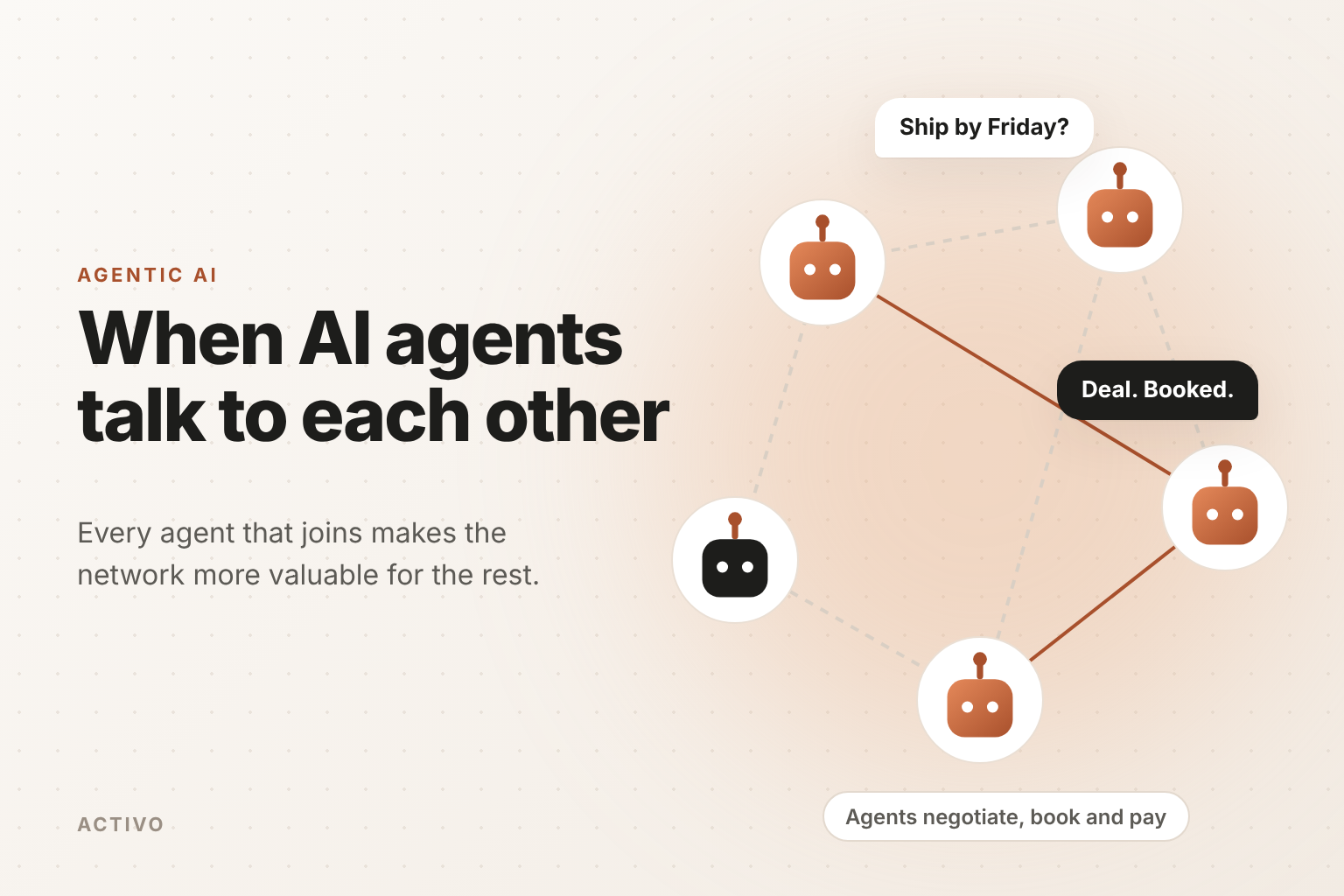
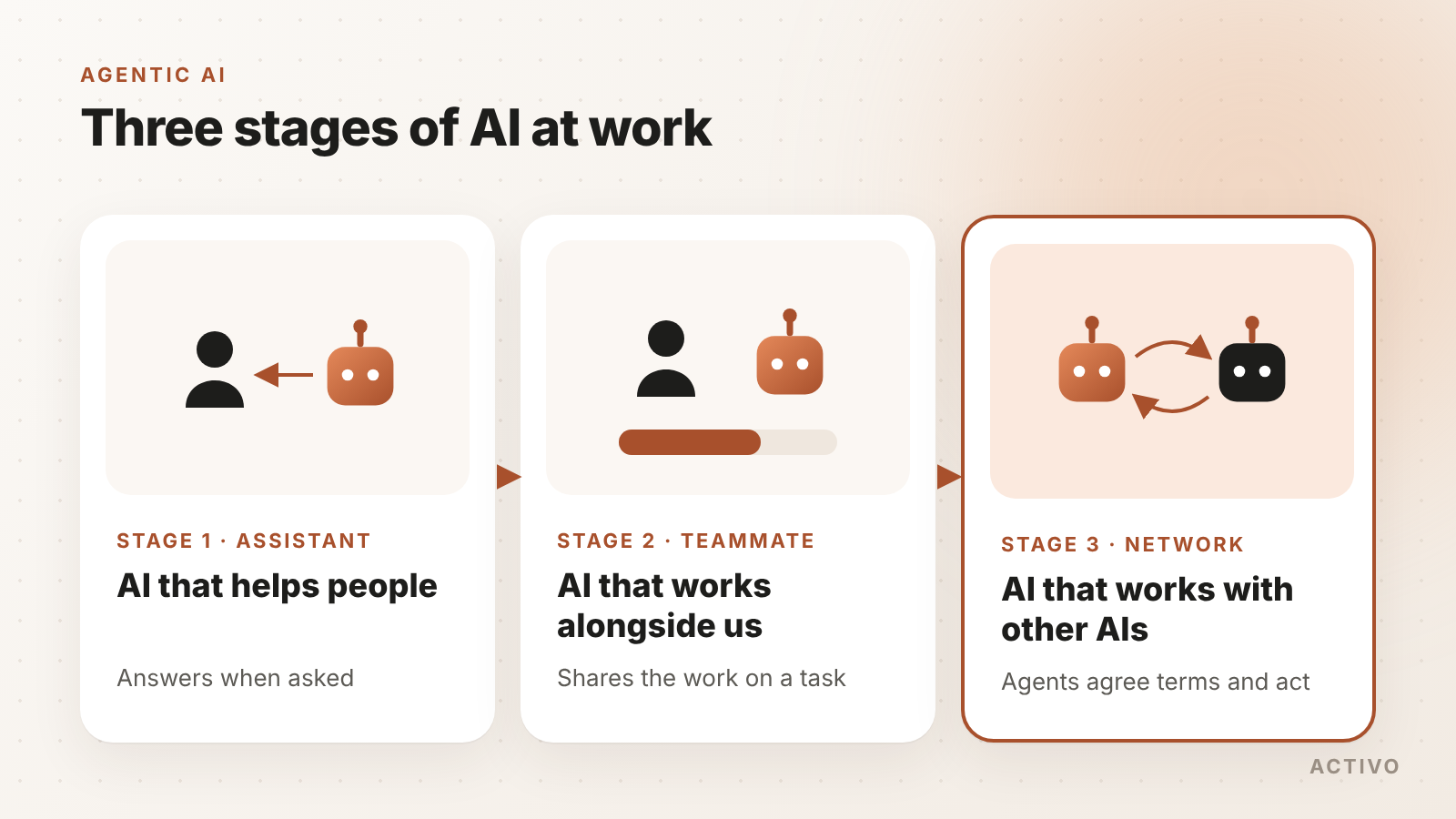
Generative AI gave businesses content and copilots. Agentic AI gives them software that plans, decides, transacts and fixes its own errors, and increasingly does so by talking to other agents. When the users of a platform include agents that can search, negotiate, book and pay at machine speed, network effects change too. This guide explains how, shows where the new advantages form, and gives you concrete ways to build them into your startup. Updated October 2026.
Why this matters now: lots of pilots, little profit
Most companies have tried AI, few have made money from it. McKinsey’s November 2025 survey found 62% of organisations experimenting with agents but only 23% scaling one, and just 39% reporting any profit impact from AI. Gartner expects more than 40% of agentic AI projects to be cancelled by the end of 2027 because of rising costs, unclear value or weak risk controls, and estimates only about 130 of the thousands of agentic vendors are genuine. The gap is the opportunity: agents that complete a whole process, not just assist with one step, are what turn usage into measurable results.
From copilot to agent: what actually changes
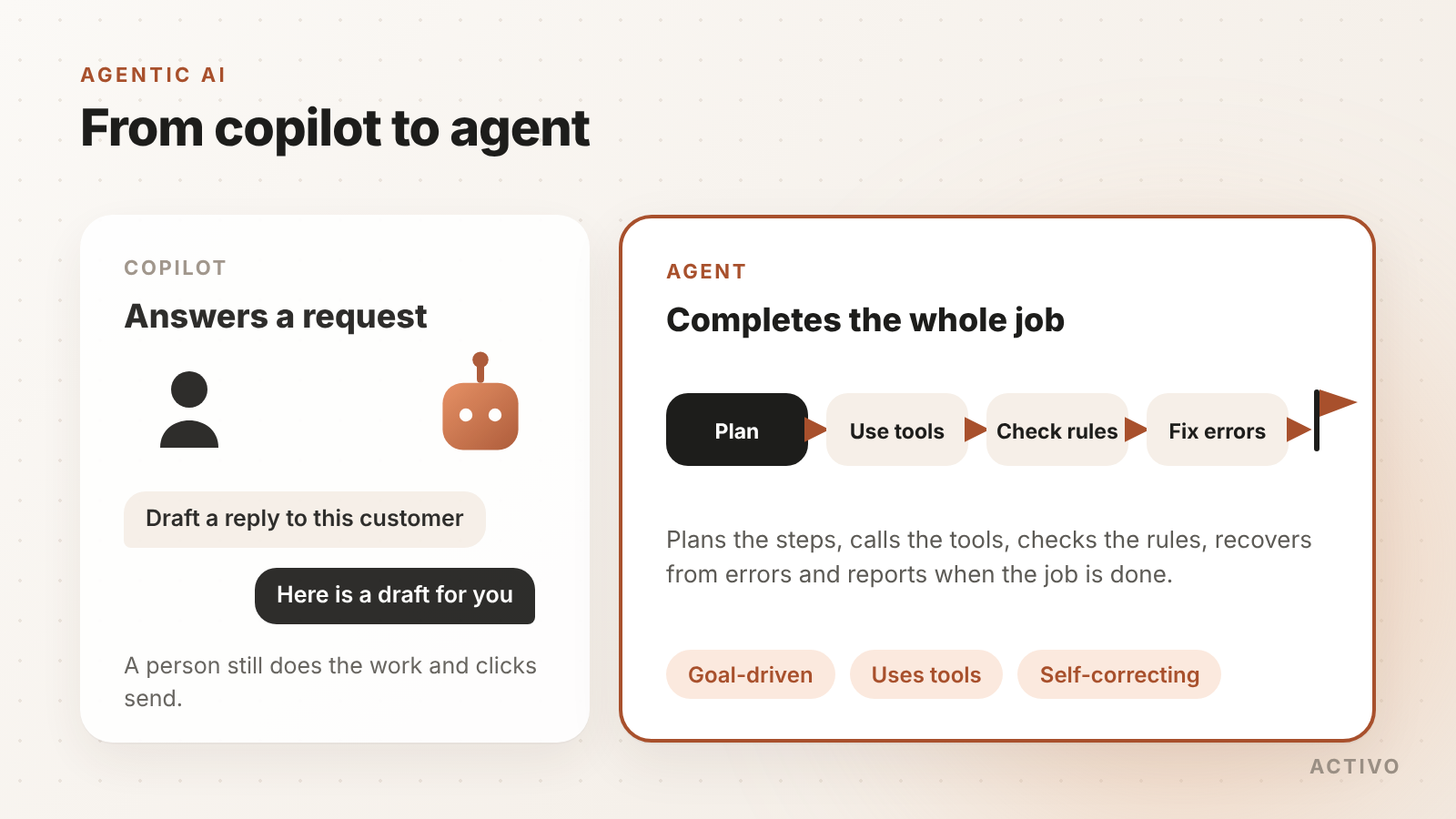
A copilot waits for a prompt and answers. An agent is given a goal, breaks it into steps, calls tools, checks rules and handles exceptions until the job is done. Think of a bright intern versus a capable operator. The real gains come when you redesign the workflow around the agent, running steps in parallel and routing exceptions automatically, rather than dropping it into an old sequential process.
Why teams of specialist agents beat one super-agent
The winning design is not one agent that does everything, but several narrow agents that check each other: one analyses, one executes, one monitors, one enforces policy and one escalates to a human. Narrow agents are easier to test and govern, they work in parallel, and control becomes an explicit layer rather than a hope.
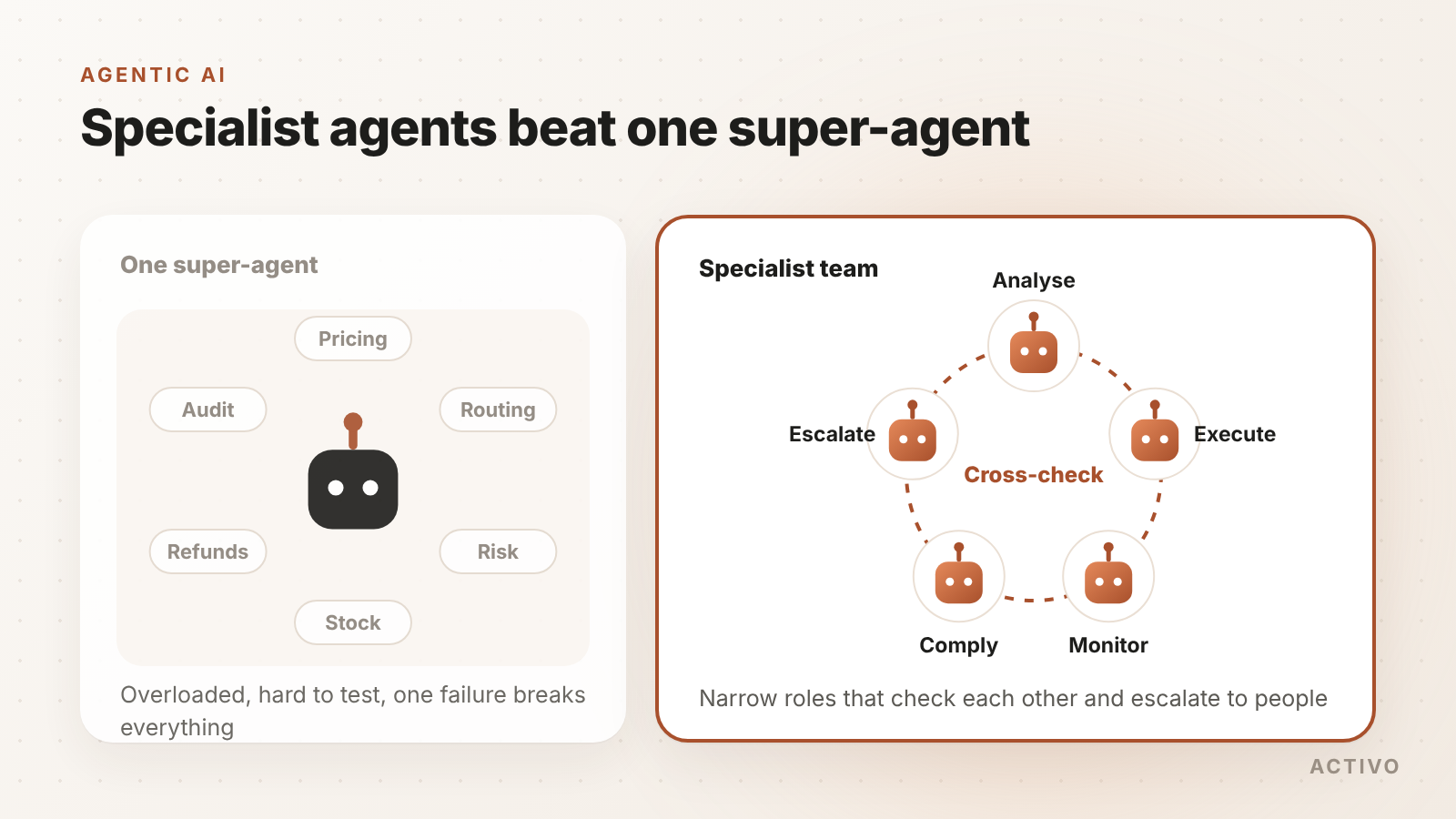
Startup example: an accounts-payable product could run an extraction agent that reads invoices, a matching agent that checks them against purchase orders, a policy agent that flags anything over the approval limit, a payment agent that schedules payment, and an audit agent that logs every decision. Each one can be measured and improved on its own, and the customer sees one finished outcome: invoices paid correctly and on time.
The plumbing: protocols that let agents work together
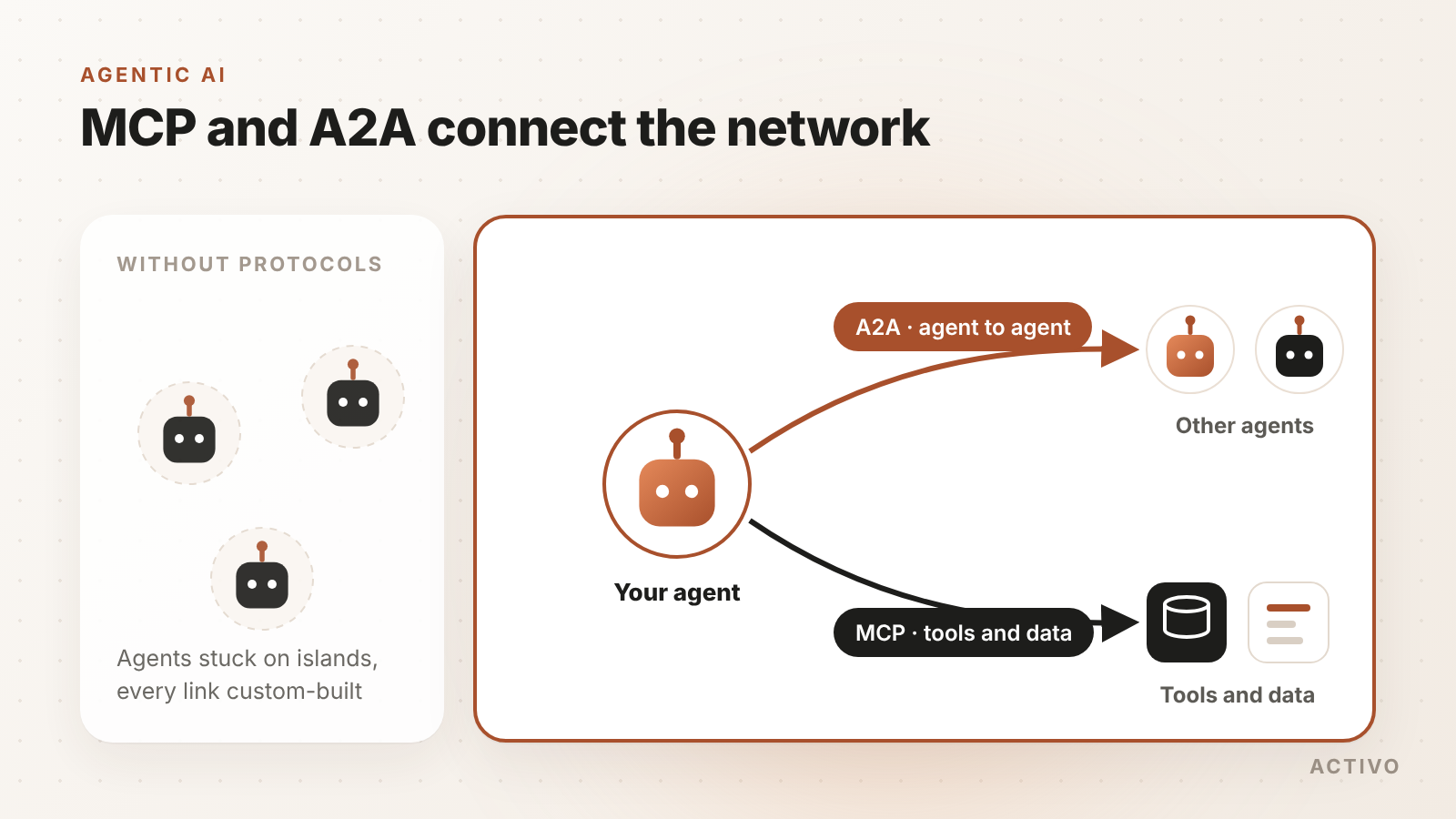
Agents only create network effects if they can connect. Without shared standards you get protocol islands, with agents trapped inside one vendor. In 2025 and 2026 the industry converged on a small set of open standards, most now under neutral foundations.
| Protocol | What it connects | Who is behind it | What it means for your startup |
|---|---|---|---|
| Model Context Protocol (MCP) | AI assistants to tools and data | Launched by Anthropic, now at the Linux Foundation’s Agentic AI Foundation. 10,000+ servers, used by ChatGPT, Claude, Gemini, Microsoft Copilot, Cursor and VS Code. | Publish an MCP server for your core actions so any assistant can use your product |
| Agent2Agent (A2A) | Agents to other agents | Launched by Google, now at the Linux Foundation. 150+ supporters, built into Azure AI Foundry, Copilot Studio and Amazon Bedrock AgentCore. | Let your agent take tasks from, and hand tasks to, agents built by others |
| Agentic Commerce Protocol (ACP) | Shopping agents to merchants and checkout | OpenAI and Stripe, open source. Powers purchases from Etsy and Shopify merchants inside ChatGPT. | Make your catalogue and checkout readable and buyable by AI shoppers |
| Agent Payments Protocol (AP2) | Agents to payment networks, with proof of what the user approved | Google, with payments and card partners, announced September 2025 | Accept payments started by an agent with a clear record of user consent |
Why this matters for network effects: open standards create gravity. Every new MCP server makes every assistant more useful, and every new assistant makes publishing an MCP server more valuable. The products that plug in early get used by more agents, collect more outcomes and become the default choice.
Five network effects of the agentic economy
| Network effect | How it works | Example | How your startup can use it |
|---|---|---|---|
| Integration | Each new connector makes the platform more useful to every agent and every user | MCP directories: each new server adds a capability to every compatible assistant | Ship connectors for the ten tools your customers use most, then publish your own MCP server |
| Agent-to-agent marketplace | Agents hire other agents, so more specialist agents attract more buyer agents, and the reverse | A procurement agent hiring a freight-quote agent and a payments agent to finish an order | Expose your service as an agent others can call over A2A, priced per completed task |
| Shared learning | Every completed workflow improves playbooks for all customers | Fraud and routing models that improve with each transaction across the network | Pool anonymised outcomes so each new customer benefits from everyone’s history |
| Trust and reputation | Agents choose counterparts with proven reliability, so reliable services win more work | Marketplaces ranking sellers on fulfilment and dispute rates | Publish completion rates, audit trails and security attestations other agents can check |
| Knowledge DNA | Expert judgement captured as reusable agent skills compounds as it is used | A credit-risk agent that encodes how senior underwriters spot weak signals | Interview your best operators, turn their rules into tested agent skills and keep improving them |
How to apply this to your startup: four worked examples
Expense management tool
Move: publish an MCP server so finance assistants in ChatGPT, Copilot or Claude can submit, check and approve expenses inside your product.
Network effect: every assistant that connects becomes a new acquisition channel, and every approval adds data that improves policy checks for all customers.
Measure: share of actions started by an agent, and completion rate without human help.
Freight or services marketplace
Move: let buyer agents query live availability and book over A2A, and give suppliers an agent that quotes and confirms instantly.
Network effect: faster matching attracts more buyer agents, which attracts more suppliers. Reliability scores make you the default counterpart.
Measure: time to match, quote-to-booking rate and disputes per thousand jobs.
Direct-to-consumer brand
Move: clean, structured product data, live stock and an agent-ready checkout through ACP or your payment provider’s agentic tools.
Network effect: shopping assistants favour merchants with complete data, reliable delivery and low returns, so quality compounds into visibility.
Measure: orders started by AI assistants, conversion from agent sessions and return rate.
Specialist consultancy or agency
Move: package your best people’s playbooks, such as tax checks or compliance reviews, as specialist agents other platforms can hire per task.
Network effect: each engagement improves the playbook, and listings in agent marketplaces bring work you never had to sell.
Measure: tasks per month from third-party agents, accuracy against expert review and revenue per task.
Run it like a network: from uptime to completion
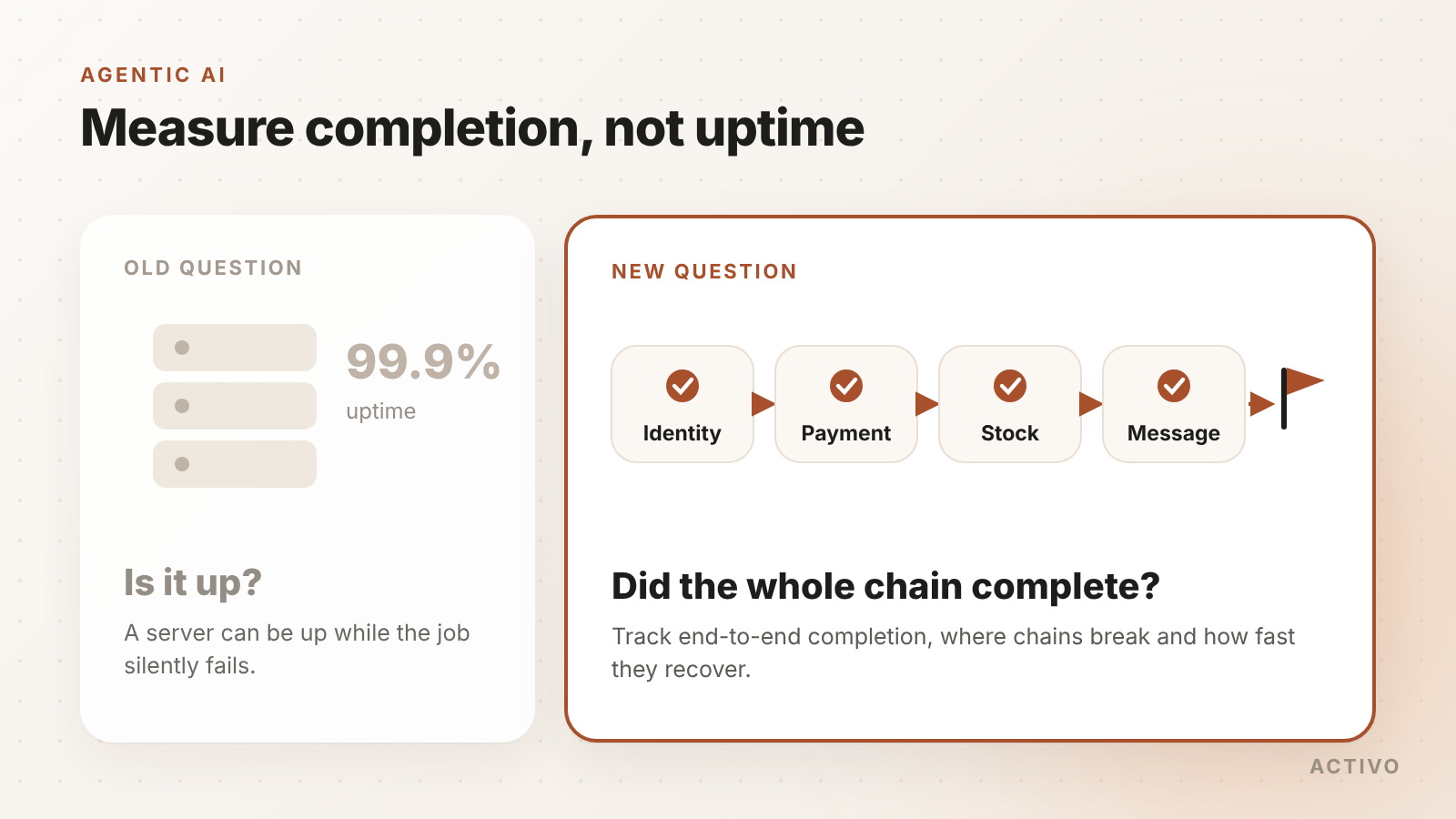
Agent workflows hop across identity, payments, stock, messaging and CRM in one chain. A server that is up 99.9% of the time is no comfort if one step in the chain fails silently. The question changes from “is it up?” to “did the whole job complete?”, and data quality becomes existential: bad data no longer produces a wrong chart, it produces a wrong payment.
| Old question | New question | What to track |
|---|---|---|
| Is the system up? | Did the whole workflow complete? | End-to-end completion rate and where chains break |
| How many users? | How many agents and tasks? | Connected agents, agent-initiated tasks, repeat hiring by other agents |
| Is the data in the warehouse? | Is the data fresh and trusted enough to act on? | Data freshness, source provenance and policy checks passed |
| Did the audit pass this quarter? | Is every action compliant right now? | Actions blocked by policy, human overrides and escalations |
The agent-ready scorecard
| Lever | What to build | Metric | A good first target |
|---|---|---|---|
| Integration | MCP server and clean APIs for your core actions | Time for a new agent to integrate | Under one day |
| Collaboration | A2A endpoints and an orchestrator for multi-agent tasks | Agent-to-agent task volume | Growing month on month |
| Trust | Provenance, policy gates and audit trails | Completion rate and incident rate | Above 95% completion on your core workflow |
| Logic | Expert playbooks turned into tested agent skills | Human override rate | Falling every month |
| Ecosystem | A directory or marketplace for partner agents | Partner agents retained after 90 days | Most partners still active |
Your 60-day plan to become agent-ready
- Days 1–7: Pick one workflow with clear money attached. Choose a process where cost, cycle time or errors are measurable, and define “done” as the completed outcome, not a conversation.
- Days 8–15: Map the chain. List every system, decision and hand-off in the workflow. Mark which steps an agent can do alone and which need human approval.
- Days 16–30: Build specialist agents with guardrails. Split the work into narrow agents, add a policy agent and an audit log, and test against 50 real cases.
- Days 31–40: Open the door. Publish an MCP server for your three most valuable actions, and add an A2A endpoint if other agents should be able to hire yours.
- Days 41–50: Instrument completion. Track end-to-end completion, overrides, exceptions and data freshness on one dashboard, and publish a reliability page.
- Days 51–60: Seed the network. Get listed in MCP and agent directories, sign two integration partners, and price at least one offer per completed task.
When agents can find, hire and pay each other, defensibility shifts from who has the most users to who is easiest to connect to, most trusted and best at finishing the job. Start with one workflow, make it agent-ready and let the network do the compounding.
Ready to put specialist agents to work in your business? We build them for support, sales, finance and operations, with permissions and evaluation from day one. Explore AI Models & Agents →
We design and build specialist AI agents, connect them through MCP and A2A, and put the guardrails and measurement in place from day one.
AI models and agents Get in touchSources: Linux Foundation, Agentic AI Foundation launch · Linux Foundation, A2A one year on · Digital Commerce 360 on Gartner B2B forecast · Outlook Business on Gartner agentic predictions · McKinsey, The state of AI in 2025 · PaymentsJournal on OpenAI and Stripe.