Generative AI gave businesses content and copilots. Agentic AI is giving them something more disruptive: autonomous agents that can plan, decide, execute transactions, recover from errors, and collaborate with other agents across tools and systems. In other words, we’re moving from “AI that helps humans” to AI that operates alongside humans—and increasingly, with other AIs.
That shift doesn’t just change productivity. It changes how platforms grow, how value gets captured, and what network effects even mean when the “users” include software agents that can negotiate, purchase, schedule, route, monitor, and optimise at machine speed.
The GenAI paradox: lots of adoption, little P&L impact
Many organisations rolled out enterprise chatbots and copilots quickly, but struggled to see precise bottom-line results. McKinsey describes this mismatch as the “gen AI paradox”: horizontal tools (chatbots/copilots) spread benefits thinly and are hard to attribute to revenue or margin, while higher-impact vertical use cases (embedded into real processes) often get stuck in pilots.
What changes with agentic AI? Agents can move beyond “assist and suggest” into end-to-end execution—the missing ingredient for measurable operational impact.
From passive tools to “digital citizens”: what makes an AI agent different?
A traditional LLM is mostly reactive: it waits for prompts and produces outputs. An agent is goal-driven: it can decompose objectives into steps, call tools, coordinate decisions, and handle exceptions—often with less human micromanagement.
Think of it as the difference between:
- A bright intern (copilot): helpful when you ask.
- A capable operator (agent): works toward an objective, checks constraints, and completes tasks.
This is why “process reinvention” matters: if you drop agents into old, sequential workflows, you get incremental gains. If you redesign workflows to exploit parallelism, conditional routing, and autonomous exception handling, you get step-change outcomes.
Multi-agent systems: why swarms beat a single “super-agent”
The future isn’t one giant agent that does everything. It’s multi-agent systems (MAS): swarms of specialised agents (analysis, execution, monitoring, compliance, escalation) that collaborate and cross-check one another.
Why specialisation wins:
- Higher reliability: narrow agents can be tuned, tested, and governed more tightly.
- Faster execution: agents can work in parallel (e.g., pricing, inventory, routing, risk checks).
- Better control: “guardian” patterns and policy enforcement become explicit layers.
McKinsey frames this kind of distributed architecture as an agentic AI mesh—designed to enable multiple agents to reason, collaborate, and act securely and at scale across tools and models.
The interoperability layer: MCP + A2A and the end of “protocol islands”
Agent swarms only create compounding value if they can interoperate. Otherwise, you get “protocol islands”: agents trapped inside one vendor stack.
Two notable interoperability efforts:
- Model Context Protocol (MCP): an open protocol to connect LLM apps to external tools and data sources in a standardised way.
- Agent2Agent (A2A): a protocol focused on agent-to-agent communication—so agents can securely exchange information and coordinate actions across platforms.
Why this matters for network effects: open interaction standards tend to create “gravity.” The easier it is for any agent to plug in, the faster ecosystems scale.
The “agentic network”: why infrastructure metrics shift from uptime to completion
Agents create multi-hop, cross-service workflows that touch identity, payments, inventory, messaging, storage, CRMs, and analytics in a single transaction chain. That changes how networks are run:
- From bandwidth planning → end-to-end orchestration: capacity is no longer a simple forecast when workflows are dynamic and probabilistic.
- From “Is it up?” → “Did it complete?” Success becomes workflow completeness, not just server uptime.
This framing shows up directly in vendor/industry discussions of “agentic networks” and operational intelligence for agent-driven workflows.
Data quality becomes existential: “garbage in” turns into “bad actions”
With agents, low-quality data doesn’t just create poor dashboards—it can lead to poor decisions and transactions.
What agent-grade data needs:
- Freshness checks: is this data current enough to act on?
- Provenance: where did it come from, and can we trust it?
- Policy enforcement in-line: compliance isn’t a quarterly audit; it’s a real-time gate.
Some platforms explicitly position this as continuous compliance—automating evidence and enforcing controls continuously rather than periodically.
Knowledge DNA: turning expert intuition into compounding software
One of the most underpriced advantages in agentic systems is capturing “Knowledge DNA”—encoding how experienced humans actually decide:
- How a network engineer triages anomalies
- How a planner re-routes supply under constraints
- How a risk manager blocks a trade based on weak signals
When that logic becomes reusable agent behaviour, it becomes institutional memory—and it can improve via feedback loops across scenarios.
How network effects evolve in an agentic economy
1) From user-based to agent-based network effects
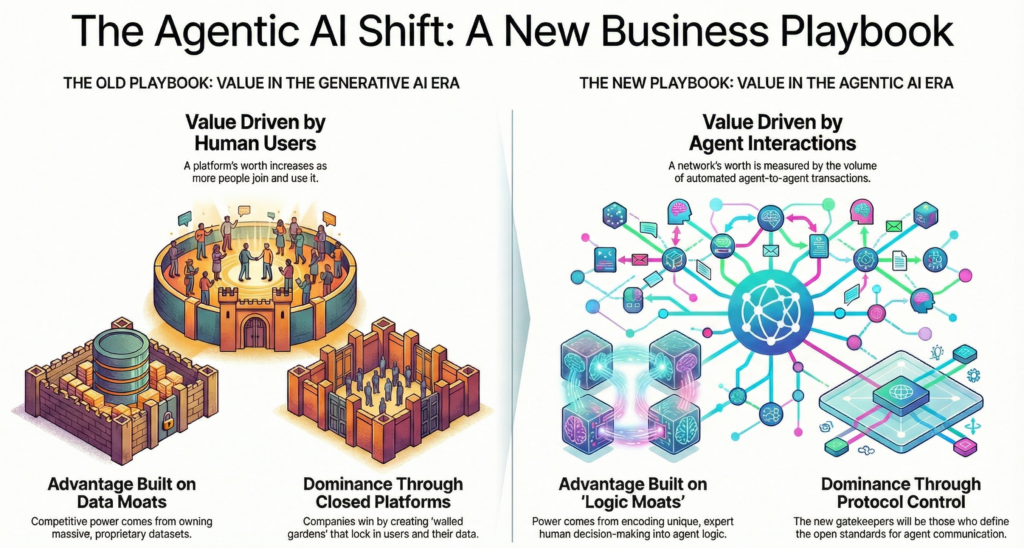
Classic network effects scale with the number of human users. Agentic network effects scale with the number of specialised agents transacting, negotiating, verifying, and delegating within your ecosystem.
New north-star metrics:
- Agent-to-agent transaction volume
- Successful workflow completion rate
- Agent onboarding time (time-to-integrate)
- “Liquidity” of tasks (how quickly an agent can find a counterpart service)
2) Logic moats beat data moats (or at least, they become equally important)
Proprietary data still matters—but specialised decision logic becomes a new defensibility:
- A “Supply Chain Re-routing Agent” that consistently finds feasible plans under disruption
- A “Credit Risk Agent” that reduces false positives without increasing losses
As more agents run more scenarios, the system builds collective intelligence—more complex to copy than a model prompt.
3) Protocol control becomes platform power
If protocols like MCP and A2A become widely adopted, the “winners” won’t just be apps—they’ll be the ecosystems that:
- make integration easiest,
- standardise negotiation and context exchange,
- and attract the broadest set of third-party agents.
Just like TCP/IP shaped the web’s growth, agent interaction standards can shape the next platform layer.
4) Reputation and trust become automated currencies
At machine speed, errors cascade. So agents will increasingly rely on complex trust signals:
- verified provenance
- policy attestation
- compliance posture
- reliability scores
Platforms that can prove reliability become the default hubs for agent interaction—creating rapid concentration effects.
5) The “service delivery chain” economy and agent guilds
No single company will own the whole agentic stack. Instead, ecosystems form where agents hire other agents:
- best-in-class payment agent
- best-in-class logistics agent
- best-in-class identity/verification agent
Here, the network effect is interoperability: the more ecosystems your agent can plug into, the more “work” it gets assigned.
A practical framework: the 5 levers of agentic network effects
| Lever | What changes with agents | What to build | What to measure |
|---|---|---|---|
| Integration | Plug-in beats lock-in | MCP tool interfaces + clean APIs | time-to-integrate, % workflows using tools |
| Inter-agent collaboration | Swarms > single bots | A2A-style communication + orchestration | agent-to-agent transaction volume |
| Trust | Brand → math + proof | provenance, policy gates, audit trails | completion rate, incident rate, trust score |
| Logic | Heuristics become product | expert playbooks → agent behaviors | decision quality, override rate, drift rate |
| Ecosystem | Modular “guilds” emerge | marketplace for specialist agents | repeat “hiring,” retention of agent partners |
Founder playbook: how to build an “agent-ready” platform
- Start vertical (one workflow), not horizontal (one copilot). Pick a process with clear economics (cost, cycle time, risk, service).
- Completion design, not conversation. Define “done” as a completed transaction chain.
- Make interoperability a feature. Treat MCP-style connectors and agent-to-agent hooks as growth loops, not plumbing.
- Ship guardrails early. Policy enforcement and continuous compliance aren’t “enterprise later”—they’re network-effect fuel.
- Productize your Knowledge DNA. Convert expert heuristics into reusable agent components and test harnesses.
- Instrument everything. Track completion rate, exception paths, overrides, and drift like you track revenue.
Conclusion: network effects are about to get… non-human
When agents can talk to each other, negotiate, and execute, network effects stop being purely about human adoption curves. They become about interoperability, trust, and compounding specialised logic inside multi-agent ecosystems.
The startups that win won’t just “add agents.” They’ll build agent-native platforms where external agents can plug in, transact safely, and get better over time—creating the next generation of defensibility.