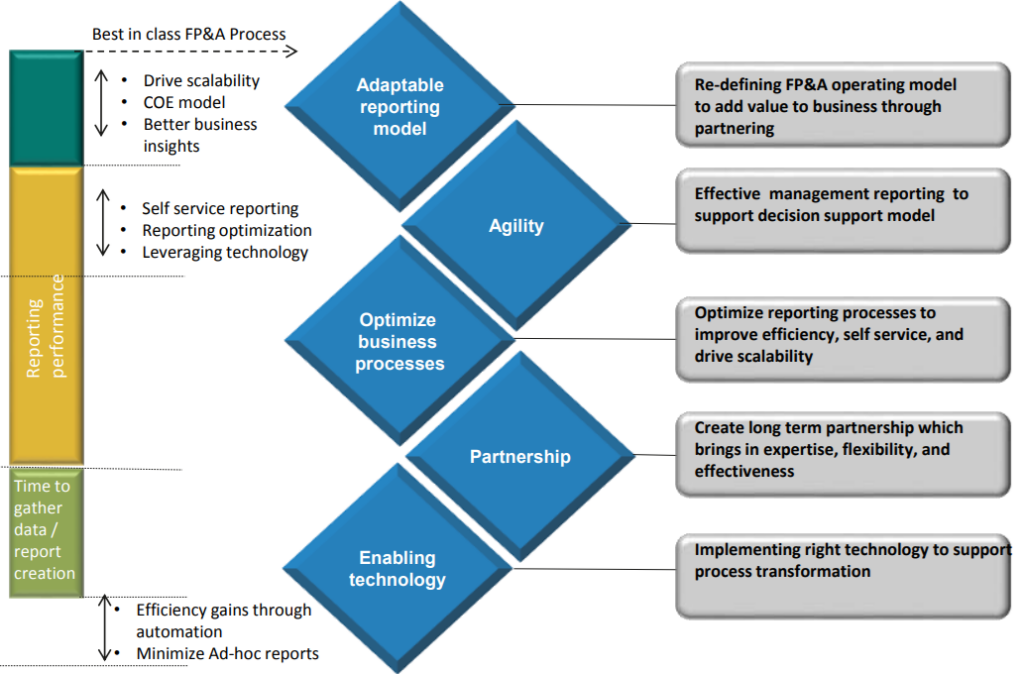
The FP&A software market offers a diverse range of solutions tailored to various organisational needs, from seamless Excel integration to comprehensive all-in-one platforms. World-class FP&A frameworks must cater to the ever-growing demand for flexibility and support business partners’ decision-making across all functions of the business.
Finance Innovation
Artificial Intelligence (AI) will have a significant impact on FP&A and create many new opportunities for your business. Essentially, you get your FP&A solution and data strategy right so that FP&A processes and governance are ready to enable your AI initiatives, such as LLMs, RAG, and AI models, and further fulfil the goal of self-service and AI Automation.
Datarails and Vena leverage Excel for data consolidation and workflow automation, making them ideal for businesses accustomed to Excel-based processes. Board and Anaplan provide robust, scalable platforms with advanced modelling and scenario-planning capabilities, suitable for large enterprises that require extensive customisation and cloud-based scalability. Workday integrates financial management with human capital management, offering a holistic ERP solution for organisations seeking unified financial and HR operations.
Planful, Solver, and Jirav emphasise automation, user-friendly interfaces, and real-time planning. Planful focuses on enhancing collaboration and automating financial processes, while Solver offers strong reporting and data visualisation tools. Jirav provides intuitive dashboards and real-time forecasting tailored for dynamic environments. Jedox and Mosaic stand out with their flexible planning and advanced analytics capabilities, catering to organisations that require adaptable solutions and in-depth financial insights.
Datarails, economical, robust data integration, yet familiar, friendly Excel interface, which will allow you to transition your FP&A in relatively short time frames. You may already be trying to build FP&A with Excel, have created manual processes, and are struggling to serve your growing business partner needs, resulting in inflexible, inconsistent data management.
Comparison Table
| Vendor | Key Features | Key Differences | Key Advantages | Estimate Costs |
|---|---|---|---|---|
| Datarails | Excel integration, data consolidation, automated reporting | Strong focus on Excel users | Seamless transition from Excel, user-friendly | $10,000 – $50,000 annually |
| Board | Unified platform (BI, performance management, analytics), customizable dashboards | All-in-one solution combining multiple functionalities | Comprehensive toolset, highly customizable | $30,000 – $100,000 annually |
| Anaplan | High scalability and complex modelling capabilities | Flexible planning, budgeting, forecasting, and strong integration capabilities | Suitable for large enterprises, robust and flexible | $50,000 – $200,000+ annually |
| Workday | Integrated financial and human capital management, real-time data | Holistic ERP approach combining finance and HR | Comprehensive integration, real-time insights | $100,000 – $500,000+ annually |
| Planful | Automation, collaboration tools, budgeting, forecasting | Emphasis on process automation and team collaboration | Streamlined workflows, enhanced collaboration | $20,000 – $80,000 annually |
| Solver | User-friendly interface with strong visualisation tools | Intuitive design, excellent data visualisation | Reporting, dashboards, data visualisation, and integration with various data sources | $15,000 – $60,000 annually |
| Vena | Excel-based interface with workflow automation, customizable templates | Combines Excel familiarity with advanced automation | Easy to use for Excel users, highly customizable | $25,000 – $90,000 annually |
| Jedox | Advanced analytics, comprehensive reporting, and strategic planning tools | Adaptable solutions with robust integration options | High flexibility, strong integration with existing systems | $30,000 – $120,000 annually |
| Jirav | Real-time financial planning, forecasting, and intuitive dashboards | Focus on real-time data and intuitive user experience | Real-time insights, user-friendly dashboards | $20,000 – $70,000 annually |
| Mosaic | Real-time financial planning, forecasting, intuiand tive dashboards | Detailed financial insights and strategic planning focus | In-depth analytics, tailored for strategic financial planning | $25,000 – $100,000 annually |
Notes on Estimate Costs:
Includes Licenses, which vary based on the number of users, modules selected, and deployment options (cloud vs. on-premises)—implementation, which covers setup, customisation, training, and integration with existing systems. The complexity and scope of implementation can significantly impact costs. Pricing Models: Many vendors offer tiered pricing or custom quotes based on specific business needs.
Summary of Key Pointers
- Integration Capabilities: Most vendors offer robust integration options, with Datarails and Vena emphasising Excel integration, while Jedox and Solver provide extensive connectivity with various data sources.
- User Experience: Solver and Jirav prioritise intuitive interfaces and user-friendly dashboards, making them accessible for users with different technical backgrounds.
- Scalability and Flexibility: Anaplan and Board cater to large enterprises with scalable and customizable solutions, whereas Planful and Mosaic are ideal for mid-sized organisations seeking flexibility and advanced planning features.
- Comprehensive Solutions: Platforms like Workday and Board offer integrated solutions that combine multiple functionalities (e.g., BI, HR, finance), providing a unified approach to enterprise management.
- Advanced Analytics and Reporting: Mosaic and Jedox excel in delivering detailed analytics and strategic planning tools, enabling deeper financial insights and informed decision-making.
Key Differences and Advantages
- Datarails vs. Vena: Both integrate closely with Excel, but Datarails focuses more on data consolidation and reporting automation, whereas Vena emphasises workflow automation and customisation within an Excel-based interface.
- Anaplan vs. Planful: Anaplan offers robust cloud-based modelling suitable for large-scale enterprises. At the same time, Planful offers robust automation and collaboration features that enhance team workflows in mid-sized companies.
- Workday vs. Board: Workday integrates financial management with human capital management to deliver a comprehensive ERP solution, whereas Board combines BI, performance management, and analytics into a single platform for versatile business intelligence.
- Solver vs. Jirav: Solver excels in data visualisation and reporting with an intuitive interface, making it great for visualisation-focused users. At the same time, Jirav offers real-time planning and forecasting with user-friendly dashboards tailored for growing businesses.
- Jedox vs. Mosaic: Jedox offers flexible planning and robust integrations for adaptable business environments, while Mosaic delivers advanced analytics and strategic planning tools for organisations seeking in-depth financial insights.
Recommendation
Selecting the right FP&A software depends on your organisation’s size and specific needs, including integration requirements, the complexity of financial modelling, user experience preferences, and the scale at which you operate. For Startups and SMBs with up to $500 million in revenue, we strongly recommend improving processes with consistent templates, reports and powerful, cloud- and AI-based data handling, letting you create best-practice finance FP&A processes without the chaos of manual processes.
References:
https://www.sap.com/products/financial-management/what-is-financial-planning-and-analysis-fpa.html