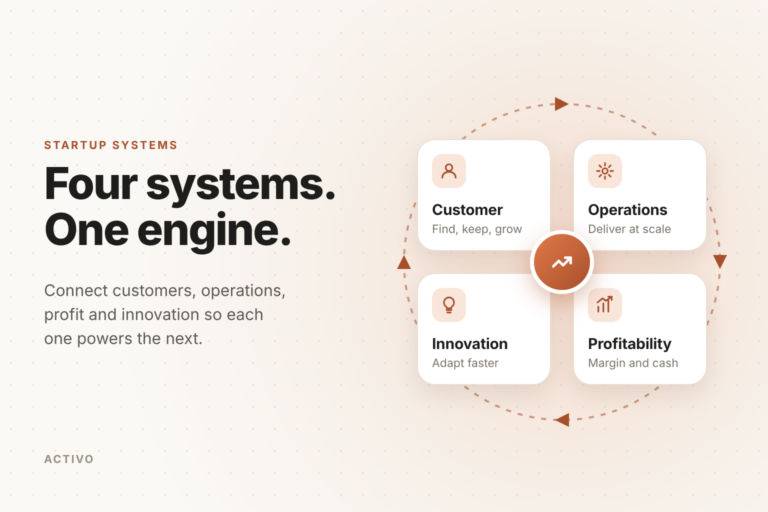
Fix your Marketing Message System
Most businesses are not ignored because their product is bad. They are ignored because their words are. Marketing messages are often confusing, clever or full of jargon that a customer’s brain rejects instantly. This guide shows how to fix that with five simple soundbites and a three-phase campaign, then gives you a one-week plan to roll it out. Updated October 2026 with new data on AI search and B2B buying.
People skim, so every word has to earn its place
The brain notices what feels tied to survival or to solving a painful problem. Anything else gets tuned out. And on the web, people barely read: Jakob Nielsen’s research found that on an average page, users have time to read at most 28% of the words, and 20% is more likely.
That is why the goal is zero cognitive load. Light, simple words keep people reading; heavy, abstract words make them scroll past. No vague slogans, no mission-statement fluff, no clever lines your agency loves but your customer does not understand. Rule of thumb: if a stranger cannot tell within a few seconds what you do and why it matters, your copy is too heavy.
| Heavy (gets ignored) | Light (gets read) |
|---|---|
| We optimise digital transformation journeys. | You’re paying for software your team doesn’t use. |
| An end-to-end synergistic workforce platform. | Run payroll in ten minutes, not two days. |
| Empowering growth through data-driven insight. | See which customers are about to leave, before they do. |
Why clarity matters even more in 2026
Your words now face a second filter before people see them: AI. When Pew Research tracked the Google searches of 900 US adults, about one in five searches produced an AI summary. When a summary appeared, people clicked a traditional result on just 8% of visits, against 15% when there was no summary, and clicked a link inside the summary itself on only 1%. They were also more likely to end their browsing session there and then.
Business buyers are moving the same way. Gartner’s survey of 632 B2B buyers found that 61% prefer a rep-free buying experience, 73% actively avoid suppliers who send irrelevant outreach, and 69% had spotted differences between what a supplier’s website said and what its salespeople said.
Put together, the message is simple. Fewer people will reach your page, the ones who do will read less, and many will form their view from an AI summary or your website alone, before they ever speak to you. A clear, consistent message is no longer a nice-to-have. It is often the only pitch you get.
The five soundbites (PEACE)
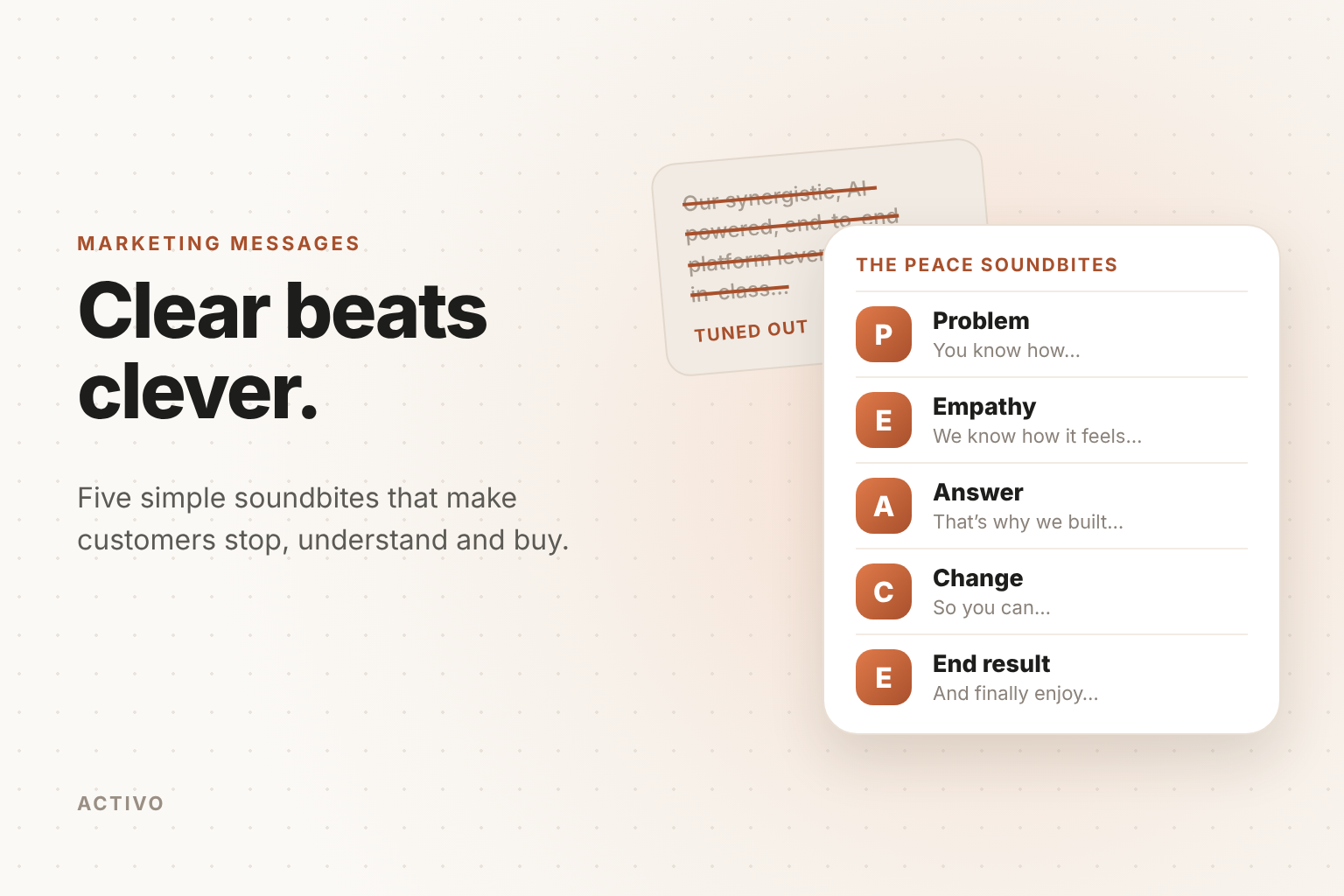
Inspired by Donald Miller’s StoryBrand framework, the strategy rests on five short, repeatable soundbites that tell a simple story about your customer and your product. Here they are with a fill-in template and an example for a payroll service for independent restaurants.
| Soundbite | Fill-in template | Example |
|---|---|---|
| Problem | “You know how [customers] struggle with [problem]?” | “Most restaurant owners lose a day every fortnight to payroll.” |
| Empathy | “We know how frustrating it is when [feeling].” | “We know what it’s like doing timesheets at midnight after a double shift.” |
| Answer | “That’s why we created [product], which [what it does].” | “So we built a payroll app that pulls hours from your till and pays staff in one tap.” |
| Change | “So you can become [stronger version of them].” | “You get back to running the kitchen, not the spreadsheet.” |
| End result | “And finally enjoy [outcome].” | “Happy staff paid on time, every time, and your Sundays back.” |
Each soundbite should be short enough to memorise, simple enough for a 12-year-old to understand, and repeated word for word everywhere.
Make your message easy for AI to repeat
AI assistants and search summaries build their answer about you from what they can find and understand. The same rules that help a distracted human help a machine: plain words, one clear claim, said the same way everywhere. Five habits make the difference.
- Lead with the problem and the answer. Put your problem and answer soundbites in the first two sentences of your homepage and every key page, not below the fold.
- Say who it is for. Name the customer plainly: “independent restaurants with 5 to 50 staff” beats “hospitality businesses of all sizes”.
- Use identical wording everywhere. Your website, LinkedIn page, directory listings, sales decks and proposals should all carry the same soundbites, so every source tells the same story.
- Answer real questions. Add a short question-and-answer section in the words customers use: what it costs, how long it takes, what happens if it goes wrong.
- Back each claim with a number. “Pays staff in one tap” is good. “Cuts payroll from a day to ten minutes” is better, and far easier to quote.
The three-phase campaign
You need to build a relationship with your audience in three phases. Skip one and people will not enter your world, trust your product or become customers.
| Phase | Goal | Formats | Metric to watch |
|---|---|---|---|
| 1. Curiosity | Get them to stop and think “that’s me”. | Headlines, ad hooks, social posts, video openers, email subject lines | Click-through and scroll rate |
| 2. Enlightenment | Help them understand how it works, what it costs, how risky it is and why it fits. | Landing pages, case studies, webinars, videos, blog posts, lead magnets, nurture emails | Lead conversion and time on page |
| 3. Commitment | Make saying yes easy and timely. | Checkout pages, sales decks, proposals, offer emails, retargeting ads, with a trial, bonus, guarantee or deadline | Close rate and time to purchase |
The soundbites are the spine of all three phases. In curiosity they are the hook. In enlightenment, a landing page can follow them in order: problem and empathy, then the answer, then the change, then the end result with testimonials. In commitment, restate the problem and end result at the top, summarise the answer in three bullets, show proof of change, and make the call to action the obvious next step.
Your one-week messaging plan
- Day 1: Choose the one problem you own. Ask: “What is the single painful problem our best customer has that we solve better than anyone?” Write it as one plain sentence.
- Day 2: Draft your five soundbites. Use the templates above. Read them to someone outside the business and keep cutting until they can repeat them back after one hearing.
- Day 3: Lock the wording. Save the final versions somewhere central, labelled “Official soundbites: do not freestyle”. Consistency beats creativity.
- Day 4: Update your first touches. Put at least one soundbite in your website headline, social bios, pinned posts, top ad headlines and the first ten seconds of your videos.
- Day 5: Rebuild one page and set a test. Restructure your main landing page around the five soundbites, then A/B test it against the old one on clicks, sign-ups and sales. Change the soundbites only if you find a clearer problem or customers echo back a simpler phrase.
The checklist for every new piece of content
- Does it clearly name the customer’s problem?
- Does it use the exact soundbite wording, with no ad-libbing?
- Could a distracted person get it in the 120 words they will actually read?
- Is it clear which phase it serves: curiosity, enlightenment or commitment?
If the answer to any of these is no, rewrite it.
Test your message in a day
You do not need a research budget to find out whether your message works. Run these four tests before you change a single ad, and again after.
| Test | How to run it | Pass mark |
|---|---|---|
| Five-second test | Show your homepage to five people outside the business for five seconds, then ask what you do and who it is for. | At least four of the five get both right. |
| Repeat-back test | Read your five soundbites aloud once, then ask the listener to explain your business in their own words. | They describe your problem and answer, close to your wording. |
| AI summary test | Ask two or three AI assistants: “What does [your company] do, and who is it for?” | The answer matches your problem and answer soundbites. |
| Consistency check | Put your homepage next to your last three proposals or sales decks. | Same problem, same promise, same words. |
If a test fails, go back to Day 1 of the plan. Most of the time the problem is not the copywriting. It is that the business has not yet chosen the one problem it owns.
A clear message is the first step to compounding growth. Growth Mindset helps you sharpen it and turn it into content and campaigns that convert. Explore Growth Mindset →
We help you build a messaging system that runs across curiosity, enlightenment and commitment: a half-day discovery workshop, a two-to-three-day channel rollout, ongoing content and a one-day team enablement session. One-off, fast-track, performance-linked or consulting.
Get in touchSources: Jakob Nielsen, How Little Do Users Read? (Nielsen Norman Group, 2008); Donald Miller, StoryBrand; Pew Research Center, Google users are less likely to click on links when an AI summary appears (2025); Gartner, 61% of B2B buyers prefer a rep-free buying experience (2025).