Build an AI Startup with a Real Moat
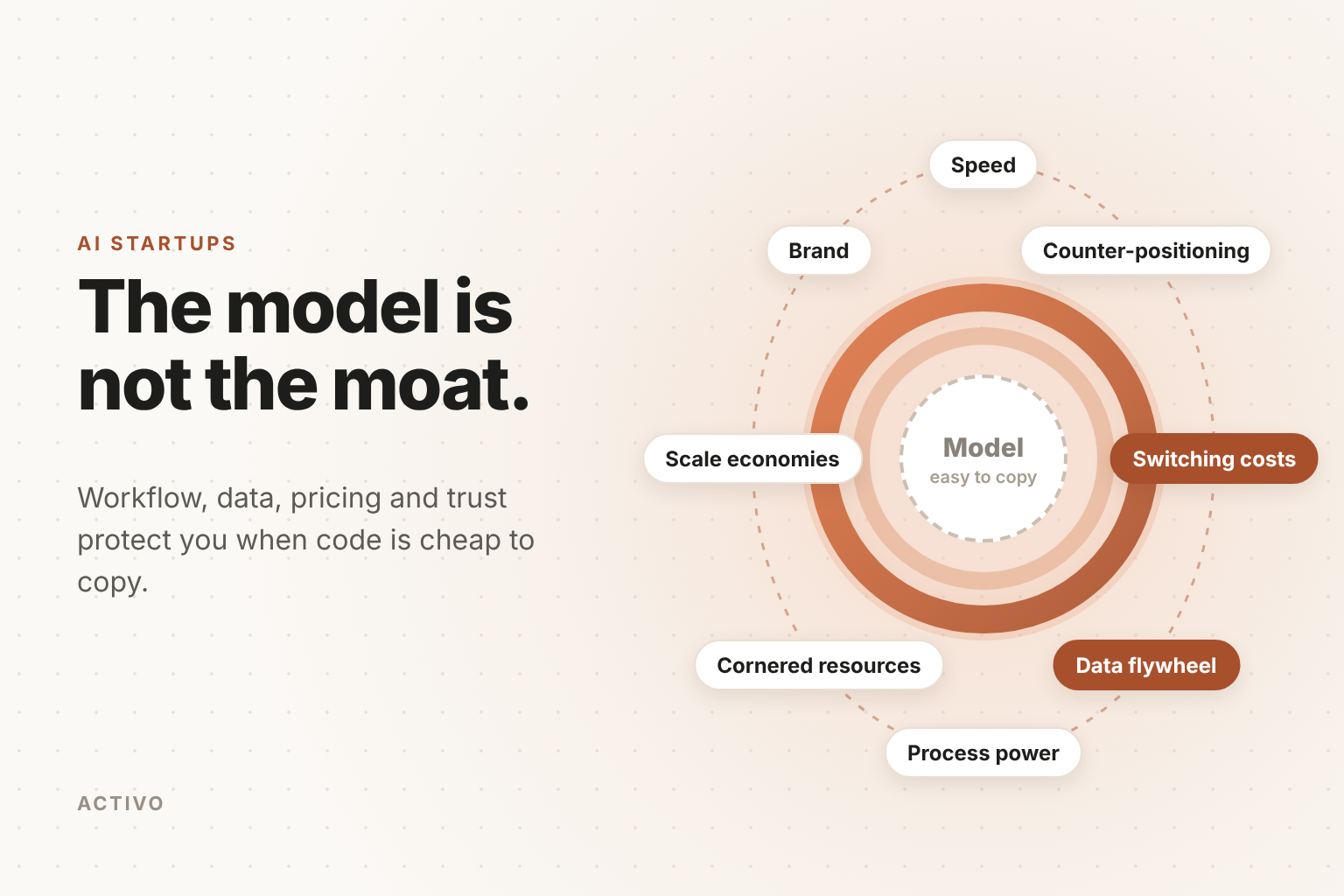
AI makes building fast and copying even faster. When a competitor can rebuild your demo in a weekend, the model is not your advantage. What protects you is everything around it: how deeply you sit in the workflow, the data and evaluations only you have, how you price, and how much customers trust you. This guide shows which moats work for AI startups, which ones fit your type of startup and sector, and a four-week plan to start building yours. Updated October 2026.
Why AI moats are different
Three things changed. First, model capability is now a commodity: when the cost of a capable model falls 280-fold in two years, “we fine-tuned it cheaper” stops being an edge. Second, the labs and incumbents move fast and ship features that wipe out thin products overnight. Third, buyers are spending: enterprise generative AI spend reached $37bn in 2025, and startups won almost two dollars for every one won by incumbents in applications. The money goes to products that own a painful job end to end, not to chat boxes on top of a model.
The eight AI moats, with real examples
Hamilton Helmer’s 7 Powers still frames defensibility well. For AI startups we add an eighth that matters most on day one: speed.
| Moat | What it means in AI | Real example | First step to build it |
|---|---|---|---|
| 1. Speed | Shipping and learning faster than incumbents can decide. It decays, so use it to reach the other moats. | Cursor entered AI coding after GitHub Copilot, yet passed $4bn in annualised revenue by June 2026 by out-shipping larger rivals. | Release weekly, talk to five users a week, and track which features change daily usage. |
| 2. Counter-positioning | A model incumbents cannot copy without hurting their own business, such as charging for work done instead of seats. | Intercom charges $0.99 per successful Fin outcome. Sierra bills per resolved conversation and reached $200m ARR in May 2026. | Price on a unit of work the customer already measures: cases closed, claims filed, hours saved. |
| 3. Switching costs | Being so embedded in workflows, integrations and habits that replacing you is painful. | Abridge built its clinical scribe deep into Epic, the hospital record system doctors already use, and was valued at $5.3bn in 2025. | Integrate with the system of record on day one and own one step of the workflow completely. |
| 4. Data flywheel | Usage produces data and feedback that make the product better, which brings more usage. | Glean maps each customer’s documents, people and permissions through 250+ connectors, and passed $300m ARR in May 2026. | Capture every correction a user makes and turn it into evaluation and training data. |
| 5. Process power | Hard-won reliability: edge cases, guardrails and evaluation that work in production, not just in a demo. | Harvey built legal workflows that law firms trust with client work, reaching $400m ARR and a $15.5bn valuation in October 2026. | Build an evaluation set of real failure cases and block any release that gets worse on it. |
| 6. Cornered resources | Exclusive data, access, certifications or talent that others cannot easily get. | Tempus has 45 million+ de-identified patient journeys, 1.5 million with sequencing data, to train oncology models. | Sign exclusive data partnerships with design partners, or pursue a certification rivals will take years to earn. |
| 7. Scale economies | Large fixed costs spread over many customers, so unit costs fall as you grow. | Frontier labs and large search indexes spread training and crawling costs over millions of users. | Only invest in shared infrastructure once at least three customers will reuse it. |
| 8. Brand | Becoming the default name buyers trust in a category, which lowers acquisition cost. | ChatGPT became the default consumer AI, with 800 million weekly users by October 2025, despite strong rival models. | Publish reliability numbers, security audits and customer outcomes, not just launch videos. |
Which moats suit which type of startup
Not every moat is available to every startup. A consumer app cannot win on forward-deployed engineers, and an infrastructure tool rarely wins on brand alone. Pick one primary moat and one secondary moat that fit your model.
| Startup type | Primary moat | Secondary moat | Example pattern | Main risk |
|---|---|---|---|---|
| Vertical AI in regulated sectors | Process power | Switching costs | Clinical scribes, legal research, insurance claims | Long sales cycles and liability if outputs are wrong |
| AI agents replacing services work | Counter-positioning | Data flywheel | Customer support, collections, bookkeeping priced per outcome | Margins squeezed if model costs or error rates rise |
| Horizontal B2B tools | Speed | Brand | Coding assistants, meeting notes, writing tools | Labs and suites bundle the same feature for free |
| Enterprise knowledge and workflow platforms | Switching costs | Data flywheel | Enterprise search, internal agents connected to company data | Security reviews and data-access objections |
| Consumer AI apps | Brand | Switching costs through memory and personalisation | Companions, tutors, photo and video tools | High churn and copycat apps within weeks |
| AI infrastructure and developer tools | Scale economies | Switching costs through APIs and SDKs | Inference hosting, evaluation tools, vector databases | Price wars and open-source alternatives |
| Data-rich deep tech | Cornered resources | Process power | Drug discovery, materials, oncology diagnostics | Capital intensity and slow proof of results |
Which moats work best in each sector
Activo assessment of moat strength for AI startups by sector.StrongUsefulWeak
| Sector | Speed | Counter-positioning | Switching costs | Data flywheel | Process power | Cornered resources | Scale | Brand |
|---|---|---|---|---|---|---|---|---|
| Healthcare | Weak | Useful | Strong | Strong | Strong | Strong | Weak | Useful |
| Legal and professional | Useful | Useful | Strong | Useful | Strong | Useful | Weak | Strong |
| Financial services | Weak | Useful | Strong | Strong | Strong | Useful | Useful | Strong |
| Government and defence | Weak | Weak | Strong | Useful | Strong | Strong | Weak | Useful |
| Customer support | Useful | Strong | Useful | Strong | Useful | Weak | Useful | Useful |
| Software development | Strong | Useful | Useful | Strong | Weak | Weak | Useful | Strong |
| Consumer and creator | Strong | Weak | Useful | Useful | Weak | Weak | Useful | Strong |
| Industrial and supply chain | Weak | Useful | Strong | Strong | Useful | Strong | Weak | Weak |
How to read the matrix: in healthcare, a startup that wins accreditation, integrates with the record system and builds a clinical evaluation set is very hard to displace, while being first to market counts for little because buyers move slowly. In software development the opposite holds: buyers try new tools every month, so speed and developer love decide the winner, and switching costs stay low until you own team workflows.
Choose your moats by stage
| Stage | Main moat | What to build | Proof investors want |
|---|---|---|---|
| 0 to 1 (first 3–12 months) | Speed | One painful, specific workflow with AI doing the work behind a familiar interface, not a general copilot | Weekly active use and a clear time or cost saving per user |
| Wedge to product (first paying customers) | Switching costs and counter-positioning | Forward-deployed pilots wired into real systems, with pricing tied to work completed | Pilots converting to contracts and expansion within accounts |
| Product to moat | Data flywheel and process power | An evaluation suite treated as a product, exclusive data partnerships, domain-tuned models | Quality improving release on release, gross margin rising as volume grows |
| Defend and expand | Brand and scale | Security certifications, published reliability, shared infrastructure across customers | Low churn, shorter sales cycles and inbound demand |
Answering the moat questions investors will ask
| Question | Weak answer | Strong answer |
|---|---|---|
| Why won’t the labs crush you? | “Our prompts are better.” | “We own the workflow and the integration into the system of record, we price per outcome, and our evaluation data from 40 customers improves results every month.” |
| Isn’t this just a wrapper? | “We use the best model.” | “Models are interchangeable components. Our edge is the workflow, the data we capture and the reliability we can prove on real cases.” |
| What is your moat today? | “Network effects.” (with 12 customers) | “Speed today. Switching costs from embedded pilots within 12 months, then exclusive data partnerships.” |
| What if model prices fall again? | “We will lower our prices.” | “Our margins improve, because we charge for outcomes, not tokens.” |
Your four-week moat plan
- Week 1, days 1–2: Pick the painful job. Shadow three target users and write down the boring, costly workflow your product will take over, with the time and money it costs today.
- Week 1, days 3–5: Choose two moats. Use the startup-type table and sector matrix to pick one primary and one secondary moat, and write one sentence on how each will be visible in 12 months.
- Week 2: Ship a thin slice inside the workflow. Build one end-to-end step that runs inside a tool users already use, without a chat box, and connect it to the system of record.
- Week 3: Stand up evaluations. Collect 50 real examples and the right answers, score every release against them, and log every user correction as new test data.
- Week 4, days 1–3: Offer an outcome-priced pilot. Give one design partner pricing per task or result, with an engineer embedded in their team to wire up integrations.
- Week 4, days 4–5: Write your moat memo. One page: the two moats, the evidence so far, the next three milestones and the answer to “why won’t the labs crush you?”. Revisit it every quarter.
A moat has to survive real users. Product Development takes you from idea to a working AI product fast, with prototypes and MVPs that test it. Explore Product Development →
We help founders choose the right moats, design outcome-based pricing and build the evaluation and data systems that compound.
Get in touchSources: Stanford HAI, AI Index Report 2025 · Menlo Ventures, State of Generative AI in the Enterprise 2025 · Intercom pricing · Dealroom on Cursor · Glean · Tempus · SaaSRise on Harvey · Hamilton Helmer, 7 Powers. Sector matrix and startup-type mapping are Activo assessments.