5 Lead Gen Campaigns Every Founder Should Run (2026)
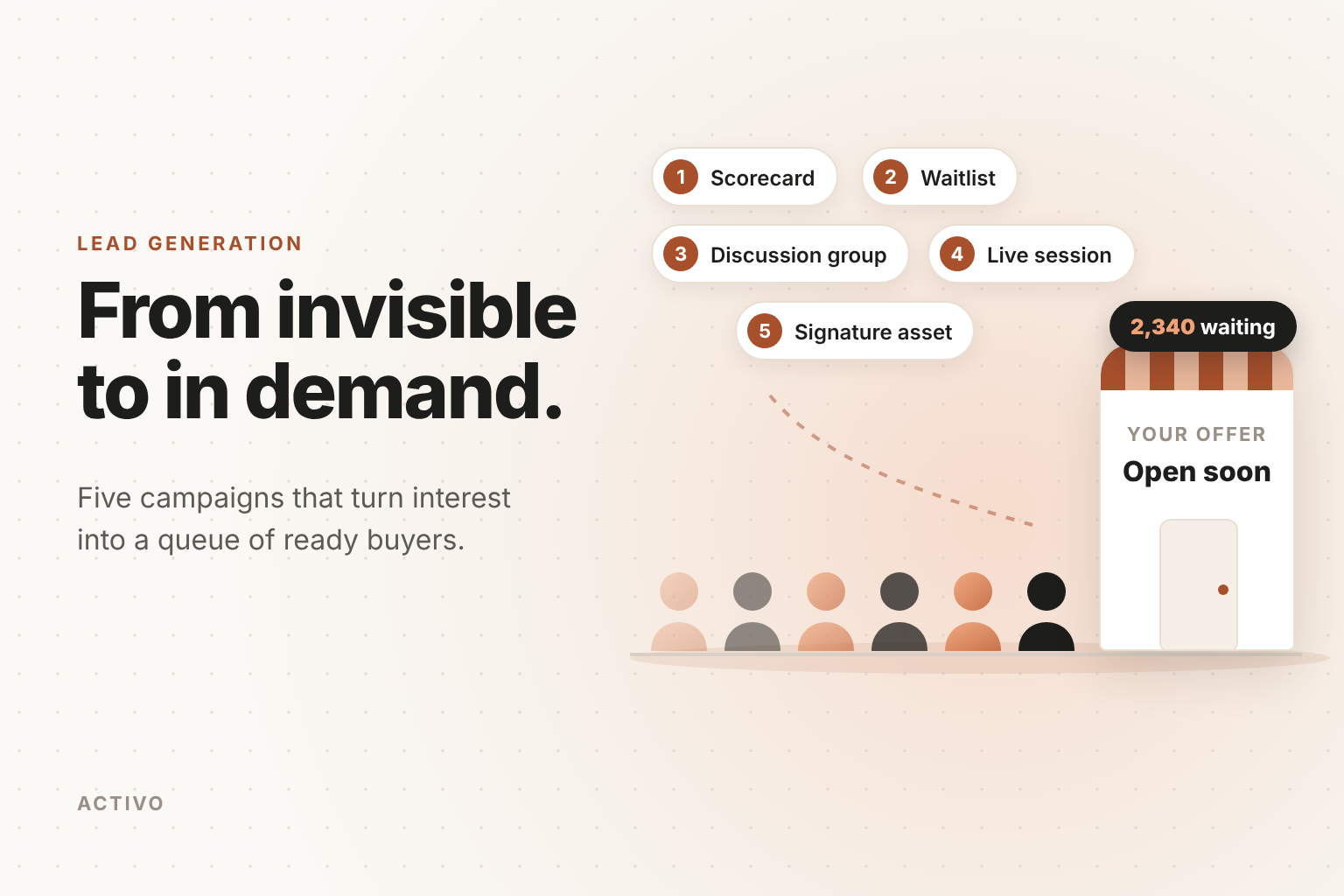
The best lead generation does not feel like selling. It collects signals: people taking a scorecard, joining a waitlist, applying to a group or turning up to a session. Those signals tell you who has the problem, how badly and what they will pay. In 2026 there is a second reason to work this way. Buyers now do most of their research alone, often inside an AI chatbot, before they ever speak to you. This guide covers five campaigns every founder should run, the latest data on how buyers find vendors through content, social, video and AI search, worked examples and a 30-day plan. Updated October 2026.
The idea behind it: signals before sales
This approach draws on Daniel Priestley’s work with founders. Three principles make it work.
| Principle | What it means | What to do |
|---|---|---|
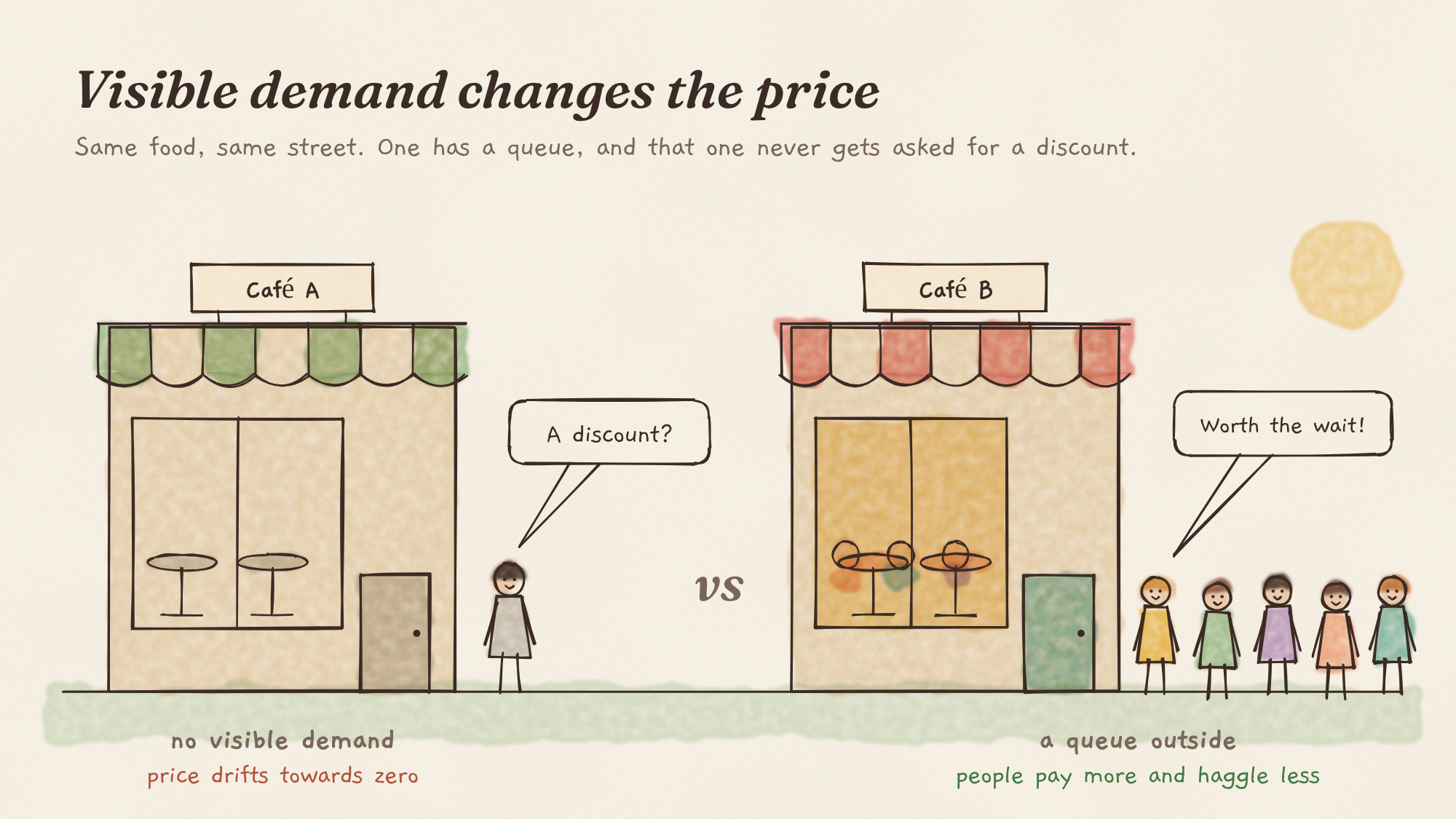
| Price follows visible demand | Digital supply is close to unlimited, so without visible demand, prices drift towards zero | Show the queue: waitlist numbers, sold-out sessions, limited cohorts |
| Ask for a signal first | People will happily raise a hand long before they are ready to buy | Lead with a scorecard, waitlist, group or session, not a sales call |
| Leads are an asset | A list with useful answers attached is worth more than a list of emails | Ask questions about stage, pain, budget and timing at every step |
A business with more leads than it can handle can fix almost anything else. A great product nobody hears about is worth very little.
What changed: buyers decide before they talk to you
Buyers have taken control of the process. 6sense found that buyers first contact sellers 61% of the way through their journey, down from 69% in its earlier studies, and 94% have already ranked their shortlist by then. They buy from the vendor they ranked first 77% of the time. Gartner found 61% of B2B buyers would rather buy without a sales rep at all. And G2’s 2026 survey of 1,076 software buyers found 51% now start in an AI chatbot, 69% picked a different vendor than planned because of chatbot advice, and about a third bought from a vendor they had never heard of before.
What this means for you: your campaigns have to reach people while they are still researching, and give them a reason to raise a hand before they have chosen. That is exactly what the five campaigns below are built to do.
| Old playbook | 2026 reality | What to do instead |
|---|---|---|
| Rank on Google and wait for clicks | AI summaries answer the question, and fewer people click | Become the source AI answers quote, and capture visitors with a scorecard |
| Gate a PDF behind a form | Buyers research alone and avoid forms that feel like a sales trap | Offer something useful in return: a personal score, a seat, early access |
| Cold email at volume | Average reply rates sit around 3% | Reach out when someone shows a signal, with context from their answers |
| Brand posts from the company page | Buyers follow people, and video is growing fast on LinkedIn | Founder-led posts and short videos, with a clear next step |
The five campaigns at a glance
| Campaign | Best for | Signal you collect | 2026 upgrade | Metric to watch |
|---|---|---|---|---|
| 1. Scorecard | Any business with a diagnosable problem | Stage, pain, budget, timing | AI-personalised results report | Start-to-lead rate |
| 2. Waitlist | New products, launches, limited capacity | Intent and demand size | Referral queue and cohort releases | Sign-ups and referrals per sign-up |
| 3. Discussion group | Problems people talk about with peers | Language, objections, trust | Content and AI-citable answers from real questions | Active members and applications |
| 4. Recurring live session | Considered purchases that need education | Attendance and questions asked | Recorded, clipped and repurposed as short video | Show rate and calls booked |
| 5. Signature asset | Authority in a niche | Downloads plus scorecard completions | Original data that AI answers and press cite | Citations, mentions and leads |
1. Scorecards: diagnose the problem, collect the data
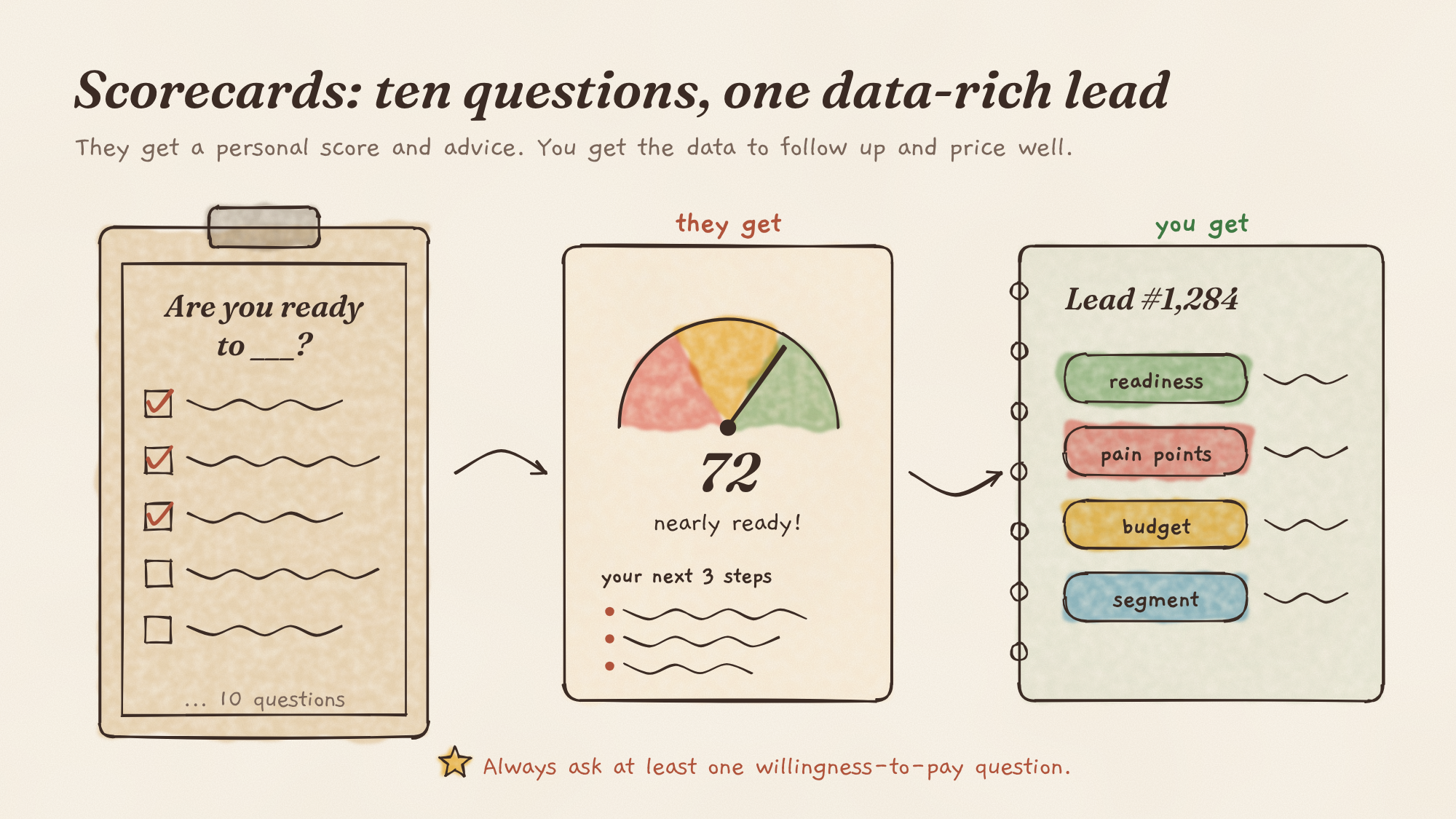
A scorecard is a short quiz with a clear promise: ‘Are you ready to X? Answer 12 questions to find out.’ The person gets a personal score and advice. You get structured data on their situation. It works because it gives value first and feels like help, not a sales form. Interact’s 2026 benchmarks across its quiz customers show 65% of people who start a quiz finish it, and 40.1% leave their contact details.
- Ask 10 to 15 questions: most about their situation, two about goals, one about budget and one about timing.
- Split results into three tiers, each with a different next step: a guide, a live session invite, or a call.
- Use AI to turn answers into a short personalised report the moment they finish. Then edit the template in your own voice.
- Send every answer to your CRM, so follow-up emails and sales calls start from what the person told you.
Example: a cybersecurity startup runs ‘Is your company ready for an ISO 27001 audit?’ Low scorers get a checklist and an invite to the monthly live session. High scorers with budget and a deadline get a call within 24 hours. Answers also show which gaps are most common, which becomes next quarter’s content plan.
2. Waitlists: prove demand before you build
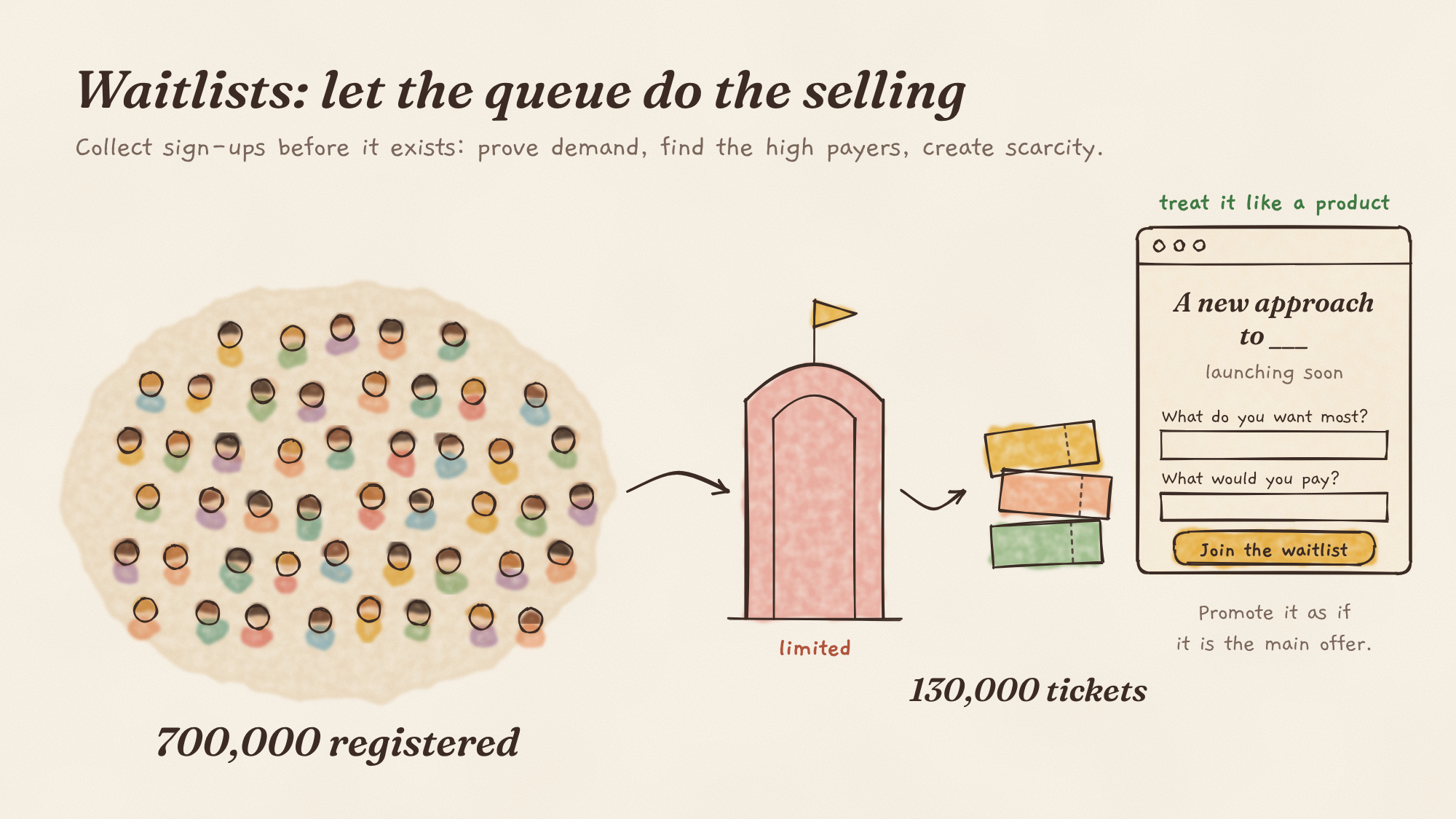
A waitlist turns interest into a visible queue. Robinhood is the classic case: a simple sign-up page showed people their place in line and moved them up when they referred friends. It reportedly drew 10,000 sign-ups on day one and close to a million people before launch. Glastonbury uses the same tension at scale, with far more people registered than tickets available.
- Treat the waitlist page as the product: a clear promise, who it is for and why joining early is worth it.
- Ask two or three questions: their role, the problem they most want solved and what they would pay.
- Show each person their position and let referrals move them up. Publish the count once it is meaningful.
- Let people in by cohort, starting with the segment that answered highest on budget and urgency.
Example: an AI scribe for veterinary practices opens a waitlist before the product is finished. Sign-up answers show multi-site practice groups will pay three times what solo vets will, so the first cohort and the pricing page are built for them.
3. Discussion groups: own the problem, not just the solution
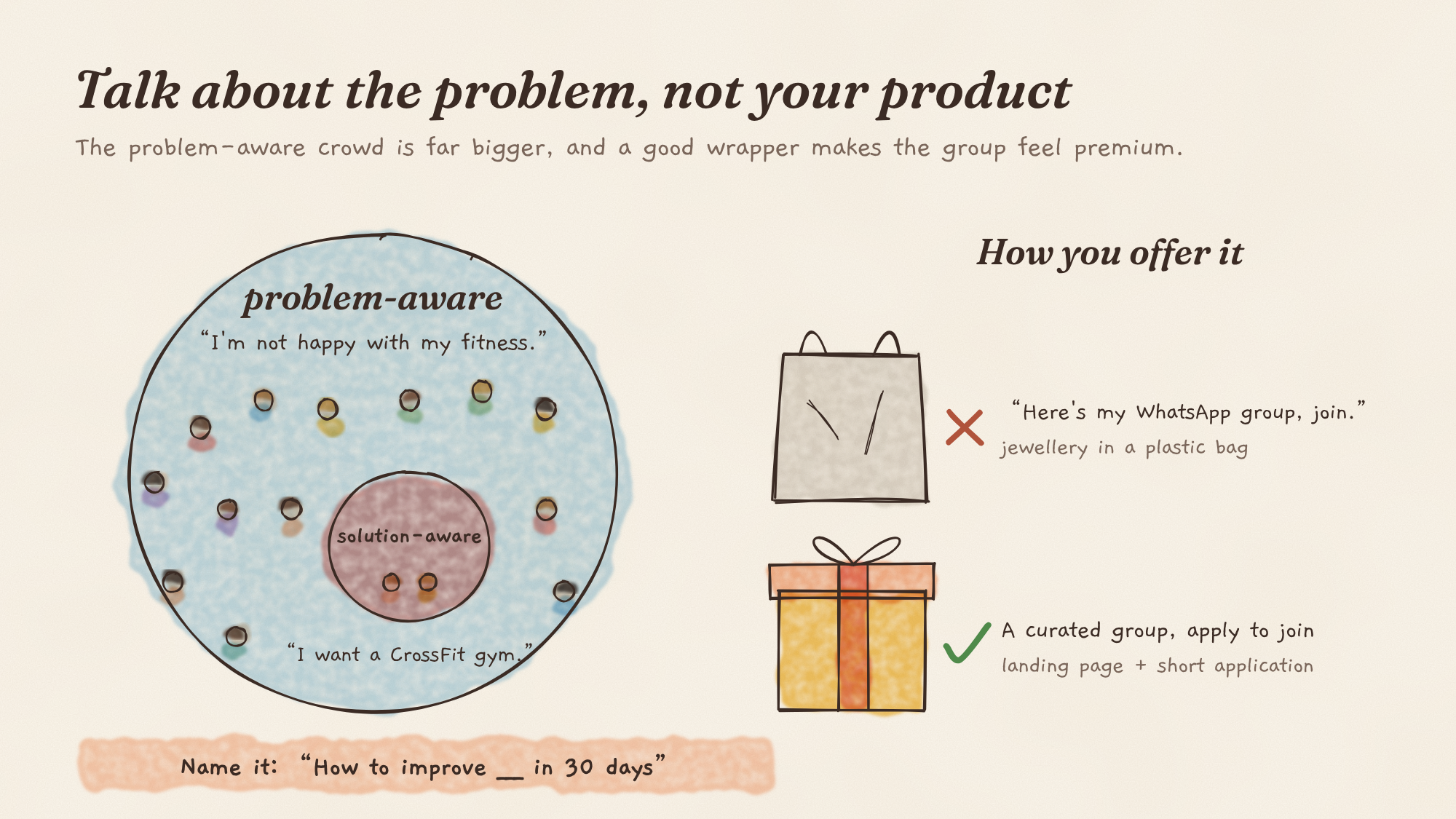
Far more people know they have a problem than know which solution they want. ‘I am unhappy with my fitness’ is a much bigger audience than ‘I want a CrossFit gym’. A discussion group gathers the bigger, problem-aware audience around an improvement goal, so you hear their language, test ideas and build trust long before you sell.
- Name it around progress: ‘How to cut your cloud bill 20% in 30 days’ beats ‘Acme Customer Community’.
- Make people apply with three short questions. It raises perceived value and gives you data.
- Host it where your buyers already are, such as LinkedIn, Slack or WhatsApp, and post one useful prompt a week.
- Turn the most common questions into public answer pages. These are the long-tail, specific pages AI tools tend to cite.
Community platforms matter for AI visibility too. In Similarweb’s analysis of US ChatGPT answers in early 2026, Reddit was the second most cited domain after Wikipedia. Real expert answers in the communities your buyers read can surface in AI answers, but promotional posting gets ignored or removed.
4. Recurring live sessions: educate once, sell every month
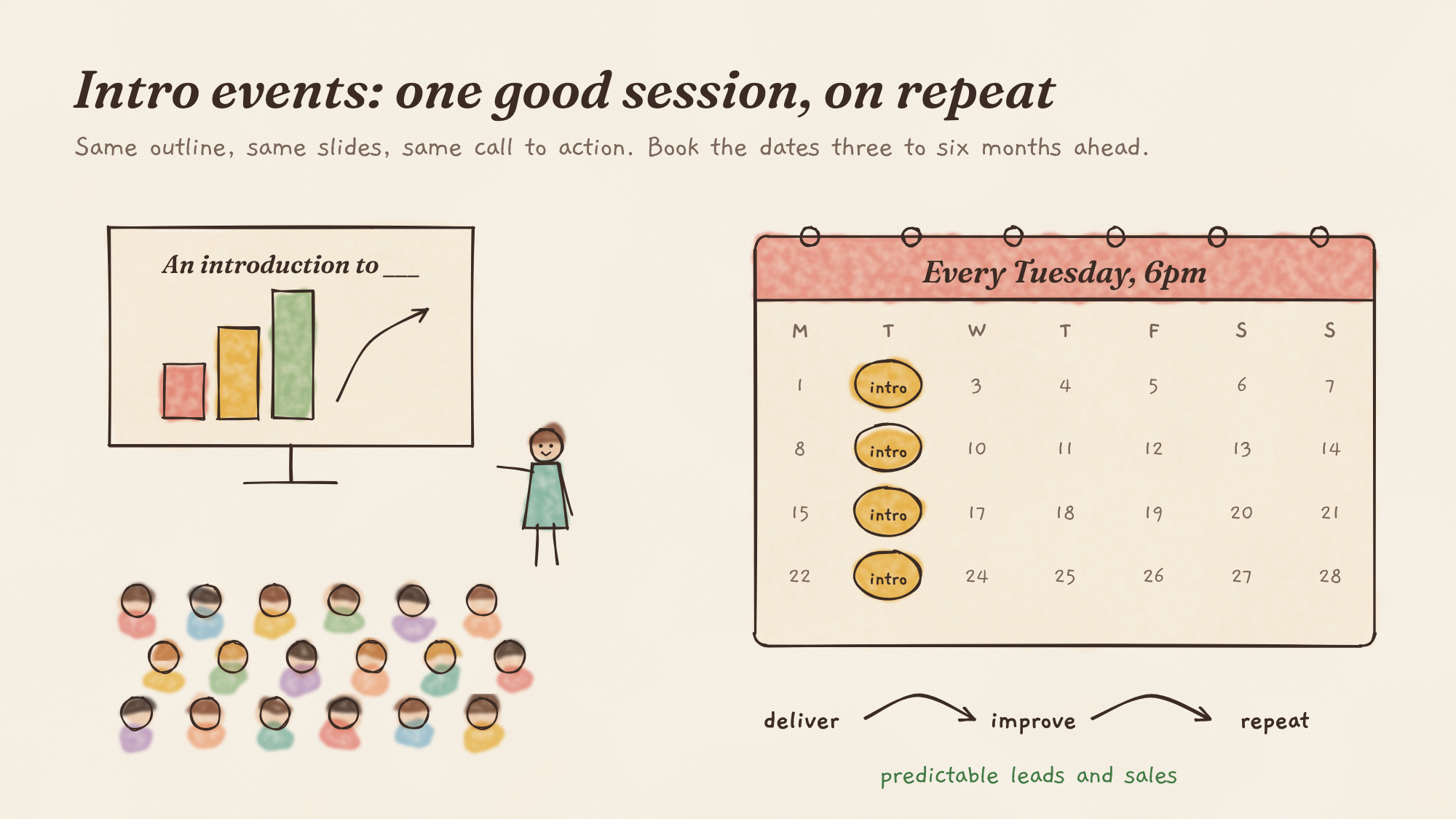
Most buyers want a low-risk introduction before a sales call. A repeatable session, ‘An introduction to X: how to get Y faster and cheaper’, gives them that. Run the same session on the same day every month and you get better at it each time, and lead flow becomes predictable. Priestley tells of a financial planner who ran weekly boardroom sessions for years and eventually sold the business for $30m.
Live video now does double duty. Wistia’s 2026 State of Video report found around 40% of webinar registrants attend, and a third of webinars still draw views three months later. Long videos also hold attention: on websites, videos over 30 minutes had a 37% play rate against 24% for videos under a minute.
- Fix the date for the next six sessions and promote them from every scorecard result and waitlist email.
- Cover the landscape first: the market, common mistakes and the options. Then show where your approach fits.
- Record it. Cut five to ten short clips for LinkedIn and YouTube, and turn the transcript into an article.
- Follow up within a day, using what each person asked to tailor the offer.
Example: a payroll startup runs ‘UK payroll for your first 10 hires’ on the first Tuesday of each month. Each session produces a long recording, six short clips and an FAQ page, so one hour of work feeds the content calendar for a month.
5. A signature asset: a book or original research
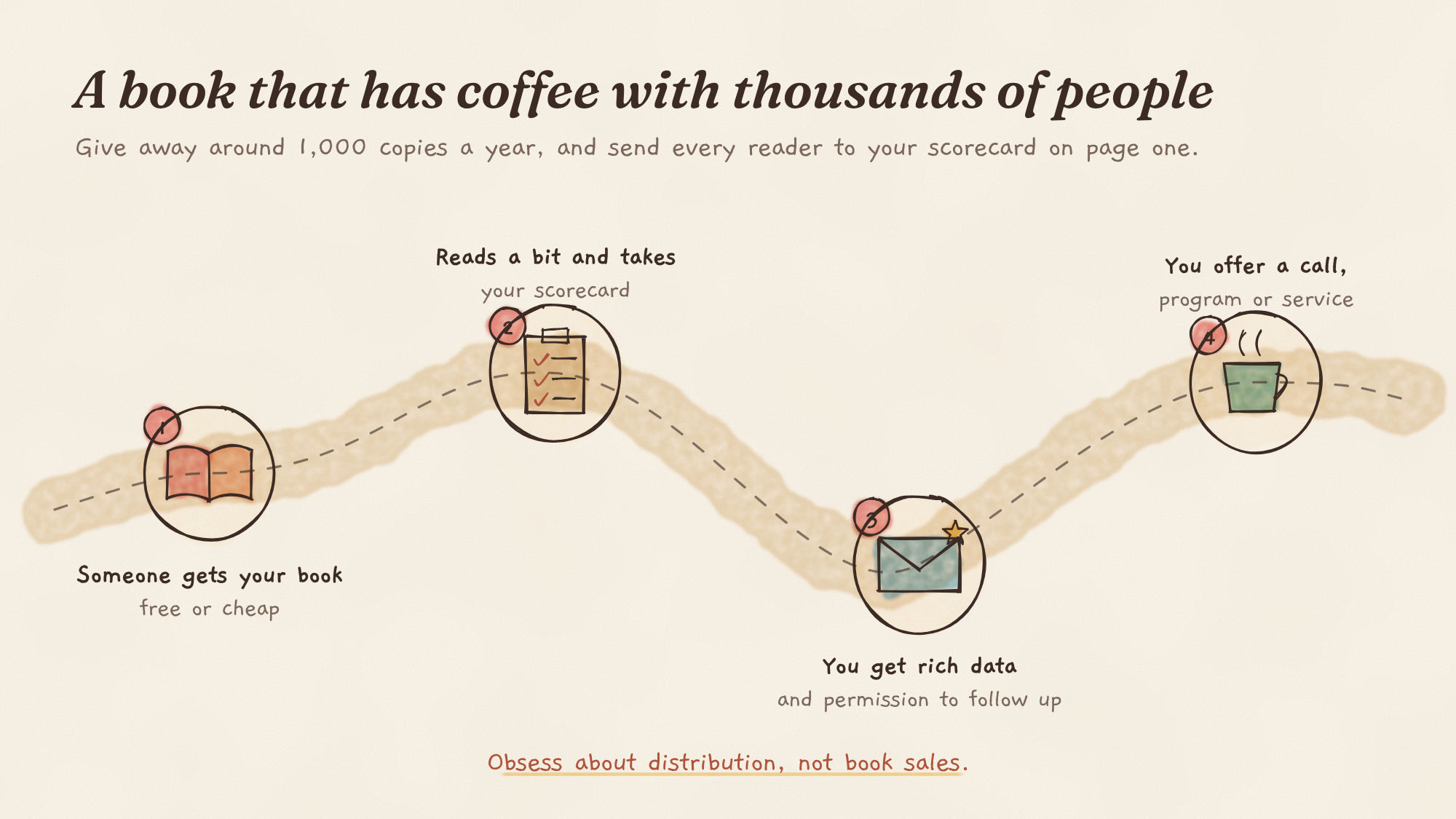
A book still works as a relationship engine. It makes you ‘the author of’, and it can have coffee with thousands of people you will never meet. The money is not in book sales. Give away around 1,000 copies a year to the right people, and send readers to your scorecard on page one.
Original research is the 2026 version of the same idea, and it is quicker to make. A ‘State of X’ report built from your product data or a survey of 200 customers gives journalists, LinkedIn and AI answers something to quote. The Edelman and LinkedIn 2025 thought leadership study found 79% of buyers are more likely to champion a vendor in a buying process if it consistently publishes quality thought leadership.
Be found: content and AI search
Search is changing under every content strategy. Pew Research tracked nearly 70,000 Google searches and found people clicked a result on 8% of searches with an AI summary, against 15% without one, and clicked a link inside the summary only 1% of the time. Fewer clicks reach websites, but the visitors who do arrive are further along. At Ahrefs, AI search brought 0.5% of visitors but 12.1% of sign-ups over 30 days in mid 2025.
| Do this | Why it works | Example |
|---|---|---|
| Write one page per real buyer question | AI tools cite specific, single-topic pages more than home pages | ‘How much does SOC 2 cost for a 20-person startup?’ |
| Lead with numbers, quotes and sources | The GEO study found these raised visibility by about 27 to 41% | Benchmarks from your own product data |
| Publish honest comparison pages | Buyers ask chatbots to compare vendors, and comparison prompts pull from these pages | ‘Acme vs Rival: which suits a seed-stage team?’ |
| Be present where AI reads | Reddit, YouTube and LinkedIn are among the most cited sources | Founder answers in relevant threads, clipped talks on YouTube |
| Track AI as a channel | Analytics undercounts it, because many people never click | Add ‘ChatGPT or another AI assistant’ to your how-did-you-hear question |
Show up: social and video
Buyers follow people more than logos, and video is where attention is growing. LinkedIn reported video uploads up 36% year on year in early 2025, with video creation on the platform doubling. In Wistia’s 2026 survey, 81% of businesses named LinkedIn their main video channel, ahead of YouTube at 76%, a jump of 33 points in two years.
| Channel | Role in your lead engine | What works now | Cadence |
|---|---|---|---|
| Founder LinkedIn | Reach buyers while they research | Opinions backed by data, customer stories, short talking-head videos | 3 posts a week |
| YouTube | Search, depth and AI citations | Full session recordings, how-to guides, product walkthroughs | 2 videos a month |
| Short video clips | Spread the best ideas from long content | 60 to 90 second clips with captions and one clear point | 1 to 2 a week |
| Email newsletter | Nurture the list you are building | One useful idea, one data point, one invite | Weekly or fortnightly |
| Communities | Trust and real questions | Helpful answers, no links unless asked | Daily, 15 minutes |
Every post needs a next step. Point social content at the scorecard, the waitlist, the group or the next live session, not at a demo request. That turns attention into a signal you can act on.
Follow up on signals, not lists
Outbound still works when it is triggered by a signal. Instantly’s 2026 benchmarks put the average cold email reply rate at 3.43%, with top performers above 10%. The difference is mostly relevance and timing. A message that refers to someone’s scorecard result or the question they asked in your session is not cold.
| Signal | What it tells you | Next step |
|---|---|---|
| High scorecard result with budget | Ready and able to buy soon | Personal email or call within 24 hours |
| Attended a live session and asked a question | Engaged and specific need | Reply to their question with a tailored offer |
| Referred others to the waitlist | Strong advocate | Early access, then a case study or referral offer |
| Visited the pricing page twice | Comparing options | Send a comparison page or offer a short call |
| Active in the discussion group for a month | Trusts you | Invite to a cohort, pilot or paid workshop |
AI agents can now research accounts, draft first emails and route leads, which makes signal-based follow-up practical for a small team. Keep a person on the message itself. Buyers can tell when nobody read their answers.
Benchmarks to aim for
| Metric | Benchmark | Source |
|---|---|---|
| Quiz completion (finish after starting) | 65% | Interact, 2026 |
| Quiz start-to-lead (leave contact details) | 40.1% | Interact, 2026 |
| Webinar attendance | About 40% of registrants | Wistia, 2026 |
| Cold email reply rate | 3.43% average, 10%+ top performers | Instantly, 2026 |
| Point of first contact with sellers | 61% through the buying journey | 6sense, 2025 |
Examples: how different startups can run this
Expense management tool
Campaigns: ‘How audit-ready are your expenses?’ scorecard, monthly live session for finance leads.
AI search: answer pages for every policy question finance teams ask, with real benchmarks.
Measure: scorecard leads per week and calls booked from the session.
Language learning app
Campaigns: ‘What is your real level?’ quiz, and a referral waitlist for a new AI tutor.
Social: short videos of learners before and after, posted by the founder.
Measure: referrals per sign-up and conversion from waitlist to paid.
Growth or design agency
Campaigns: an annual ‘State of X’ report from 200 client interviews, plus a curated founder group.
Content: each finding becomes a LinkedIn post, a clip and a quotable stat.
Measure: report downloads, group applications and inbound briefs.
Freelance or services marketplace
Campaigns: two waitlists, one for buyers and one for suppliers, released in matched cohorts.
Community: a supplier group on improving win rates, which also shapes product features.
Measure: time to first match and repeat bookings.
Industrial AI startup
Campaigns: a paid readiness assessment for plant managers, then a pilot offer.
Video: recorded site walkthroughs on YouTube and LinkedIn that show the problem.
Measure: assessments sold and assessment-to-pilot conversion.
Accountant or advisory firm
Campaigns: a short book given to 1,000 founders a year, with a scorecard on page one, and a weekly intro session.
AI search: clear answers to common tax questions, updated every year.
Measure: scorecard completions from book readers and session-to-client rate.
Your 30-day lead engine plan
- Days 1–3: Pick one buyer and one problem. Write the promise in a sentence: who it is for, the result and the time frame. Add ‘ChatGPT or another AI assistant’ to your how-did-you-hear question.
- Days 4–10: Build the scorecard. Write 12 questions, three result tiers and an AI-personalised results page. Connect answers to your CRM and set up a three-email follow-up for each tier.
- Days 11–14: Add a waitlist or group. Link it from the results page. Ask two or three qualifying questions and show people their place or their application status.
- Days 15–21: Publish content built to be found. Write five answer pages for your buyers’ top questions, each with a number, a quote and a source. Post three founder videos on LinkedIn pointing to the scorecard.
- Days 22–26: Run your first live session. Fix the next five dates. Record it, cut five clips and turn the transcript into an article.
- Days 27–30: Follow up and review. Contact every high-signal lead personally. Check start-to-lead rate, show rate, calls booked and AI mentions, then double down on whatever produced the best leads.
Closing thought
Buyers now make up their minds in private, often with an AI assistant at their side. The founders who win are the ones whose answers get quoted, whose scorecards get taken and whose sessions fill up. Start with one problem and one scorecard, show the demand you create, and you will move from chasing customers to managing a queue.
Want help running these campaigns? Growth Mindset plans, tests and scales the campaigns that fill your pipeline, from organic content to paid. Explore Growth Mindset →
We help founders design the campaigns, content and AI-ready answers that bring in qualified leads, and set up the systems to follow up on every signal.
Explore ActivoCEO Get in touchSources: Demand Gen Report on G2 AI search research · CustomerThink on the 6sense buyer study · Gartner, rep-free buying survey · TechCrunch on ChatGPT users · Sistrix on the Pew AI summaries study · Ahrefs, AI search conversions · GEO: Generative Engine Optimization · Similarweb, most cited domains by LLMs · TechCrunch on LinkedIn video · PPC Land on the Wistia 2026 video report · Demand Gen Report on Edelman and LinkedIn research · Interact, quiz conversion report · lemlist on 2026 cold email benchmarks · Prefinery on the Robinhood waitlist.