The “build it, and they will come” era of software has officially ended. Today, AI startups face a brutal paradox: they are creating more value than any previous tech generation, yet many are struggling to capture a fraction of it. The most common error? Treating pricing as a downstream task to be “figured out” after achieving scale. In a world where AI agents can replicate 2-year-old codebases overnight, startups often rely on the false security of their technical head start, only to find themselves trapped in “negative margin” growth or training customers to expect “insane value for less.”
The Myth of the Technical Moat
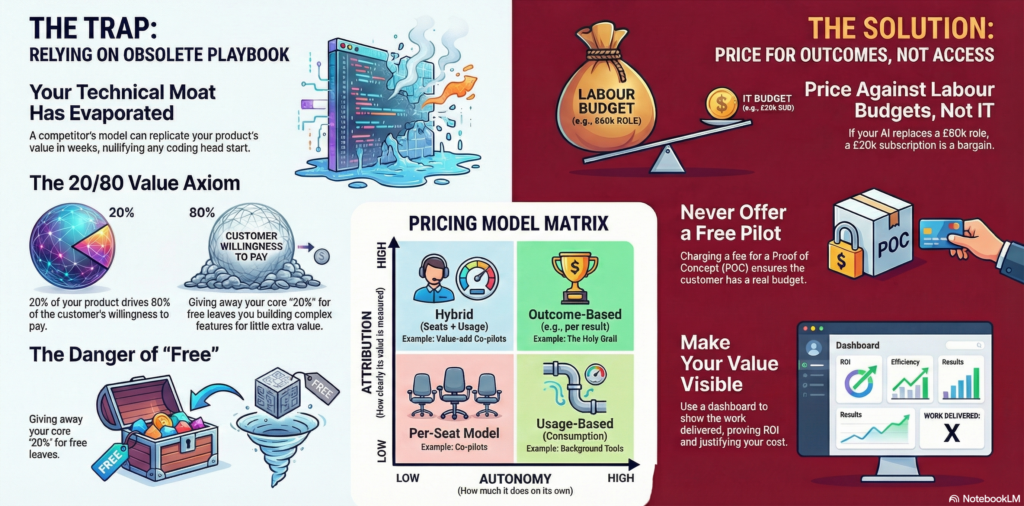
For decades, a two-year coding head start, or a piece of proprietary IP, was considered a defensible moat. In the AI era, that advantage has evaporated. If a competitor’s model can replicate your product’s value in weeks, your only true defensibility lies in your Go-To-Market (GTM) strategy—specifically, your monetisation model. You cannot rely on intellectual property when the cost of software creation is trending toward zero. Your moat is now built on proprietary data, network effects, and a pricing strategy that aligns perfectly with the work delivered, not just the software provided.
The 20/80 Axiom: Don’t Give Away the Farm
One of the most dangerous traps for AI founders is the 20/80 Axiom: 20% of what you build drives 80% of the willingness to pay. Ironically, that 20% is often the easiest to make (the “Minimum Viable Product”). When founders give this away for free to “disrupt” the market, they inadvertently give away the most valuable part of their business. They are then left to build the remaining 80%—the hardest, most complex features—which drive only 20% of the additional value.
Rethinking the Framework: Autonomy vs. Attribution
To price correctly, you must map your product on the Autonomy vs. Attribution matrix:
- Low Autonomy/Low Attribution (Co-pilots): Stick to the traditional per-seat model.
- High Autonomy/Low Attribution (Background Tools): Pure usage-based (consumption) pricing is best.
- Low Autonomy/High Attribution (Value-add Co-pilots): Use a hybrid “Seats + Usage” model (e.g., base fee plus AI credits).
- High Autonomy/High Attribution (The Holy Grail): Outcome-Based Pricing. This is where you charge for the specific result (e.g., $1 per resolved support ticket).
Innovative Pricing Ideas for Your AI Product
To move beyond commoditization, consider these emerging pricing strategies:
- Labour Budget Displacement: Don’t price against IT budgets; price against labour. If your AI replaces a $60k/year role, a $20k/year subscription is a bargain.
- The “Lego” Credit System: allows users to buy credits that apply across different agents or tasks, providing flexibility while ensuring every “inference” is monetised.
- Tiered Success Fees: For AI that generates revenue (e.g., sales outreach), take a percentage of the “found money” or recovered costs.
Summary: Stop Playing the “Disruptor” Game
Startups cannot survive by being “community builders” who never charge or “disruptors” who sell for $1 when it costs $0.80. Real success comes to the Profitable Growth Architect—someone who pays equal attention to market share (acquisition) and wallet share (monetisation).
Action Plan: Your Pricing-First Checklist
Don’t let pricing be an afterthought. Follow this 90-day action plan to ensure your AI product is built to last:
- Identify Your Quadrant: Map your product’s level of autonomy and attribution today. Are you a co-pilot or an agent?
- The “Expensive” Test: Conduct willingness-to-pay interviews. Ask potential customers what price is “acceptable,” “expensive,” and “prohibitively expensive.” Aim for the “expensive” bracket to signal value.
- Charge for your POC (Proof of Concept): Never do a free pilot. Charging even a nominal fee filters out “tyre kickers” and ensures the customer has a budget.
- Pivot POCs to Business Cases: Frame every pilot as a joint exercise to prove ROI. If you can’t show how you save time or make money in 90 days, you don’t have a product-market fit.
- Build an Attribution Dashboard: Make the value your AI provides visible. If the customer can’t see the “work delivered” on the dashboard, they will eventually see your invoice as a cost to cut.
- Audit Your 20%: Ensure you aren’t giving away your most valuable features for free. If it drives 80% of the value, it must be part of the core monetisation.
Conclusion: Pricing is not a math problem; it’s a psychology and strategy problem. By shifting from “access to software” to “payment for work,” you align your destiny with your customer’s success. Start pricing for the value you create, or someone else will.