For a modern founder—especially one building with AI and agentic technologies—understanding network effects isn’t optional. It’s the mathematical architecture of value.
Most founders talk about “viral growth,” but there’s a critical distinction:
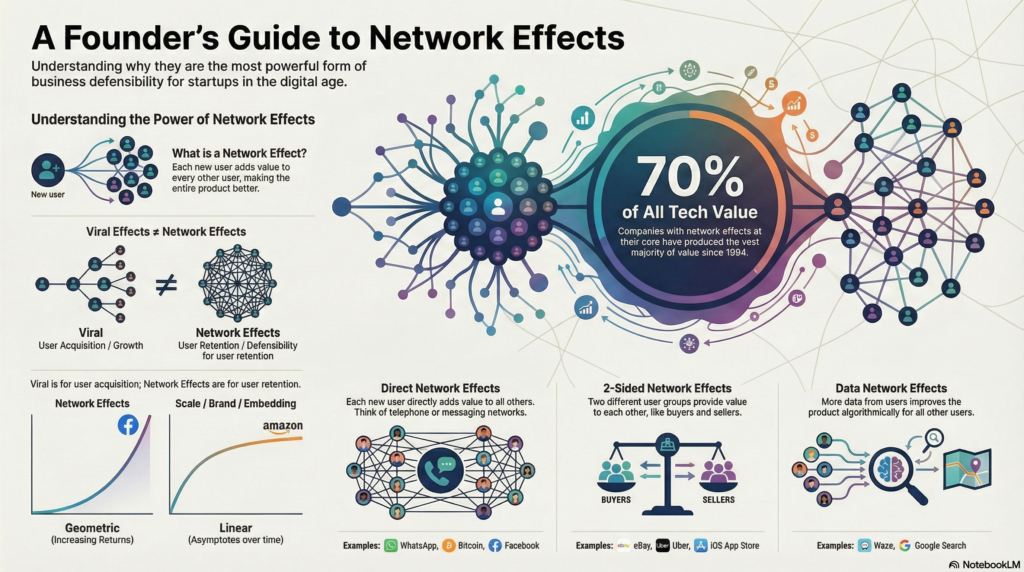
- Virality is about acquisition (how users bring in more users).
- Network effects are about retention and defensibility (why users stay, and why competitors struggle to copy you).
If you only have virality, you can grow fast… and churn just as fast. If you have real network effect, each new user makes the product more valuable to existing users—creating compounding value and a durable advantage.
The 4 defensibilities left in the digital age
As digitisation erodes old moats (distribution, geography, capital), there are only a few defensibilities that matter long-term:
- Scale: unit economics and cost advantages at volume
- Embedding: complex to rip out of workflows once adopted
- Brand: psychological preference and trust
- Network effects: the product gets more valuable as more users join
Of these, network effects are the most powerful because they can increase value geometrically while costs often rise linearly.
What a network effect really is (and why it compounds)
A network effect exists when every new user increases the value of the product for existing users.
This is why network-effect businesses can win markets decisively: the leader’s product improves simply by growing, and switching away feels like a loss of value.
The network math founders should know.
These “laws” are mental models for how value can scale:
- Sarnoff’s Law (linear): value grows with each new node (1 → 1).
Typical for broadcast-like products. - Metcalfe’s Law (quadratic): value grows with the square of nodes (n²).
Typical for direct connections between users. - Reed’s Law (exponential): value can grow exponentially (2ⁿ) because users form sub-groups and clusters.
Typical for communities where groups, rooms, teams, and circles create dense value.
You don’t need perfect math to use this—just the idea that connections and clusters create compounding value.
Virality vs Network Effects (the founder’s mistake that kills retention)
Virality = growth
Virality is a mechanism where one user brings another:
- referrals
- invites
- sharing loops
- incentives
It’s about cheap customer acquisition.
Network effects = retention.
A network effect is a reason users stay:
- Their friends are there
- The marketplace has liquidity
- The data is better because everyone uses it
- The ecosystem is built on top of it
Without network effects, you can end up in what some call the “fresh produce” business: you must constantly manufacture new content/features to keep users engaged because they have no structural reason to stay.
Rule of thumb:
If growth stops and your product collapses, you likely had virality without defensibility.
The most important types of network effects (a founder’s map)
There are many variations, but these are the ones founders should intentionally design for.
A) Direct network effects (most potent)
These get stronger simply because more people join.
- Personal / identity networks: value comes from identity + audience + relationships
Examples: social graphs, creator-followers, professional presence. - Personal utility networks: daily dependency increases with adoption
Examples: messaging and coordination tools used across your circle. - Protocol networks: a standard that defines how nodes interact
If you own the protocol, you can own the network’s “language.” - Physical networks: value tied to physical connectivity
Infrastructure-style networks.
Founder takeaway: Direct network effects are powerful because users feel an immediate loss if they leave.
B) Marketplaces and platforms (liquidity = destiny)
- Two-sided marketplaces: supply ↔ demand
You’re effectively running two businesses at once. - Market networks: marketplace + social layer combined
Pros transact and maintain relationships in the same place. - Two-sided platforms: developers build for users (ecosystem)
The platform can “sleep” while others build value on top. - Asymptotic marketplaces: value rises early, then plateaus
Once a service hits “good enough” (e.g., short wait times), more nodes add less value.
Founder takeaway: Marketplaces are won by liquidity, not features. Platforms are won by ecosystem pull, not only product polish.
C) Data and tech performance effects (critical for AI)
- Tech performance networks: more usage improves speed/quality
Often tied to distributed systems or network learning. - Data network effects: the product gets smarter for everyone as users use it (details next).
Founder takeaway: For AI startups, “data” is only a moat if it forms a loop that improves everyone’s outcomes.
D) Social and psychological effects (outer rim, still real)
- Language effects: when your brand becomes a verb
Reduces mental friction; accelerates adoption. - Bandwagon effects: social pressure / FOMO
Adoption signals value. - Belief effects: value comes from shared belief at scale
Coordinated belief can be an economic force.
Founder takeaway: These can accelerate adoption, but they’re strongest when paired with a “core” network effect underneath.
The role of data: the 3 levels of defensibility (AI founders must not confuse these)
Many founders say “we have a data moat,” but they actually mean one of three different things:
1) True Data Network Effects (geometric value)
Usage automatically contributes data that improves the product for all users, often in real-time.
Signal: Users say, “This is valuable because everyone uses it.”
2) Data Scaling (linear value)
More data makes the product better over time—but not necessarily immediately, and marginal gains diminish.
Signal: The 1,000th data point helps less than the 10th.
3) Data Embedding (lock-in)
Your system holds critical operational data; switching is painful.
Signal: Retention comes from migration cost, not increasing network value.
Founder takeaway: Data embedding is robust, but it’s not the same as a network effect. The strongest AI defensibility is data network effects + embedding together.
The “Waze checklist” for real Data Network Effects
If you want actual data network effects (not just “we have a lot of data”), your product should match most of these:
- Automatic data capture: usage = contribution (no manual effort)
- Real-time value: the system updates quickly enough to matter
- No asymptote: value keeps growing (freshness matters continuously)
- Central to value: the data is the product, not a side feature
- Perceived network value: users feel that collective usage improves outcomes
Founder takeaway: If your data stops being valuable once preferences are known, you may hit an asymptote. If your domain constantly changes, you can build enduring loops.
Strategies to build network effects as a modern founder
1) Solve the chicken-and-egg problem
Networks often start empty. Three proven approaches:
- Single-player mode: deliver value to the first user alone
Tool-first, network-second. - Incentives: pay/credit/reward for early participation
- Focus on the hard side: in marketplaces, supply is often more complex than demand.
Secure supply, then demand follows.
2) Enter at the right “technology window”
New tech windows rearrange networks: costs drop, workflows change, and new behaviours become normal. Generative AI is one of those windows—use it to create a step-change in utility, speed, or outcomes.
3) Avoid becoming “fresh produce”
If your AI agent generates content, you might be forced into constant production to retain users. Transition toward:
- user-to-user interactions
- shared data loops
- ecosystems (plugins, templates, integrations)
- embedding into workflows
Founder checklist: “Do we have a real network effect?”
Use this as a quick self-test:
- Retention test: Do users stay because other users are there?
- Value test: Does value increase for existing users when new users join?
- Switching test: Does leaving mean losing connections, liquidity, or collective intelligence?
- Loop test: Does usage create data that improves outcomes for everyone (preferably fast)?
- Asymptote test: Does the value plateau once “good enough” is reached?
- Embedding test: Are we integrated into workflows so removal is painful?
- Ecosystem test: Can others build on top of us while we “sleep”?
If you can confidently answer yes to several, you’re moving from growth hacks to defensibility.
Conclusion: the goal for startups in the AI age
Virality can ignite growth. But network effects create enduring advantage—especially when paired with embedding and data loops. For agentic products, your north star isn’t “generate more.” It’s: Design interactions so the system becomes more valuable as the network grows—until your product becomes the default or an essential capability in your industry.