ActivoCEO · Raise & Value
ActivoCEO: Pitch Deck Assessment
One deck submission. A clear score, the right investors and a faster route to funding.
Find out how investors will read your pitch deck before you send it. ActivoCEO scores your deck against the questions angels and VCs ask, shows which investors are worth your time, and helps you submit with confidence.
- Pre-seed to Series A
- Investor-readiness score
- VC match summary
- Personalised decks
Raising investment takes longer than most founders expect
Getting a pitch deck right is hard. Getting it in front of the right investors takes even longer. Founders spend weeks perfecting slides, then more weeks submitting them to fund after fund. Most never reply. The few that do start a process of deeper review, partner presentations and due diligence that can run for months before an investment board makes its decision.
Build the deck
Drafting, redrafting and guessing what each investor wants to see.
Submit, one by one
Every fund has its own form, portal or intro route, and its own mandate.
Hear back
Most decks are ignored. Often only around 1 in 20 investors replies.
Deeper scrutiny
A partner reads the deck in detail, asks hard questions and takes a first call.
Present & diligence
Partner presentations, data room, financials, references and customer calls.
Investment board
Your champion has to persuade the partnership before anyone commits.
Every stage is a filter. Your deck has to earn the next conversation, often in under two minutes.
What investors are really looking for
Research into how angels and VCs decide points the same way: a strong deck has to be understood fast, and it has to make an investable case.
of VC firms say the team matters
In a survey of 885 venture capitalists, 95% of firms rated the management team as important, and 47% ranked it the single most important factor.
Gompers et al., Journal of Financial Economics, 2020to make a first impression
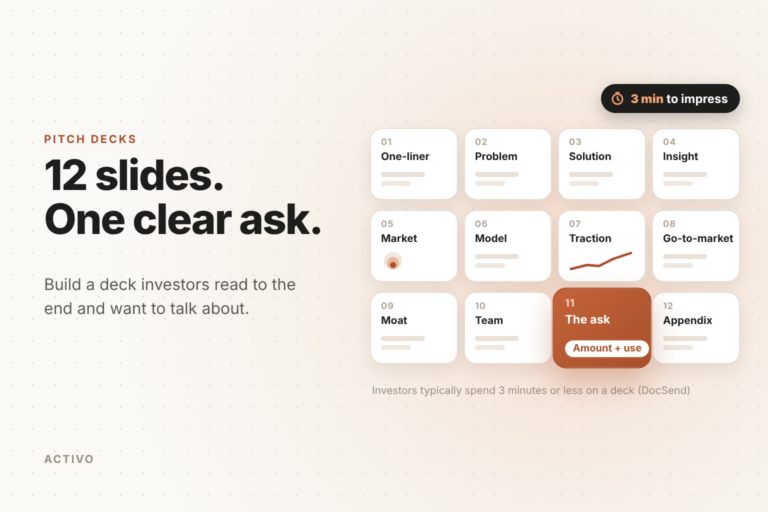
Average investor viewing time for seed-stage decks fell below two minutes in 2023. The first slides decide whether the rest gets read.
DocSend, 2023 seed-stage analysisreturn potential
Angels typically look for scalable companies that could return around ten times their investment. A deck that hides the upside rarely gets a second look.
Angel Capital AssociationBehind every slide, investors are testing five questions. How much weight each carries depends on your stage and the investor.
Opportunity
Is the problem important, and is the market big enough?
Advantage
Why will this company win against the alternatives?
Evidence
What proves customers want it and the model can work?
Execution
Is this the right team to build and scale it?
Returns
Can the investment deliver an attractive outcome at acceptable risk?
Clarity gets you read. Substance gets you funded. In a field trial with nearly 34,000 investors, better visual clarity and stronger business substance both increased the time investors spent on a deck, but only stronger substance raised their stated likelihood of investing (Blaseg & Mayer, 2024). ActivoCEO assesses both.
What if one submission did the heavy lifting?
Would you like to raise with less effort and better odds?
Save time, send a deck that resonates with investors, and target specific investors with the additional content they are looking for.
Save time
Stop rewriting and resubmitting blind. Know what to fix, and which investors are worth approaching, before you send anything.
A deck that resonates
Answer the questions investors actually ask, show off your founding team and make the 10× case clear from the first slide.
Target the right investors
Focus on investors whose stage, sector, cheque size and mandate fit, with extra content tailored to what each one wants to see.
Not raising yet? Refresh your deck every three months
Even when fundraising isn’t on the agenda, a quarterly deck refresh is one of the most useful habits a founder can build. It keeps you ready for the moment an opportunity appears, sharpens how you describe your vision and direction, and gives you an up-to-date record of progress to share with your team, board and existing investors.
You never know when circumstances will change.
Move when it matters
An investor reaches out, a competitor raises or runway shifts. You can act the same week.
Clarify your direction
Rewriting the story forces sharper choices about market, priorities and strategy.
Keep it current
Fresh traction, metrics and milestones, not last year’s numbers.
Track your readiness
Each quarterly assessment shows how your investor readiness is improving.
How the pitch deck assessment works: one submission, four outcomes
Send us your current pitch deck once. You get a clear assessment and an investor match summary, and you decide what happens next.
Assess
Get your assessment report
A scored review of how well your deck answers the key questions investors will ask.
- Scores on opportunity, advantage, evidence, execution and returns
- How well it promotes your founding team
- First impression: the two-minute test
- The 10× upside investors are looking for
- Prioritised fixes to raise your score
Match
See your investor match summary
How many VCs fit your company today, and how many more could.
- VCs that are a good fit now
- How many more would be interested in a personalised deck
- Which to skip: no fit with their mandate, stage, sector or cheque size
Your decision
Submit to matching VCs
Once your deck reaches the recommended score, choose to submit it to the investors that match.
- Only the investors you approve
- Sent when your deck is ready, not before
- Hours saved on forms and portals
Your decision
Personalise and reach more VCs
Choose to tailor your deck for more investors, adding the content each one is specifically looking for.
- Investor-specific emphasis and evidence
- Wider reach without a generic blast
- More of the right investors, not more noise
↺ Repeat every three months to stay investor-ready
What your assessment report looks like
A simplified example of an ActivoCEO report, for a fictional seed-stage company.
ActivoCEO · Sample report
Pitch deck assessment
Example Co. · B2B SaaS · Seed round · Raising £1.5m · 14 slides
Key investor questions
How well the deck answers what every investor asks.
Focus scores
The three things investors judge fastest.
Founding team
Founder–market fit comes through. The commercial lead and planned key hires are missing.
First impression
The value proposition first appears on slide 4. Lead with it on slide 1.
10× upside
No route from the first niche to a larger market, so the upside looks capped.
Investor match summary
412 VC funds screened against your stage, sector, geography and round size.
Good fit now
Stage, sector, cheque size and mandate all match.
Interested with a personalised deck
A good fit, but each wants extra evidence, such as unit economics or a sector angle.
Not worth your time
Wrong stage, sector, geography or cheque size for their mandate.
9% good fit now · 16% with a personalised deck · 75% to skip
Top fixes to reach 75+
Prioritised by the impact on your score.
- Move the value proposition and your strongest traction metric onto slide 1.
- Add a market-expansion slide showing the route from your first customer niche to the wider market.
- Link the £1.5m raise to three concrete milestones and an 18-month runway.
Illustrative example only. The company, scores and investor numbers are fictional. Your report reflects your deck, your round and current investor mandates. ActivoCEO improves your readiness and targeting; it cannot guarantee investment.
Questions founders ask
Who is the pitch deck assessment for?
Founders preparing to raise from angels or VCs, from pre-seed to Series A, and founders who want to keep an investor-ready deck up to date even when they aren’t raising.
Does a high score guarantee funding?
No. Investors back businesses, not slides. A high score means your deck clearly answers the questions investors ask and you’re approaching investors whose mandate fits. The strength of your business still decides the outcome, and your report shows where to strengthen it.
Will my deck be sent to investors automatically?
Never. You decide whether to submit, which investors to submit to, and whether to personalise your deck for more. Nothing is shared without your approval.
What do I need to get started?
Your current pitch deck as a PDF or PowerPoint, plus a few lines about your round: how much you’re raising, your stage and your timeline. You can attach your deck to the Get In Touch form.
How often should I update my deck?
Every three months. A quarterly refresh keeps your progress current, sharpens your story and means you’re ready if circumstances change. For help strengthening the team story investors look for, see Build the Right Founding Team.
Related services
Get investor-ready
Send us your deck. We’ll show you how investors will see it.
Share your current pitch deck and a few lines about your round. We’ll assess it, show you which investors fit, and help you decide what to do next.