Tech Talent Acquisition in 2026: Hiring for Capability, Execution and Human–AI Teamwork
A CV tells you where someone has been. It says far less about what they can deliver next.
In 2026 that gap matters more than ever. Companies need executives and technical specialists who can turn AI, data and modern engineering into measurable results, and who can work alongside AI agents rather than around them (Cornell CAHRS).
This article covers what has changed in tech hiring, which skills matter most, and a practical framework for hiring people and AI agents into the same team.
Why tech hiring has changed
AI adoption has moved on from experiments to redesigning how work gets done. Organisations are replacing fixed job descriptions with skills-based structures, deploying people according to what they can demonstrably do and how far they can grow.
Technology teams feel this first. Hiring is up across software development, technical management, IT operations, QA and entry-level technical roles, and fastest of all in AI (Linux Foundation). Supply hasn’t kept pace, so the competition for skilled people is sharpest in AI integration, cybersecurity and software engineering (Robert Half).
From job titles to capabilities
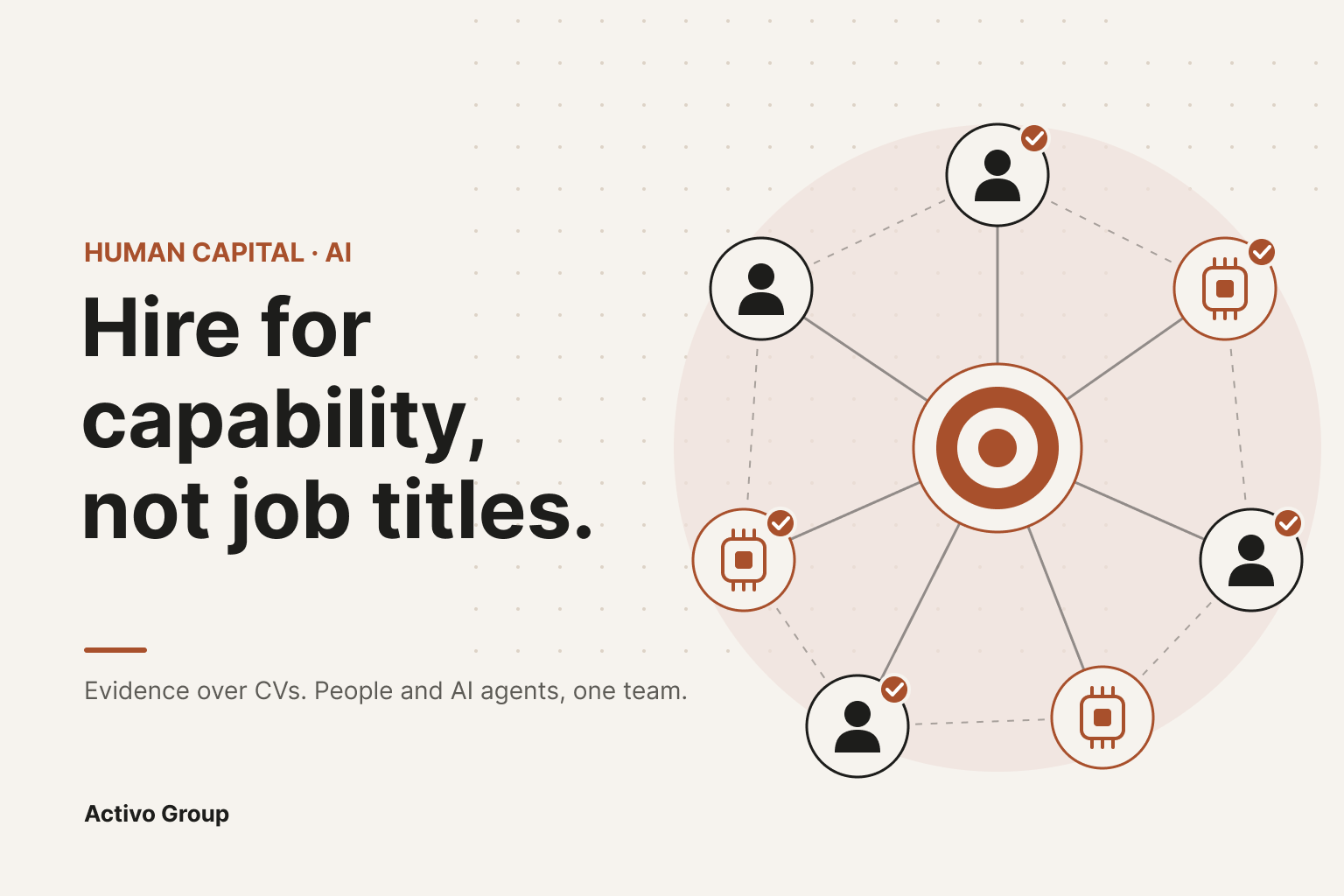
The old hiring question was: what role has this person held? The better question is: what can this person deliver, what evidence shows it, and how quickly will they learn the next thing?
A skills-based approach puts capabilities ahead of titles. It needs a clear skills map, visibility across teams, flexible deployment and continuous upskilling. It is fast becoming the thread that ties recruitment, onboarding, development, mobility and retention together (Randstad Digital).
| Hiring by title | Hiring by capability | |
|---|---|---|
| Starting point | A job title and description | The business outcome and the tasks behind it |
| Evidence | CV, years of experience, past employers | Work samples, simulations, portfolios, delivery history |
| Team design | Fixed roles in a hierarchy | People, contractors and AI agents assigned task by task |
| Success measure | Roles filled | Delivery speed, quality, adoption and business impact |
For technical and executive hires, look for evidence that someone has:
- Shipped products or systems into production
- Led delivery across functions
- Made sound trade-offs under uncertainty
- Turned business goals into technical execution
- Checked AI output critically instead of accepting it as given
- Built or led blended teams of employees, contractors and AI agents
This is why critical thinking tops the wish list. Korn Ferry found that 73% of talent leaders name critical thinking and problem-solving as the skill they most need in 2026 (Korn Ferry). AI can produce the output. People still have to judge its quality, risk, context and consequences.
How teams are being reorganised
AI is changing how work is organised as well as who does it. Instead of rigid job families, organisations are redesigning roles around tasks and deciding, task by task, whether a person or an AI system should do it (Aon). Four team shapes are becoming common:
- Product squads bring engineering, design, data, commercial and AI skills together around one outcome.
- Platform teams build the shared infrastructure, data pipelines, security controls and agent capabilities everyone else uses.
- AI enablement teams govern model use, prompt standards, evaluation, risk and adoption.
- Hybrid delivery pods mix employees, contractors, partners and AI agents to deliver at business speed.
The result is flatter and more networked. Performance reviews, rewards and governance need to follow, recognising skills, outcomes and adaptability rather than tenure or a fixed role definition (AIHR).
The skills in highest demand
Demand is spreading well beyond traditional software engineering. In 2025, job postings for AI, machine learning and data science more than doubled, and so did postings for security roles. Cybersecurity engineers alone accounted for 20,000 new postings (Robert Half).
Leaders, meanwhile, need to be fluent in both commercial strategy and technology delivery. The most effective executives can connect AI spending to revenue, margin, risk, customer experience and operating capacity.
Technical talent
- AI engineering and applied machine learning
- Data engineering, quality and governance
- Cloud architecture and platform engineering
- Cybersecurity, identity and secure AI deployment
- Systems integration and API design
- AI agent orchestration and evaluation
- Product engineering and user-centred delivery
Executive talent
- AI and data literacy at board level
- Workforce planning for human–AI teams
- Change management and adoption
- Vendor and platform strategy
- Governance, ethics and regulation
- Talent development and internal mobility
- Deciding well with incomplete or probabilistic information
AI is changing recruitment itself
Talent acquisition is going AI-first. Sourcing, screening, scheduling, candidate messages, CV rediscovery, background checks and onboarding logistics are increasingly automated (SHRM).
Buying more tools doesn’t fix hiring on its own, though. Most organisations have increased their spending, yet few can grow hiring volume without growing the recruiting team.
The model that works is human-in-the-loop AI. Automate the repetitive work, and keep human judgement for assessing candidates, aligning stakeholders, judging team fit, making senior appointments and protecting fairness.
Hiring people and AI agents into the same team
This is the thinking behind ActivoNEO: hire for both people and AI agents, and replace titles and CVs with capability backed by evidence. For people, that means skills verified through tests, work samples, portfolios and simulations. For AI agents, it means benchmarking task success, tool use, reliability, cost per task and guardrails.
Seven steps to build an AI-enabled team:
- Define the outcome first. Start with the business result, not the job title.
- Break the work into tasks. Decide which belong to people, which to AI agents and which to a hybrid workflow.
- Specify the evidence. Ask for portfolios, simulations, technical assessments or delivery case studies.
- Benchmark the agents. Measure accuracy, reliability, cost, speed and how they fail.
- Design the operating model. Agree decision rights, escalation paths and where humans oversee the work.
- Hire for adaptability. Prioritise learning speed, judgement and the ability to work across functions.
- Measure by outcomes. Track delivery speed, quality, adoption, cost and business impact.
The hires that unlock growth
For a growing company, the highest-return hires are rarely the biggest teams. They are the few people who unlock execution:
- A Chief AI or Data Officer who connects AI strategy to commercial value and governance.
- An AI engineer or agent-orchestration lead who gets reliable systems into production.
- A product leader who turns customer problems into prioritised, measurable delivery.
- A data engineering lead who builds data foundations people trust and use.
- A security and risk leader who enables innovation without exposing the business.
- A talent strategist who builds internal mobility, reskilling and a workforce model for people and agents.
The bottom line
Tech hiring is moving from volume to precision: fewer unvetted CVs and more validated capability, fewer rigid roles and more adaptable skills, less manual admin and more human judgement where it counts.
The organisations that win won’t simply hire more engineers. They will build an operating system for talent: one that identifies the capabilities they need, verifies them with evidence, puts people and AI agents where each works best, and keeps developing the workforce as the technology moves (Cornell CAHRS).
Where Activo can help
Whether you are hiring for your next stage or looking for your next role, these are good places to start.
ActivoNEO for employers
Tell NEO the outcome you need. It designs a lean, AI-native team structure, runs personalised search campaigns and introduces 5–10 evidence-backed, interested people, not 500 CVs.
Find your next hire →
ActivoNEO for talent
Get invited, not filtered out. Data-driven feedback on your CV and direct introductions to companies likely to want what you can do.
Get introduced →
AI models and agents
Design and build the agents that work alongside your people, with clear tasks, guardrails and a defined point where humans take over.
Build your agents →
ActivoCEO
The AI Outcome OS for founders and business owners. Set the outcomes and KPIs first, so every hire and every agent has a clear job to do.
Explore ActivoCEO →
Tell us the outcome you need and we’ll help you find the people, and the agents, to deliver it.
Talk to us about hiringExplore ActivoNEOSources: Cornell CAHRS; Linux Foundation Tech Talent Report 2026; Robert Half; Randstad Digital; Korn Ferry; Aon; AIHR; SHRM; Yahoo Finance.