Supply Chain Optimisation in the Age of AI: Why Adaptability Is the New Efficiency
For years, supply chain teams were judged on one question: how efficient is the plan? Lowest cost, leanest inventory, tightest routes.
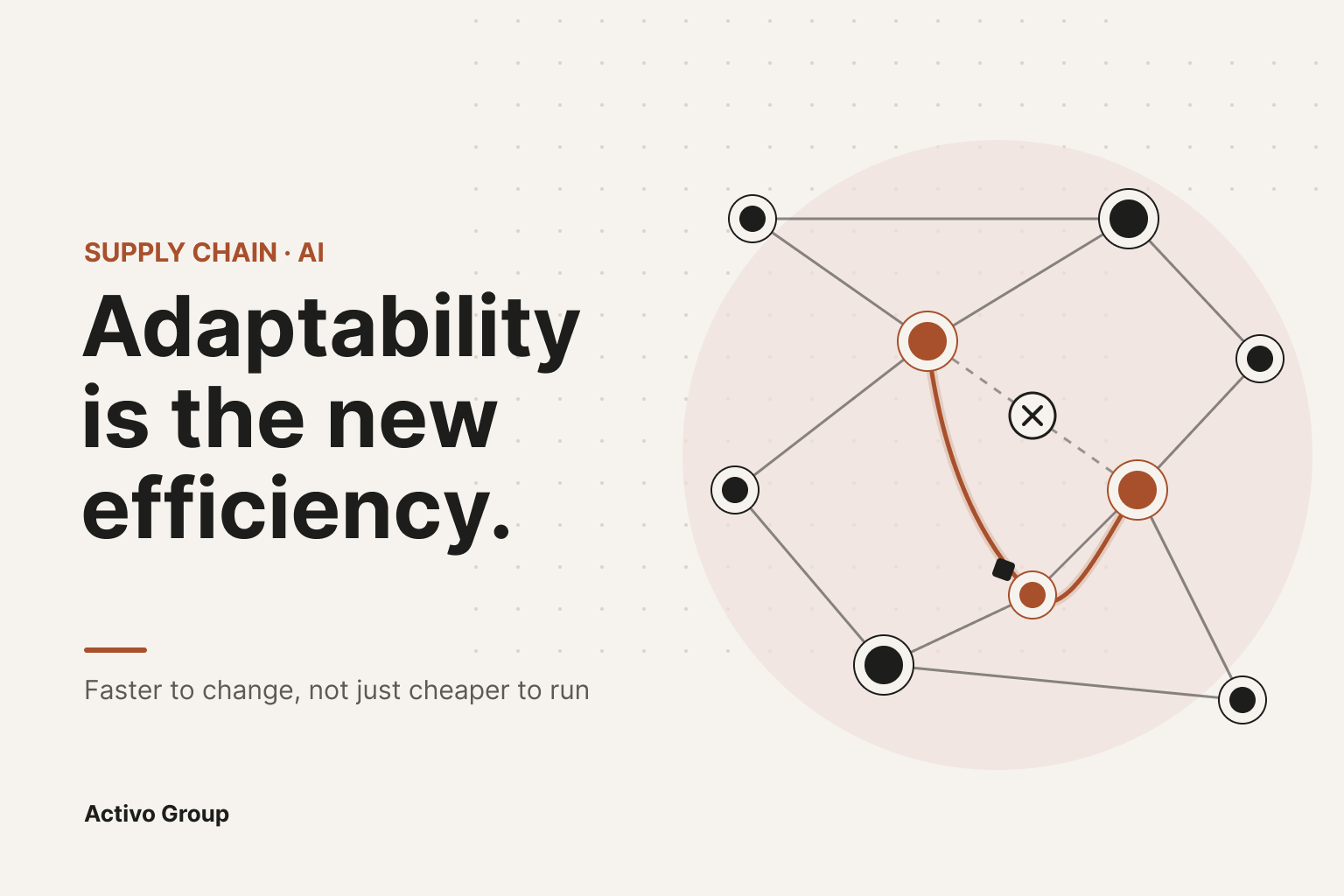
That question still matters. In 2026, though, a second one matters more: how quickly can the plan change when the world does?
AI is what makes that second question answerable. It lets a supply chain sense demand shifts earlier, rehearse disruptions before they happen and act on them in hours rather than weeks. This article looks at the technology behind that shift and the five design choices that turn an efficient supply chain into an adaptable one.
Why the old model is under pressure
Traditional supply chains were built around accurate forecasts, long planning cycles and cost minimisation. That works when demand is steady and supply is predictable. It struggles with what most businesses now face: geopolitical shocks, shifting trade policy, inflation, labour shortages and disruptions that recur rather than arrive once a decade (Yahoo Finance).
So companies are modernising around end-to-end visibility. The aim is to put procurement, production, inventory, logistics and customer demand into one decision environment, instead of letting each function optimise for itself and pass the problems to the next.
Optimisation and adaptability solve different problems
They aren’t rivals. They answer different questions, and each fails in its own way if you push it too far.
| Optimisation | Adaptability | |
|---|---|---|
| Core question | What is the most efficient plan? | How fast can we change the plan? |
| Focus | Cost, inventory, routes, capacity, service levels | Risk, resilience, speed, scenario response |
| Works best when | Demand is stable and supply is predictable | Demand is volatile and disruption, regulation or geopolitics keep changing the rules |
| Typical tools | Forecasting, routing, warehouse automation, inventory models | Digital twins, control towers, agentic AI, real-time visibility |
| Risk if overdone | Fragility: the “optimal” network has no slack | Cost creep: too much buffer, duplication or decentralisation |
The practical answer is adaptive optimisation. Use AI to find the most efficient plan, then design the network so that plan can be rewritten quickly when its assumptions break. That is why supply chain leaders now treat resilience and governance as part of the foundations, not an optional layer on top.
Five technologies changing how supply chains work
1. Demand sensing that changes decisions
AI forecasting models combine sales history with promotions, weather, market signals and other external indicators. They pick up changes earlier and say more precisely where stock should sit, when to replenish and which products need extra buffer (ASCM).
The test is simple: does the forecast change what happens next? If it feeds replenishment, production, procurement, carrier choice and warehouse staffing, it earns its keep. If it ends up as another dashboard, it doesn’t (Economic Times).
2. Control towers that coordinate, not just monitor
Control towers started as dashboards that showed where things were. They are becoming orchestration hubs that combine live operational data with predictions, so one team can coordinate suppliers, carriers, warehouses and customers from the same view. A useful control tower answers four questions:
- Which orders are at risk in the next 48 hours?
- Which suppliers, lanes or sites are showing early signs of stress?
- What is the best response if a port, plant or carrier fails?
- Which trade-off gives the best mix of service, cost and cash?
3. Digital twins for rehearsing disruption
A digital twin is a virtual model of a factory, warehouse, transport network or product flow. It lets you test “what if” before you commit money or capacity (Microsoft).
Unilever shows what this looks like at scale. Its AI-enabled twins monitor equipment and production lines, predict maintenance needs and make sure spare parts are on hand. At one plant it reported 20% less waste and 10% more capacity, with fewer stoppages and defects at others (Yahoo Finance).
4. Agentic AI: from insight to action
This is the biggest shift. Conventional automation follows fixed rules. Agentic systems are given a goal and can reason, plan, decide and act towards it with limited human input (DHL).
In logistics, that means an agent can reroute a shipment around a closed port, add transport capacity, flag a coming stock shortage or start a replenishment order. DHL ranks agentic AI among the most impactful logistics trends because it moves supply chains from watching problems to dealing with them.
Agents are leaving the pilot stage quickly. That means questions about data quality, guardrails and oversight need answers now, not after the first agent is already making decisions.
5. Warehouse automation and physical AI
AI is reshaping the physical layer too. Warehouse orchestration assigns work to robots based on priority, stock position and equipment status, while predictive maintenance cuts unplanned downtime (WNS).
The next step is “physical AI”: robots and machines that use AI to work better in warehouses, distribution centres and transport. Microsoft describes it as combining 3D simulation, discrete-event simulation and digital twins to predict outcomes, tune performance and prescribe the next action.
How to build a network that changes efficiently
The most valuable supply chains aren’t necessarily the leanest. They are modular, visible and ready to decide. Five design choices get you there.
1. Build visibility before autonomy
An AI agent can’t reroute a shipment, rebalance stock or replace a supplier if it can’t see the data. Connect procurement, inventory, transport, supplier performance and demand signals first. Fragmented systems make forecasts unreliable and responses slow.
2. Plan with scenarios, not a single forecast
Instead of planning around one expected outcome, run scenarios: a demand spike, a supplier failure, port congestion, a tariff change, a carrier running out of capacity. AI can compare the responses and put a number on the service, cost and inventory impact of each before any of it happens.
3. Tier decisions by risk
Not every decision needs a person to sign it off. Low-risk, easily reversed actions can be automated. Decisions with a big or lasting impact should keep a human in the loop.
4. Design options into the network
Adaptable networks have more than one supplier for critical items, flexible transport modes, regional inventory and fulfilment paths that can be reconfigured. The goal isn’t to remove every inefficiency. It’s to avoid a design where one failure stops everything.
5. Measure adaptability
Cost per order, inventory turns and on-time delivery still matter. Add measures that show how well the network copes with change:
- Time to act: hours from a disruption being detected to a corrective action being taken
- Data freshness: share of decisions made on current, integrated data
- Shock accuracy: forecast error during demand shocks, not just in normal weeks
- Concentration risk: dependence on single suppliers and carriers
- Scenario coverage: share of critical products and lanes with a tested response plan
- Promise accuracy: how often customer delivery promises hold during disruption
What comes next
Over the next few years, supply chains will become more predictive, more autonomous and more elastic. AI will take on routine operational decisions, and people will spend their time on exceptions, strategy, supplier relationships, governance and ethical oversight (DHL).
The strongest supply chains will combine three capabilities:
- Optimisation to remove waste and improve unit economics.
- Intelligence to spot change earlier and put numbers on the trade-offs.
- Adaptability to reconfigure sourcing, inventory, production and delivery quickly.
Treat AI as a better forecasting tool and you will get some efficiency gains. Use it to build a connected network that runs scenarios and acts on them, and you will be far better placed to protect service, margins and customer trust when the next disruption arrives.
Where Activo can help
If this sounds like your operation, these are the places we usually start.
Supply chain optimisation
AI demand forecasting and sensing, multi-echelon inventory optimisation, continuous S&OP and route planning, so every daily decision gets better.
Explore optimisation →
Supply chain automation
Agents that spot disruption and trigger responses within agreed guardrails, plus touchless order, replenishment and supplier communications.
See automation →
AI models and agents
Design and build the agents behind tiered decisions: clear goals, the right data, and a defined line where people take over.
Build your agents →
Actionable analytics
The visibility layer that comes before autonomy: connected data and control-tower views that drive decisions, not just reports.
Get visibility →
Tell us about your network and the disruptions that hurt most. We’ll show you where AI can make it faster to change, not just cheaper to run.
Talk to a supply chain specialistSources: Yahoo Finance, supply chain modernisation; Yahoo Finance, Unilever; ASCM Top 10 Trends 2026; DHL Logistics Trend Radar; Microsoft; WNS; Economic Times.