Solutions · Product Market Fit
Build what customers will pay for, in a world where anyone can build
AI has made building cheap. Traction, the right customers and a defensible position are now the hard part.
Activo Group helps founders and product teams find a narrow, high-value customer, focus on the features that customers will pay for, and stack the moats that stop fast followers copying the result. The goal is to find, sell, serve and retain customers consistently.
- Founders
- Product leaders
- Corporate innovation teams
- New AI propositions
The new reality: building is cheap, traction isn’t
With AI, a small team can ship a credible product in days. So can every competitor. When the ability to build stops being scarce, it stops being an advantage.
Shared tools and models create no edge on their own, and customers aren’t buying “AI-powered” anything. They pay for accurate books, lower costs, booked meetings and completed work. Product market fit now depends on choosing the right customer, delivering an outcome they value far above the price, and building advantages that compound faster than they can be copied.
Commoditising ↓
- The ability to build software
- Generic AI features and wrappers
- Commodity tools everyone has
- Feature lists and “AI-powered” claims
- Endless ad and copy variations
Compounding ↑
- Access to customers and distribution
- Proprietary data and feedback loops
- Deep domain workflows and know-how
- Trust, brand and relationships
- Speed of learning from real customers
Path 1
You’ve found a market problem…
…and you’re searching for the right solution. Your risk is building something generic. Go deep on one painful problem for one ICP, and validate what they’ll pay for before you scale the build.
Path 2
You’ve built a great solution…
…and you’re searching for a market that will buy it. Your risk is a product looking for a problem. Find the narrow segment where the pain is sharpest and your solution is clearly better, then reshape the offer around their outcome.
The PMF system
We take you through six steps, in order. Each step makes the next one cheaper and faster, and every step is tested against real customer evidence rather than opinion.
Pick the right mountain
Choose a market with a persistent, growing need and a ceiling worth years of effort.
Narrow your ICP
Win one specific, reachable customer group that feels the pain most.
Prove the pain
Describe their problem in their words, so they see themselves instantly.
Price the outcome
Build only the features they’ll pay for, delivering value far above the price.
Earn the evidence
Move from interest to usage, payment, renewal and referral.
Stack the moats
Layer advantages that compound once you have something worth defending.
↺ Learn, adjust and repeat
ICP: win a narrow beachhead first
“Everyone who could use it” is not a market. The fastest route to traction is a narrow ideal customer profile (ICP) where people share the same painful problem, gather in the same places and trust each other’s recommendations. A thousand people who badly want what you offer are worth more than a hundred thousand who are mildly interested.
The ICP canvas
Fill this in for one ICP before you build for many.
Beachhead to market
Dominate the centre, then let word of mouth carry you outwards.
Prioritise the features customers will pay for
Sell outcomes, not AI features. The question is not “what can we charge?” but “how much value can we create relative to what we need to charge?” The bigger that gap, the easier the product is to sell, and the more customers try, repeat and recommend it.
Create a large consumer surplus
Example: a £50/month product replacing £500/month of manual work.
Score every feature before you build it
| Feature | Pain | Will pay | Unique | Call |
|---|---|---|---|---|
| Auto-reconciled monthly accounts | ●●● | ●●● | ●● | Build now |
| Cash-flow alerts | ●● | ●● | ●● | Test |
| AI chat assistant | ● | ● | ● | Park |
| Custom dashboard themes | ● | ● | Park |
Example for an SME finance product, for illustration.
Price closer to the outcome
Seats
Per user
Simple, familiar; suits copilots added to existing software.
Usage
Per credit or call
Protects margins on heavy users, but harder for buyers to budget.
Output
Per unit of work
Priced per task done, or as a share of what the equivalent role costs.
Outcome
Per result
Paid only when it delivers: a meeting booked, a ticket resolved. Agree attribution up front.
Trust what customers do, not what they say
The higher the rung, the stronger the evidence of fit. Compliments are not traction.

Use their language, not yours: customers buy when they see their own problem described.
Build moats you can stack
Without a moat, AI-era products get competed down to zero margin. But timing matters: don’t over-engineer defensibility before you have something worth defending. First ship something a specific customer badly wants, fast. Then layer moats through hard, unglamorous work, and remember the model itself is rarely the moat. Stack several modest advantages until copying the whole system becomes impractical.
Before fit
Speed and insight
Ship faster than labs and incumbents, learn daily from customers, and own a non-obvious truth about the problem.
After fit
Data and workflow depth
Data and evaluation loops, deep integration into mission-critical workflows, and switching costs from custom logic and memory.
At scale
Brand, network and scale
Trusted default status, network effects as usage grows, and unit costs that fall with size.
The 7 moat types, in the AI era
Process power
Hard-to-copy operating know-how, such as finely tuned agents with proven reliability.
Cornered resource
Preferential access to proprietary data, domain models, clearances or distribution.
Switching costs
Bespoke agent logic, memory and workflow rewiring that customers won’t abandon.
Counter-positioning
A model incumbents can’t copy without hurting themselves, like task-based pricing against per-seat.
Brand
Trusted default status, vital in consumer AI and sensitive enterprise use.
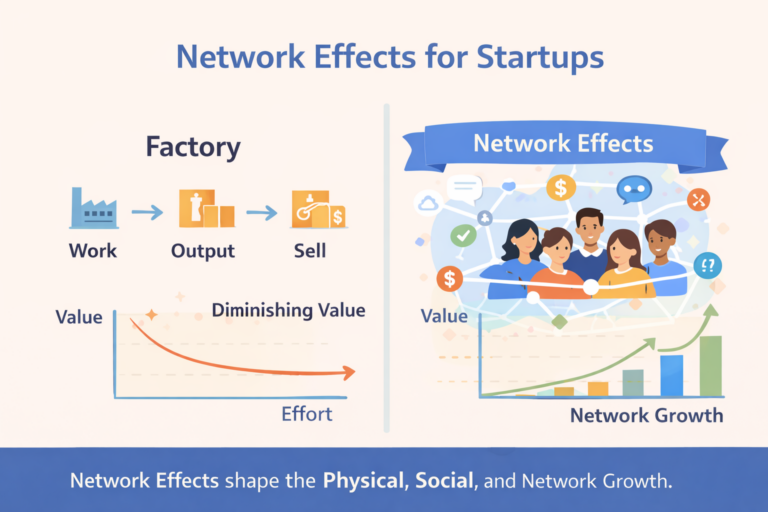
Network economies
More usage improves prompts, routing and results through data and evaluation loops.
Scale economies
Unit costs fall with size, strongest at the model and infrastructure layer.
+ Speed
In a greenfield market, shipping faster than everyone else is the first, and sometimes decisive, advantage.
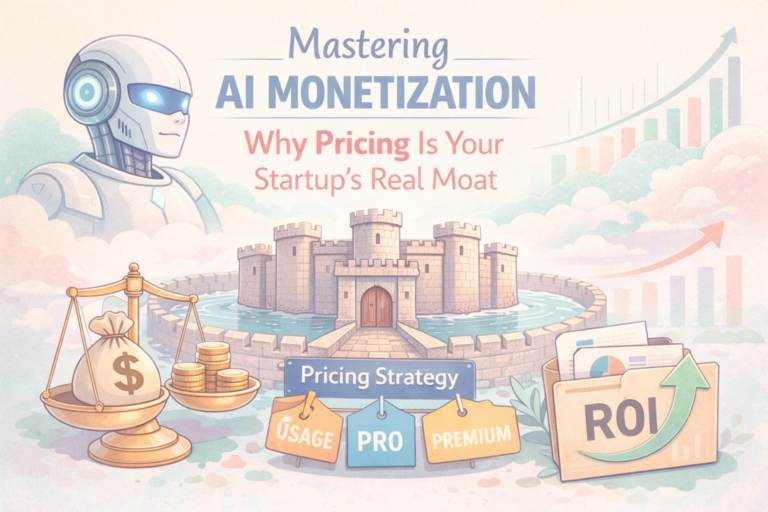
Read more: Why pricing is a startup moat →
Choose your strategic direction
Before pursuing fit, decide which path you’re on and commit to it. It sets where resources and innovation go, and which moats you’ll build. Corporates can lean on existing customers, proven models and cash flows; startups can move faster and use that agility to disrupt. Both need a deliberate choice.
01
Intellectual property
Protect proprietary innovation and become the essential component everyone needs.
02
Architectural
Own the platform at the centre of a new value chain, and reach customers anywhere.
03
Value chain
Master one horizontal layer of an existing value chain and become indispensable.
04
Disruption
Win an underserved segment, build traction and new technology, then move up-market.
Size the prize, then focus
Market share efficiency
Ground growth targets in the regions and markets where you actually operate. Define your total, serviceable and obtainable markets, then focus resources where you can realistically win.
Even a small share of a large market can signal real traction. What matters is winning your obtainable segment efficiently, then expanding from strength.
A credible SOM is built bottom-up: target customers × realistic annual revenue per customer.
What fit feels like
Product market fit gives you the capabilities, momentum and culture to find, sell, serve and retain customers consistently. These are the signs we look for.
Find
Pull, not push
Customers arrive through referrals and word of mouth, not just paid ads.
Sell
Short, simple deals
Fewer objections on price; buyers see the value quickly.
Serve
No heroics needed
Delivery is repeatable without the founder in every loop.
Retain
Renew and expand
Customers stay, buy more and recommend you.
Where we help
PMF diagnostic
An honest read of where you stand on the evidence ladder, and what is holding traction back.
ICP and beachhead
Define the one customer group to win first, where they gather, and the problem in their words.
Value and pricing
Quantify the outcome, design the consumer surplus and choose a pricing model that matches value.
Feature prioritisation
Score the roadmap on pain, willingness to pay and uniqueness, so you build what sells.
Moat strategy
Choose the moats that fit your stage and stack them deliberately as you grow.
Go-to-market launch
Concentrate launch energy on your ICP, with trial built in so the product sells itself.
Related services
Start today
Find the customers who’ll pay, and the moat that keeps them
Tell us about your product, your customers and the traction you have so far. We’ll show you where you stand on the evidence ladder, which ICP to win first, and the features worth building next.