AI-Native Startup Structures and Team Org Design (2026)
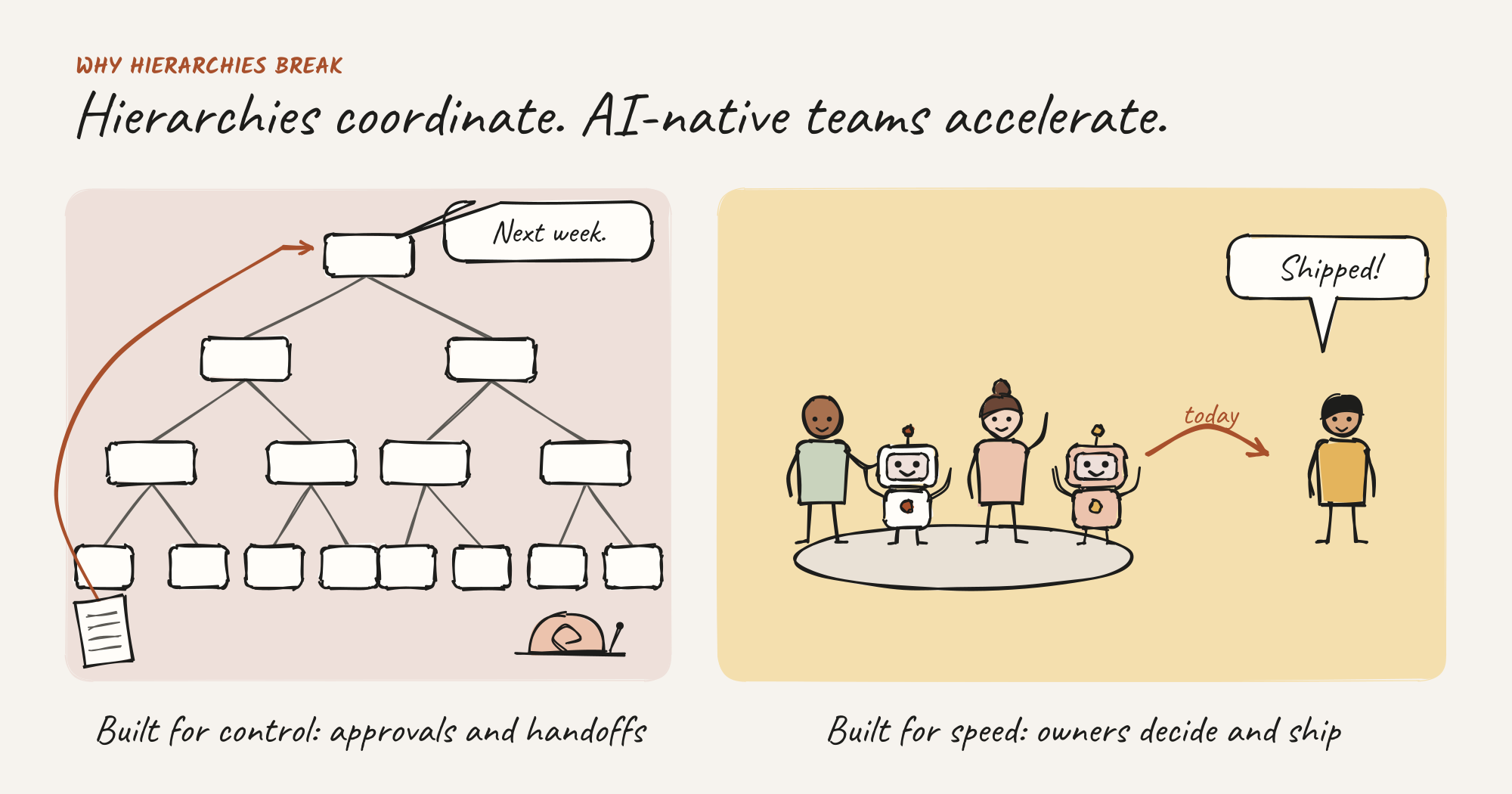
AI changed how fast a startup can build. It also changed how a startup should be built. The old org chart, with layers of managers, separate departments and slow handoffs, was designed for control. In an AI-native company the constraint is different: code and content are cheap to produce, so the scarce resources become clear decisions, good specs, design taste and quality checks. This guide covers the latest data and thinking on AI-native org design, the roles that matter now, team blueprints by stage, worked examples and a 30-day plan. Updated October 2026.
Why the old hierarchy breaks
Hierarchies exist to standardise work, coordinate specialists and enforce quality through approvals. Each of those jobs now has a faster alternative.
| What hierarchy did | Why it slows an AI-native team | AI-native replacement |
|---|---|---|
| Standardised repeatable work | Agents now do most playbook tasks | Documented workflows run by agents, owned by one person |
| Coordinated specialists through handoffs | Every handoff adds days when building takes hours | Small cross-functional cells that own an outcome end to end |
| Enforced quality through approvals | Approval queues become the slowest step | Automated tests, evaluation sets and clear decision rights |
| Moved information up and decisions down | Context is lost at every layer | Shared written strategy, specs and dashboards everyone can read |
The new bottleneck: building is cheap, deciding is not
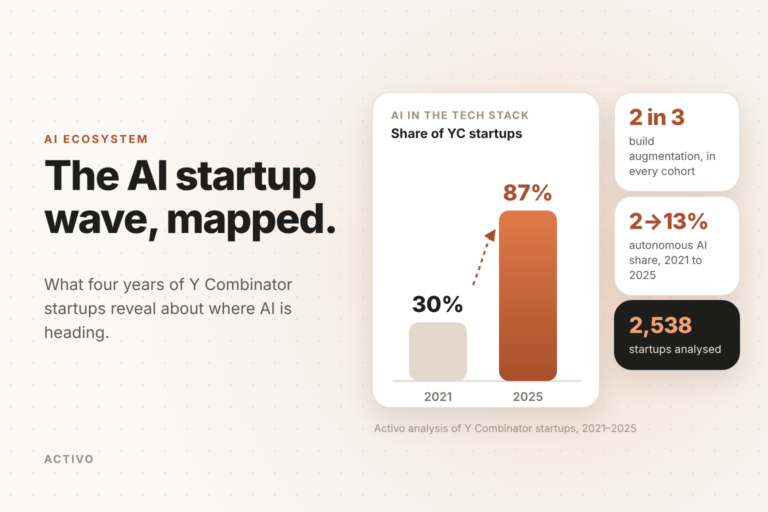
A quarter of Y Combinator’s Winter 2025 batch had codebases that were about 95% AI-generated, according to managing partner Jared Friedman. YC’s partners added the caveat that matters: founders still need the taste and training to tell good output from bad. Andrew Ng has made the same point from the other side. Teams traditionally ran around six engineers per product manager. As AI made building cheaper, he said teams had started proposing far more product managers relative to engineers, because deciding what to build had become the constraint.
Faster building is not automatic, though. A 2025 trial by METR found experienced open-source developers were about 19% slower with AI tools on their own codebases. Its February 2026 follow-up suggests developers are probably faster now, but the evidence is weak. Google’s DORA research explains why results vary: AI amplifies what is already there. Teams with clear goals, good tests and tight feedback loops speed up. Fragmented teams ship more confusion faster.
Specs and design are the new source code
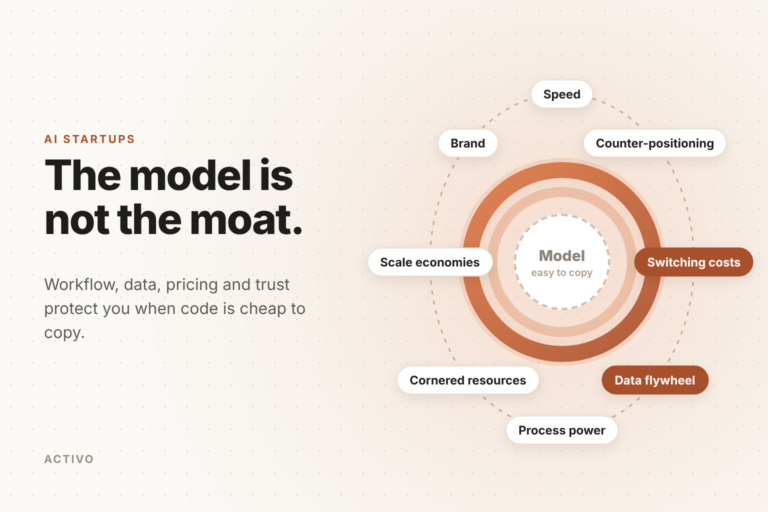
When an agent can write the code, the quality of what it builds depends on what you tell it. That is why spec-driven development has spread fast. GitHub’s open-source Spec Kit structures work as specify, plan, break into tasks, then implement. AWS built its Kiro development environment around the same idea. The spec becomes the version-controlled source of truth, and code is the output.
| Artefact | Why it matters more now | Who owns it | Make it good |
|---|---|---|---|
| One-page strategy | Fast teams sprint in the wrong direction without it | Founder or CEO | Include what you are not doing and how to break ties |
| Product spec | Agents build exactly what you write, gaps included | Product lead or builder-PM | User stories, acceptance criteria, edge cases, examples |
| Design system | AI generates screens fast, but consistency and taste do not come free | Design engineer | Tokens, components and rules agents can follow |
| Evaluation set | The only reliable way to know if AI output is good enough | Quality owner | 50 to 200 real cases with expected results |
| Decision log | Small teams forget why they chose things | Whoever makes the call | Date, decision, options considered, reason |
Hire for outcomes, not functions
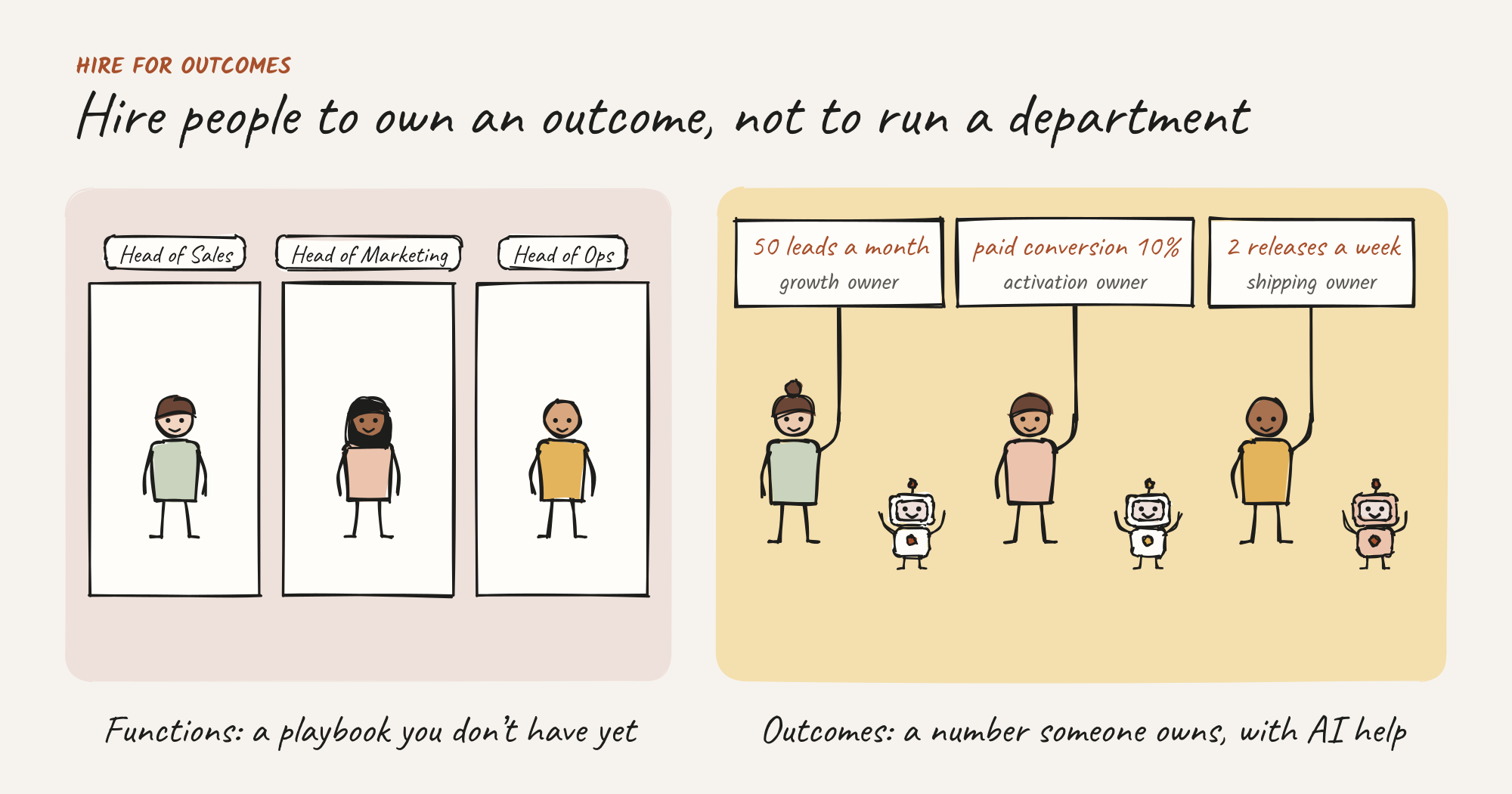
Hiring a head of sales, marketing or operations assumes you already know the playbook and need someone to run it. AI-native startups hire owners of measurable results, and give each one agents for the repeatable work.
| Outcome owner | Example target | What agents handle | What the human owns |
|---|---|---|---|
| Growth owner | 50 qualified leads a month | Research, list building, first drafts, follow-ups | Positioning, channel bets, key relationships |
| Activation owner | Trial to paid from 6% to 10% | Onboarding emails, usage analysis, nudges | What the aha moment is and how to reach it |
| Shipping owner | Two customer-visible releases a week | Code, tests, refactors, documentation | Specs, architecture, code review, trade-offs |
| Customer outcomes owner | Median resolution time from 24 hours to 6 | Triage, tagging, first replies, knowledge base | Escalations, root causes, product feedback |
| Quality owner | Agreed accuracy on the evaluation set every release | Running evals, monitoring, regression alerts | What good looks like and when to stop a release |
Playbooks versus judgment: the 70% rule
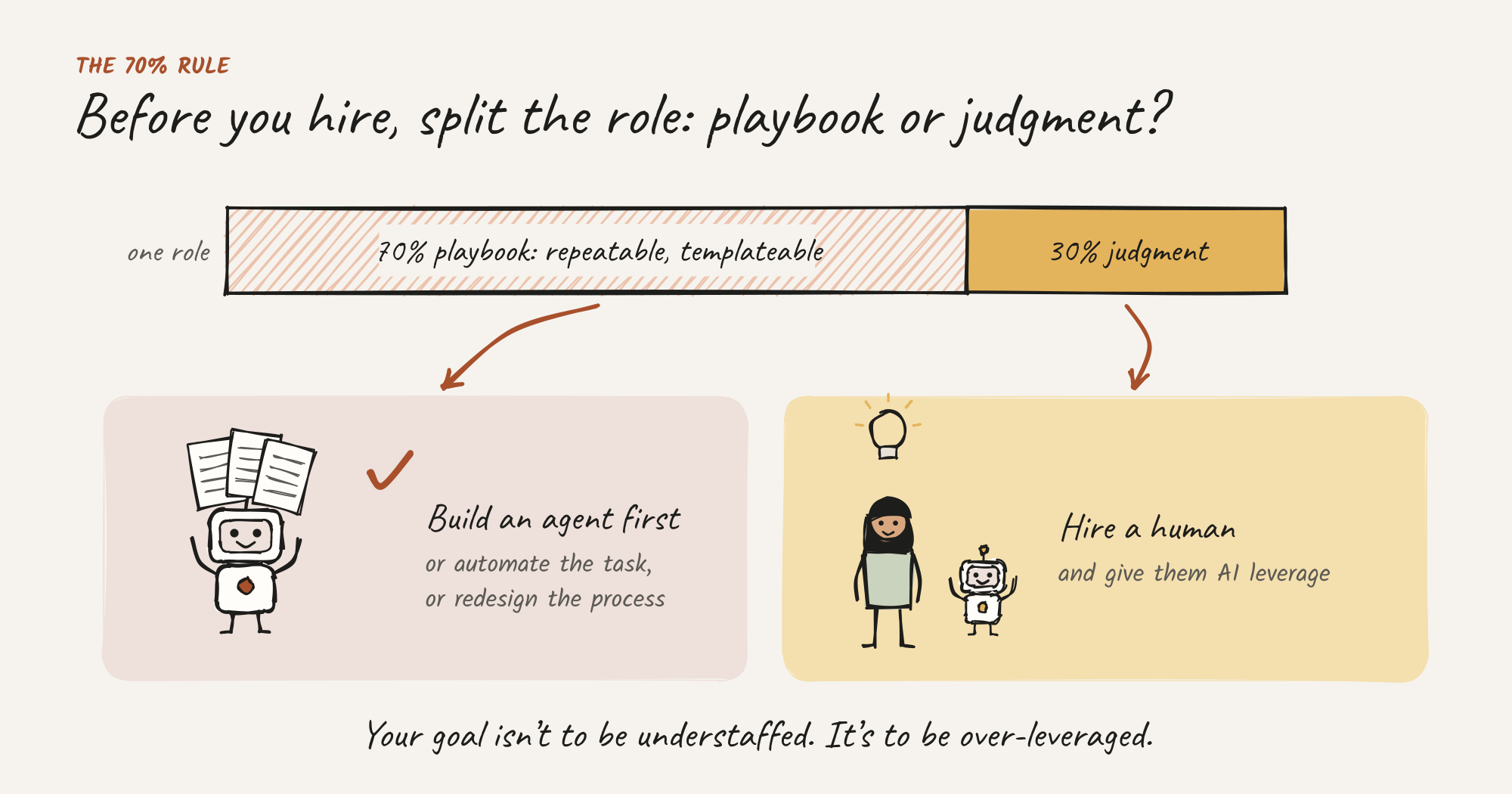
Before opening any role, list its tasks and split them into playbook work, which is repeatable, templated and easy to check, and judgment work, which is ambiguous, creative, relationship-heavy or high-stakes. If roughly 70% of the role is playbook work, build or buy an agent first and assign an owner. If the role is mostly judgment, hire a person and give them AI leverage from day one. Shopify made this company policy in 2025: teams asking for headcount must first show why AI cannot do the work.
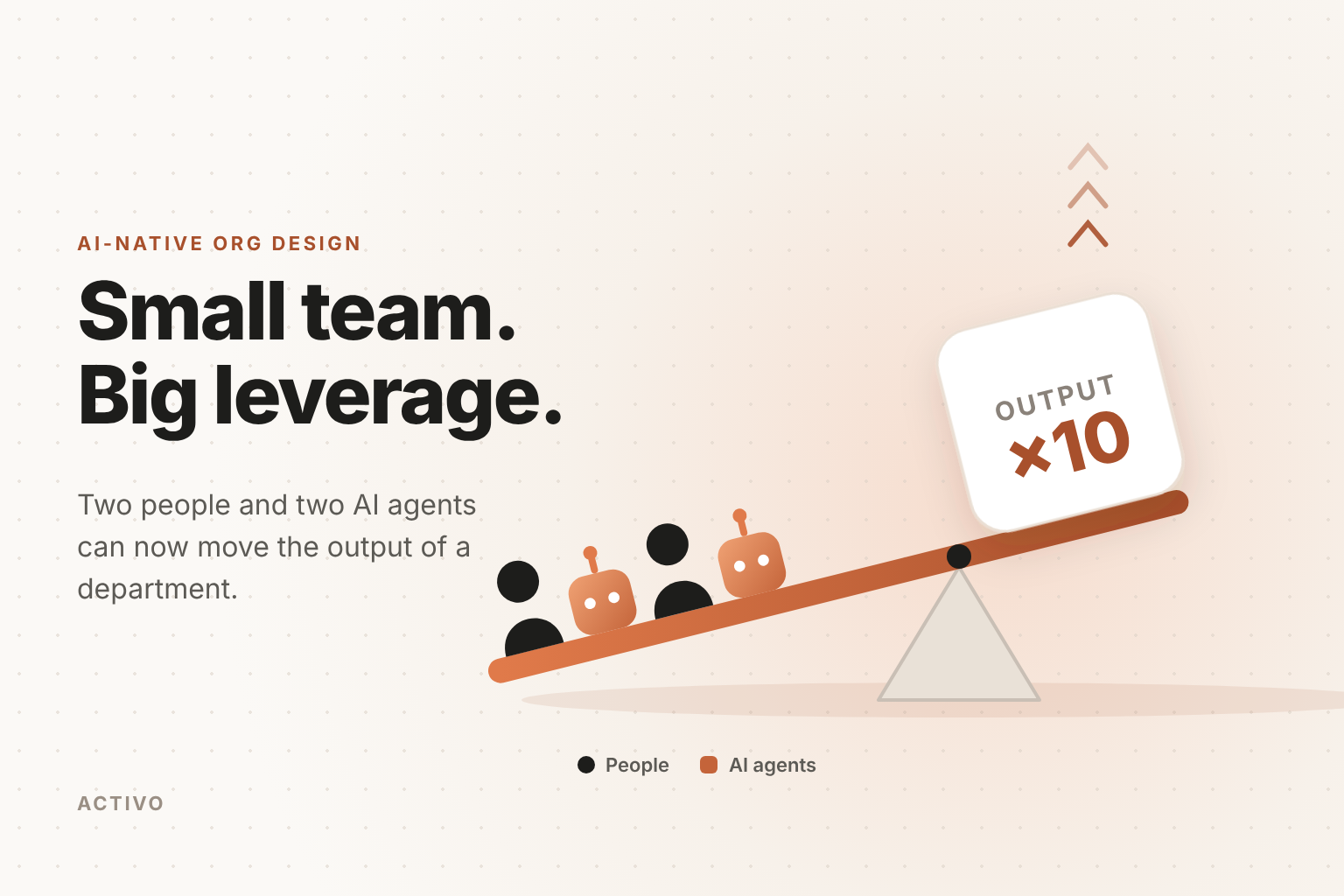
Small teams, big output
Roles that matter more in an AI-native company
| Role | What they do | Why it matters now |
|---|---|---|
| Builder-PM or product lead | Writes specs, talks to customers, prototypes with AI | Deciding what to build is the new bottleneck |
| Product engineer | Owns features from spec to production, using agents for most code | One strong engineer with agents covers what a squad used to |
| Design engineer | Designs and builds the interface, maintains the design system | Taste and consistency do not come from generated screens |
| Quality and evaluation owner | Builds evaluation sets, monitors accuracy, cost and safety | Confident nonsense at speed is the biggest AI risk |
| Agent operations | Builds and maintains internal agents and workflows | Agents need owners, updates and monitoring like any system |
| Domain expert | Brings deep judgment in law, health, finance or industry | In high-stakes fields, expert review is the product |
Team blueprints by stage
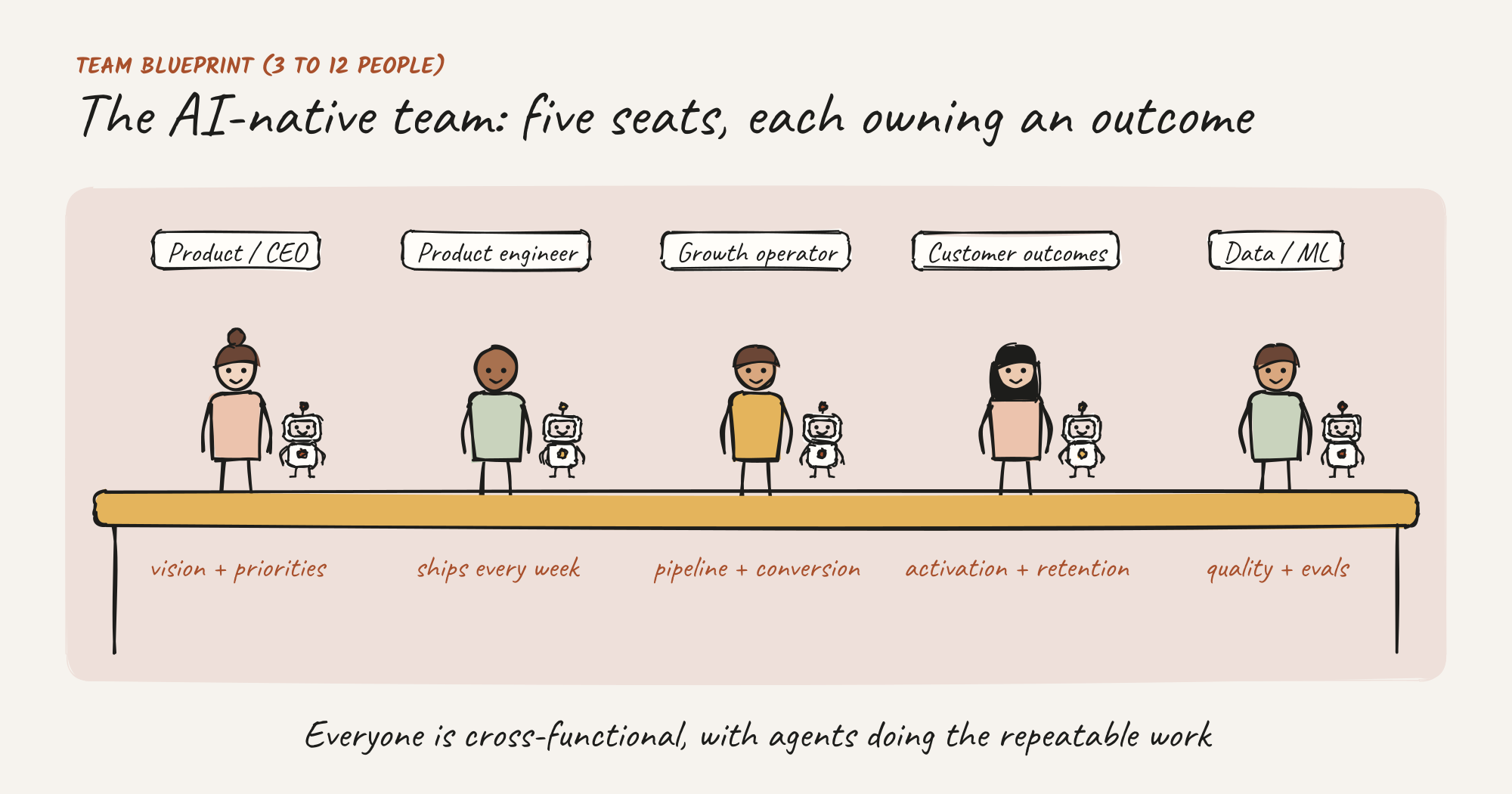
| Stage | Team size | Seats | What to formalise |
|---|---|---|---|
| Idea to first customers | 1 to 3 | Founder as builder-PM, one product engineer, optional domain expert | One-page strategy and a spec template |
| Product-market fit search | 4 to 8 | Add a growth owner, design engineer and customer outcomes owner | Evaluation set, weekly outcome review, decision log |
| Early scale | 9 to 15 | Split into two or three outcome cells, add a quality owner and agent operations | Decision rights per cell, shared agent platform, security basics |
| Scaling | 15 to 40 | Cells of five to seven people, a small leadership team, specialist hires where judgment is scarce | Planning cadence, hiring bar, governance and risk owners |
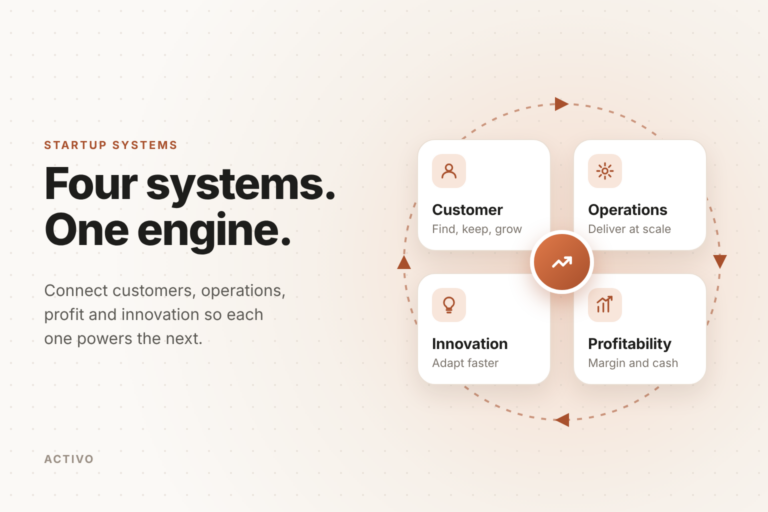
Keep cells small. Amazon’s two-pizza rule still holds, and agents make it easier to keep teams at five to seven people. Each cell owns one outcome, its own agents and the specs for its area.
A weekly operating rhythm
| When | Ritual | Output |
|---|---|---|
| Monday | Outcome review, 30 minutes | Each owner reports the metric, the blocker and the bet for the week |
| Tuesday | Spec review | Specs for the week approved, with acceptance criteria and evaluation cases |
| Daily | Ship and review | AI builds, humans review against the spec and the evaluation set |
| Thursday | Quality check | Accuracy, cost and incident review for AI features and internal agents |
| Friday | Customer and decision log | Learnings written up, decisions recorded, strategy page updated if needed |
Examples: AI-native structures you can copy
B2B tool, one person
Structure: the founder writes specs and handles sales, with coding, research and support agents.
First hire: a product engineer once the spec backlog outgrows review time, not before.
Watch: review becomes the bottleneck. Protect two hours a day for it.
Five people at $1m ARR
Structure: founder, two product engineers, one design engineer and one growth owner, each with agents.
Rule: every new role passes the 70% test first.
Watch: keep one shared spec library so agents work from the same truth.
Legal or healthcare workflow
Structure: domain experts sit inside the product cell and own the evaluation set.
Rule: nothing ships without passing expert-written cases.
Watch: hire judgment early. It is your moat and your safety net.
Direct-to-consumer brand
Structure: one growth cell running creative, ads and email with agents, and one operations cell running stock, support and returns.
Rule: a human approves brand voice and pricing changes.
Watch: agent-made content drifting off brand. Keep a style guide agents follow.
Agency becoming AI-native
Structure: senior experts write playbooks, and agents run delivery under expert review.
Rule: price per outcome, not per hour, as delivery time collapses.
Watch: juniors losing the learning path. Pair them with experts on reviews.
Compliance-heavy product
Structure: two product cells plus a small risk and quality cell that owns policies, logs and evaluations.
Rule: agents never move money without a verifier and human approval.
Watch: treat governance as a product feature, not a late-stage add-on.
Common failure modes and fixes
| Failure mode | Symptom | Fix |
|---|---|---|
| Spec debt | Agents build the wrong thing quickly, and rework piles up | Spec template with acceptance criteria, reviewed before work starts |
| Review bottleneck | Output piles up waiting for one senior person | Evaluation sets and tests do first-pass review. Share review across owners |
| Tool sprawl | Everyone uses different tools and prompts | One standard stack, shared prompt and skills library, monthly clean-up |
| AI worship | Confident nonsense reaches customers | Quality owner with the power to stop a release |
| No accountability | Everyone helps, nobody owns | One named owner and metric per outcome, reviewed weekly |
| Governance gaps | Legal, privacy or reputational surprises | Treat trust and safety as a product area with an owner and logs |
A 30-day plan to redesign your startup as AI-native
- Days 1–5: Write the strategy page and outcomes. One page: goal, customers, what you are not doing, how to break ties. List the four to six outcomes that matter most this quarter, each with a metric.
- Days 6–10: Assign owners and run the 70% test. Give every outcome one owner. Split each role into playbook and judgment work, and list the agents to build before any new hire.
- Days 11–17: Set up specs and evaluations. Adopt a spec template with acceptance criteria. Build a first evaluation set of 50 real cases for your main AI feature or workflow.
- Days 18–24: Build the first agents. Automate the top three playbook workflows, each with a named owner, a budget and a simple quality check.
- Days 25–30: Install the rhythm. Start the weekly outcome review, spec review and quality check. Measure cycle time from spec to shipped, and revisit your hiring plan with the new numbers.
Closing thought
AI makes building fast. It does not make deciding, specifying or judging any easier, and those are now the skills that set startups apart. Design your company like a product: small cells that own outcomes, specs as the source of truth, agents for the playbook work and people for the judgment. Speed comes from clarity, not from adding layers.
An AI-native team starts with the first hires. ActivoNEO helps you find founding team members matched on capability and fit, not keywords. Explore ActivoNEO: Build the right founding team →
ActivoNEO helps you find and hire the builders, product engineers and domain experts who thrive in small, outcome-driven teams with AI leverage.
Explore ActivoNEO Get in touchSources: Carta, Solo Founders Report · TechCrunch on Lovable · Google, 2025 DORA report · TechCrunch on YC W25 codebases · HackerNoon on Andrew Ng and PM ratios · METR, developer uplift update · IntuitionLabs on GitHub Spec Kit · Fortune on the Shopify memo · ARR per employee benchmarks.