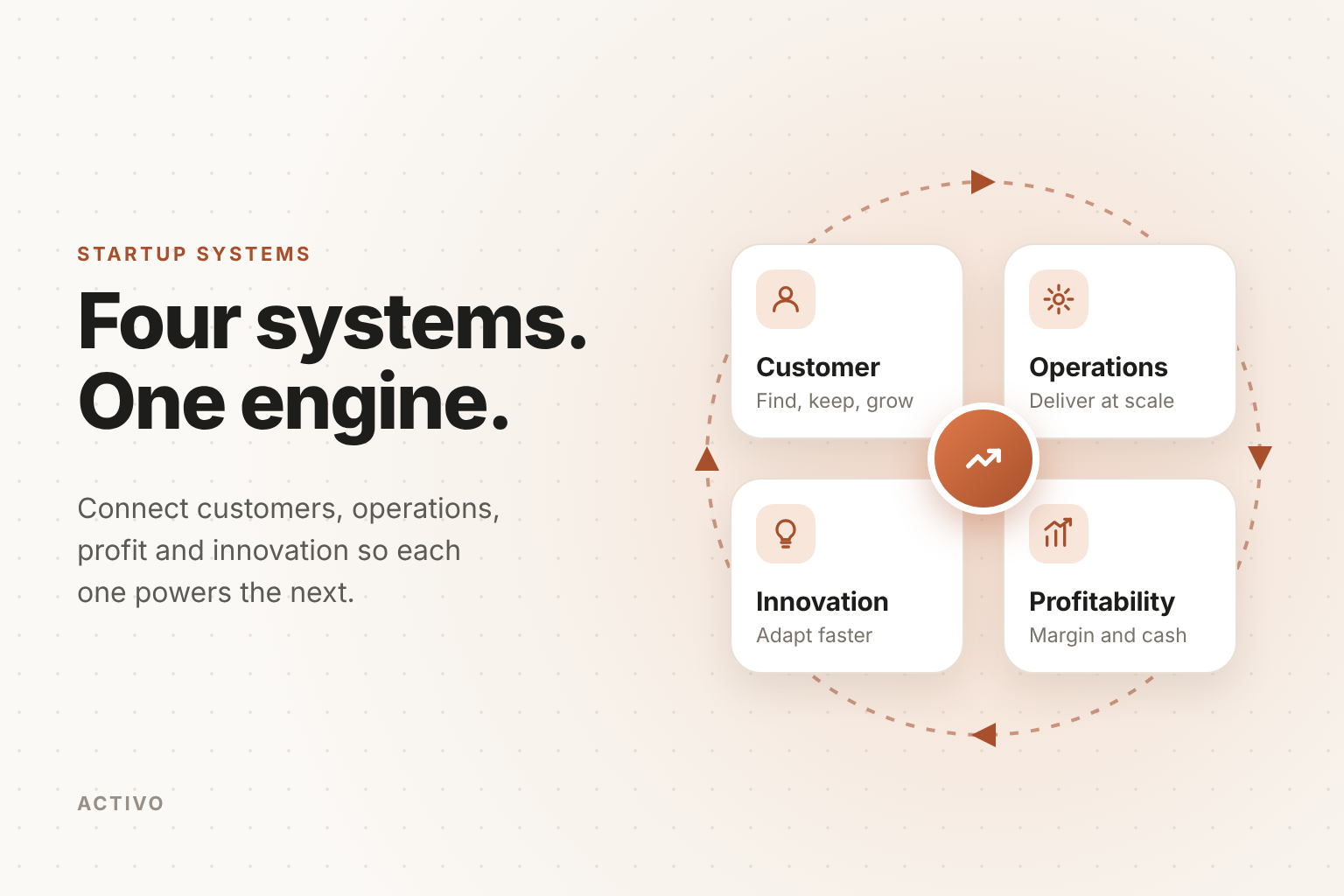
The 4 Core Systems Every Startup Must Master
Startups rarely fail for lack of ideas. They fail because their systems pull against each other: sales promises outrun delivery, product ships features nobody pays for, or cost cuts wreck the customer experience. To scale and win market share efficiently, you need four connected systems that reinforce each other.
Customer system
- Find, serve, keep and grow customers
Operations system
- Deliver reliably as volume grows
Profitability system
- Sustain margins, cash flow and smart allocation
Innovation system
- Adapt faster than customer tastes and technology
Why this matters: startups die of system failures
CB Insights analysed 431 venture-backed startups that have shut down since 2023. Every one of the leading causes maps onto a system that was not working.
Running out of money is usually the symptom. Weak product-market fit (customer system), poor unit economics (profitability system) and missing a market shift (innovation system) are the causes. That is why you design all four systems together.
What market share efficiency means in practice
Market share efficiency is your ability to turn effort and spend into durable market share. You see it when you grow without customer acquisition cost exploding, keep customers while adding new ones, scale delivery without quality collapsing, and fund innovation without starving the core business.
Every system is built from the same parts: inputs (data, talent, capital), processes (workflows, decisions, automation), outputs (value delivered), feedback loops, constraints (the bottleneck that caps growth), metrics and governance (who decides, how often).
The four systems at a glance
| System | Goal | Core elements | What usually breaks |
|---|---|---|---|
| Customer | Acquire, activate, retain, expand, refer | Clear segment and positioning, a discovery loop, measurable channels, fast onboarding, lifecycle marketing, voice-of-customer signals, clear pricing | Tastes change faster than roadmaps. Feedback is noisy unless structured. AI raises expectations for instant, personal service. |
| Operations | More throughput without losing quality | Standard workflows, capacity planning, QA gates, automation, a searchable knowledge base, incident triage and SLAs | Handoffs hide failure. Urgent work crowds out improvement. The bottleneck keeps moving as you grow. |
| Profitability | An engine that self-funds growth | Unit economics (LTV, CAC, payback, gross margin), pricing rules, cost-to-serve, cash flow, scenarios, investment allocation | Growth hides bad margins. AI makes some costs fall and others (data, infrastructure, compliance) spike. Teams chase vanity growth. |
| Innovation | Explore, validate, scale | An idea pipeline, experiments with kill rules, a customer and tech radar, outcome-based roadmap, retros and decision logs | Shiny-object syndrome. Experiments with no path to production. AI-native rivals ship faster. |
How the systems reinforce each other
Aligned, the four systems run as one loop: customer insight shapes the roadmap, innovation is built into repeatable delivery, efficient operations protect margins, profit funds experiments, and experiments improve customer outcomes. Friction is a sign of misalignment. Sales outrunning delivery is Customer against Operations. Features nobody pays for is Innovation against Profitability. Cuts that hurt service are Profitability against Customer.
AI-native companies tighten this loop by redesigning how work gets done: small teams that own outcomes rather than functions, agents embedded in support, research, QA and sales operations, decision speed treated as a metric, and data flywheels where usage improves the product. Adding AI without aligning the systems just gets you faster chaos.
One dashboard per system
| System | Leading indicators (predict) | Lagging indicators (confirm) |
|---|---|---|
| Customer | Activation rate, time-to-value, demo-to-trial conversion, onboarding completion | Retention, churn, expansion revenue, NPS or CSAT |
| Operations | Cycle time, backlog health, incident rate, automation rate | SLA performance, defect rate, cost-to-serve |
| Profitability | LTV/CAC, payback period, gross margin by segment, forecast variance | Net margin, burn multiple, runway, cash flow |
| Innovation | Experiment velocity, share of roadmap tied to outcomes, learning cycle time | Revenue from new products, adoption of new capabilities |
Step 1: Score your four systems in 15 minutes
Score each statement from 0 (not true) to 5 (consistently true). Each system scores out of 20.
Customer
- We can name our number one segment and its top three problems.
- Our acquisition channels are measured and repeatable.
- We know why customers churn and have a plan to reduce it.
- Pricing and packaging match perceived value.
Operations
- Workflows are documented and consistent across teams.
- We track cycle time and quality on a simple dashboard.
- Support and incidents have clear triage and owners.
- Automation removes manual work every month.
Profitability
- We know LTV/CAC and payback by segment.
- We understand cost-to-serve and margin drivers.
- We run best, base and worst cases and act on triggers.
- Budget follows strategy, not politics.
Innovation
- Experiments have hypotheses and kill rules.
- Roadmap items link to measurable outcomes.
- We evaluate new tech, including AI, without distraction.
- We capture lessons so we do not repeat mistakes.
Reading your scores (per system): 0–10 is fragile and high risk, 11–16 works but inconsistently, 17–20 is strong and scalable. Your lowest system is usually your constraint. Plot the four scores on a simple radar like the example below.
Steps 2 to 5: a 90-day plan
- Find your constraint. Ask: “If demand doubled next month, what breaks first?” Typical answers are lead quality, delivery handoffs, margins or cash collection, or slow decisions. Fix that before optimising anything else.
- Pick one keystone initiative per system. For example: tighten your ideal customer profile and onboarding to cut time-to-value by 30%; clarify definitions of done and automate handoffs; rebuild pricing and cost-to-serve by segment; run two to four experiments a month.
- Days 1–30: instrument and stabilise. Build a one-page dashboard from the table above, document your three core workflows (sales to delivery, support, release) and capture your top 20 customer insights from wins, churn and objections.
- Days 31–60: remove the bottleneck. Put one cross-functional squad on the constraint, start a weekly metrics-and-decisions meeting and ship two or three automations in support triage, reporting, QA or research.
- Days 61–90: scale what works. Roll successful playbooks out across the company, double down on the best channel and segment, and promote winning experiments into the core roadmap. Then lock it in with one North Star metric, four system dashboards, clear decision rights and a weekly, monthly and quarterly cadence.
When you deliberately design and align the customer, operations, profitability and innovation systems, you get a company that solves real problems, scales delivery, protects margins and adapts faster than the market.
ActivoCEO Outcome Agents keep these four systems running 24/7: they watch what matters, handle the routine and bring you only the decisions that need you. Explore ActivoCEO: Outcome Agents →
Share your four scores and we will help you find your constraint and build a 90-day plan with one OKR per system.
Get in touchSources: CB Insights, The top reasons startups fail (March 2026).