Which UK Investors Accept Cold Pitches? We checked most
The costly mistake is waiting for a warm introduction before you pitch anyone. Of the 282 investors active in the UK that Activo checked between 11 and 14 November 2026, 113 publish a route for founders to pitch them directly, about 40% of the list, and 90 of those 113 are confirmed or recently active. So plenty of UK investors accept cold pitches; most just want them through their own form rather than a partner’s inbox. The steps below take you from deck to first submissions, with what each one costs, so you can decide which investors to approach first and how.
Key facts
- 113 of 282 investors publish an open route: 75 say they accept pitches and 38 take direct applications from founders.
- 93 of those 113 routes are an official pitch form. Only 12 are a published pitch email.
- 118 publish no submission policy. Only 5 say they need an introduction, and 5 aren’t taking submissions.
- Angel networks (10 of 12) and accelerators (9 of 12) are the most open. Corporate venture arms are the least open (1 of 17).
- SEIS gives your investors 50% Income Tax relief on up to £200,000 a year.
Step 1: Get your deck investor-ready before you send it
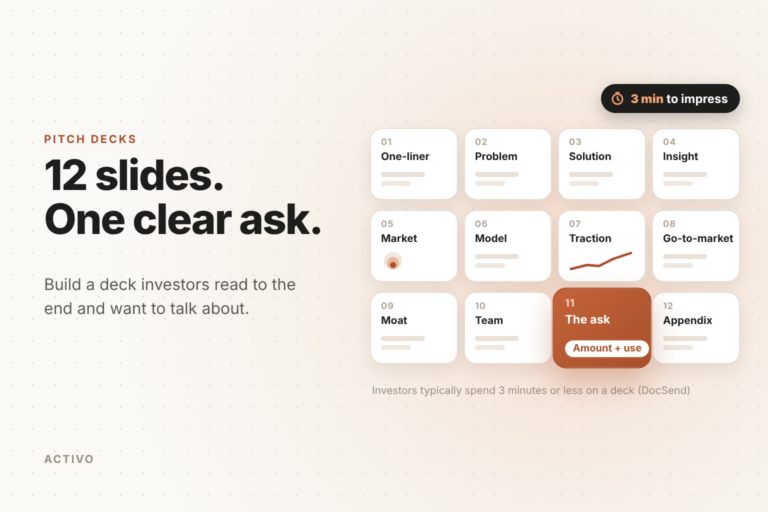
A cold pitch arrives without you in the room, so the deck has to do the explaining. Activo’s free Pitch Deck Assessment scores a deck out of 100, recommends 75 or more before you submit, and ranks the fixes slide by slide. It costs nothing, and the report comes to you, not to investors.
Put your evidence early. The British Business Bank, quoting the UK Business Angels Association, says many investors don’t invest until a company shows some commercial traction, such as early trials or paying customers. Our guide to building a pitch deck investors lean into covers the slides in more detail.
Step 2: Apply for SEIS or EIS advance assurance early
If your company may qualify, start this before you send a single pitch. SEIS lets your investors claim 50% Income Tax relief on up to £200,000 a year, and EIS 30%; they can claim in the tax year they invest or treat the investment as made in the previous year (HMRC).
Allow for the wait. A startup law firm says HMRC replies used to take about four weeks, with at least two more if HMRC asks for further information (Jonathan Lea Network). Settle your round terms first, too: once HMRC issues an assurance, it won’t correspond further, and any change to the planned investment needs a new application (HMRC manual VCM60270). See our SEIS and EIS support guide for the application itself.
Step 3: Choose the investor types that take unsolicited pitches
Open doors are not spread evenly, so start with the types at the top of this table. Early-stage investors were the most open in our check; private equity and corporate venture funds the least.
| Investor type | Our Network | Publish an open route | Open route and active |
|---|---|---|---|
| Angel networks | 12 | 10 | 6 |
| Accelerators | 12 | 9 | 9 |
| Government and public funds | 12 | 8 | 8 |
| Venture capital | 123 | 53 | 43 |
| Private credit | 31 | 11 | 10 |
| Growth equity | 11 | 4 | 3 |
| Family offices | 9 | 3 | 1 |
| Private equity | 33 | 4 | 4 |
| Corporate venture capital | 17 | 1 | 0 |
| Other | 22 | 10 | 6 |
| All investors | 282 | 113 | 90 |
Venture capital is the biggest group: 53 of 123 firms publish a route, and 43 of those are active. Angel networks are the most open, but only 6 of their 10 open routes show recent activity, so check a network’s latest deals or pitch events before you apply. For a pre-seed or seed round, private equity (4 of 33) and corporate venture arms (1 of 17) are seldom worth a cold approach.
Step 4: Use the investor’s own route, which is usually a form
Of the 113 open routes, 93 are official pitch forms, 12 are published pitch emails, 4 are direct founder applications, and 4 are general enquiry routes. If an investor publishes a form, use it: that is the route its team has chosen for screening new deals, and a partner’s inbox is not.
Whichever route you use, keep it short. SeedLegals advises a brief message with a clear ask and the amount you are raising, plus a deck an investor can review in three to five minutes. Fill in every field the form asks for, and keep your stage, sector and raise the same as in the deck.
Traps to watch for
- No published policy. 118 investors publish no submission route. Nothing tells you a pitch will be screened, so put them after the investors with open routes.
- Introduction only. 5 investors say they need an introduction, and 5 aren’t taking submissions. Leave them until you have a mutual contact or they reopen.
- Stale activity. 64 of the 282 have an unclear activity status, and 3 are confirmed inactive. A recent fund close is a better sign: 42 investors in our list have a latest fund dated 2025 or later.
- The 75% unopened claim. HubSpot for Startups claims about 75% of cold emails to VCs go unopened. Treat it as a rough claim about emails; most investors in our check ask for a pitch form instead.
- Changed terms. A different round from the one HMRC assessed needs a fresh advance assurance application (Step 2).
When to send your first pitches
There is no single deadline for a cold pitch, but timing still matters. Our figures are a snapshot from 11 to 14 November 2026, and routes and activity change, so recheck each investor’s own page on the day you apply. If your round uses SEIS or EIS, relief follows the tax year your investors subscribe in, with the option to carry it back one year, so ask early investors whether that affects when they want to complete.
Where Activo can help
If you do one thing before your first submission, get your deck to 75 or more and pick five investors whose published sector, stage, region and cheque size fit your round. ActivoPitch does both for free: you get your top five investors, each with a match score from 0 to 100, and you contact them yourself through their own websites.
ActivoPitch investor matching
Your top five professional investors, matched on published sector, stage, region, cheque size and mandate, each in a dated two-page briefing.
Find your matches →
Pitch Deck Assessment
A free investor-readiness score out of 100, with fixes ranked slide by slide. Your deck is never sent to anyone.
Check your deck →
SEIS and EIS support
Check whether your company may qualify and how advance assurance from HMRC works before you raise.
Read the guide →
Investor and board reporting
Once investors say yes, they expect regular updates. Our Essentials guide covers investor and board reporting.
Plan your reporting →
Tell us your sector, stage, location and raise. ActivoPitch returns your top five matches and never sends your deck to anyone.
Find your investor matchesThis is general guidance. Check your own situation with a qualified adviser. ActivoPitch is general information, not investment advice.
Last checked: November 2026
Sources: How to approach an investor, British Business Bank; Venture capital schemes: tax relief for investors, HMRC; Venture Capital Schemes Manual VCM60270, HMRC; How long does it take to get SEIS and EIS advance assurance?, Jonathan Lea Network; Investor outreach guide, SeedLegals; Investor outreach email, HubSpot for Startups; Activo investor database, 282 investors checked 11 to 14 November 2026.